
When elite tennis players walk onto the court for a Masters 1000 final, the expectation is simple: the better player wins. But high-performance tennis rarely comes down to just forehands and backhands. Behind every championship result lies a complex mix of physical readiness, mental clarity, recovery cycles, and—often overlooked—sleep.
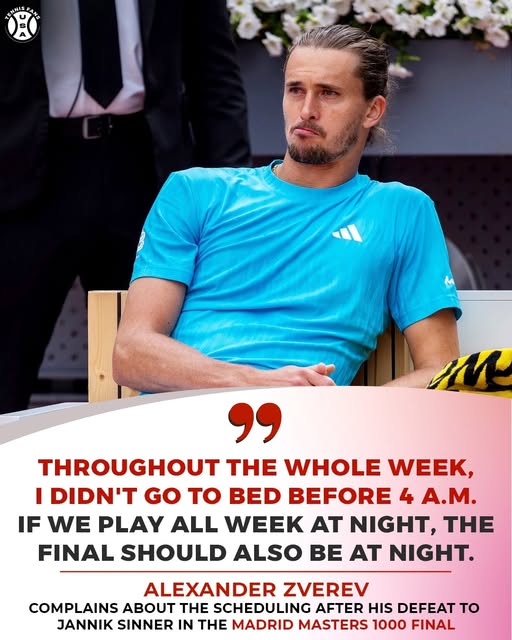
The recent Madrid Open final between Alexander Zverev and Jannik Sinner reignited a critical conversation inside the sport: how much do scheduling and sleep deprivation influence outcomes at the highest level?
Zverev’s comments after the match raised a legitimate issue. After playing multiple late-night matches throughout the week, he found himself competing in a daytime final—without adequate recovery adjustment. This is not an excuse. It’s a performance variable. And in elite tennis, small variables decide big matches.
Let’s break this down from a U.S.-style tennis performance analysis perspective—direct, evidence-driven, and rooted in how champions actually prepare.
The Hidden Opponent: Sleep Deprivation in Elite Tennis
Sleep is not optional for professional athletes. It is a biological necessity tied directly to:
- Muscle recoverye
- Reaction time
- Decision-making speed
- Emotional regulation
- Injury prevention
When a player consistently sleeps at 3–4 AM due to late match schedules, the body shifts into a stress state. Cortisol levels remain elevated. Recovery slows. The nervous system becomes less efficient.
For a player like Zverev—who relies heavily on timing, rhythm, and baseline consistency—this matters.
A lack of sleep does not always show up as fatigue in the traditional sense. Instead, it appears subtly:
- Slightly slower first step
- Marginally late contact point
- Reduced serve precision
- Poor shot selection under pressure
Against a player like Sinner, those margins are fatal.
Jannik Sinner: Precision Built on Stability
Jannik Sinner represents the modern gold standard of structured preparation. His game is not just powerful—it is repeatable.
What separates Sinner from many players is not just talent, but consistency of execution under varying conditions.
Key strengths include:
- Early ball striking
- Efficient movement patterns
- Mental calmness in rallies
- Controlled aggression
These traits are heavily dependent on neurological sharpness—something directly tied to proper sleep cycles.
While we don’t have to assume Sinner had perfect scheduling, his performance suggested a player operating at full cognitive and physical capacity.
Alexander Zverev: Rhythm Disrupted
Alexander Zverev is one of the most dangerous players on tour when his timing is locked in. His serve, backhand, and court coverage can dominate anyone.
But his game has a vulnerability: it depends heavily on rhythm.
Sleep disruption impacts rhythm players more than instinct players.
Why?
Becausee:
- Timing-based games require consistent neural firing patterns
- Fatigue disrupts coordination and spacing
- Decision-making becomes reactive instead of proactive
Zverev’s situation—playing late matches all week, then shifting to a daytime final—creates a circadian mismatch.
In simple terms: his body clock was not aligned with match time.
That’s not a small issue. That’s a performance limiter.
Scheduling in Tennis: An Underrated Factor
Tournament scheduling is one of the least discussed but most influential elements in professional tennis.
Unlike team sports, tennis players must adapt daily:
- Night matches one day
- Day matches the next
- Variable rest periods
- Changing weather conditions
At events like the Madrid Open, where altitude already affects ball speed and stamina, scheduling inconsistencies amplify physical stress.
The core issue is not fairness—it’s physiological adaptation.
When a player consistently competes at night, their body adjusts:
- Peak alertness shifts later
- Sleep onset delays
- Recovery cycles move forward
Suddenly switching to a daytime final forces the body to perform outside its optimized window.
That’s not ideal preparation. That’s forced adaptation.
Stamina vs Scheduling: What Really Decided the Match?
Let’s be clear: Sinner won because he played better tennis.
But performance does not exist in isolation. It is influenced by preparation conditions.
So what decided the match?
1. Sinner’s Execution
He controlled rallies, dictated tempo, and maintained composure.
2. Zverev’s Marginal Drop-Off
Not collapse—just enough decline in precision to lose control of key points.
3. Energy Efficiency
Sinner’s game requires less physical strain per point. That matters when recovery is compromised.
4. Mental Sharpness
Sleep-deprived players struggle with:
- Shot selection
- Momentum control
- Pressure management
At the Masters 1000 level, a 3–5% drop in mental sharpness is decisive.
The Mental Layer: Why Prayer and Reflection Matter
In American high-performance sports culture, mental conditioning is not optional—it’s essential.
This is where practices like prayer and journaling come in.
Not as superstition. Not as ritual.
As tools for clarity.
Prayer in Sports Performance
Many elite athletes incorporate prayer into their routines—not necessarily for outcomes, but for:
- Focus
- Emotional stability
- Perspective
Prayer reduces anxiety. It anchors the mind. It allows athletes to detach from pressure and reconnect with purpose.
For a player dealing with fatigue and scheduling frustration, this matters.
It shifts the mindset from:
“Why is this happening to me?”
to
“How do I perform regardless of this?”
That shift is powerful.
Journaling: The Underused Weapon
Journaling is one of the most effective mental performance tools available—and one of the least used in tennis.
A structured journal helps players:
- Process emotions after matches
- Identify performance patterns
- Clarify tactical mistakes
- Reinforce positive habits
For someone like Zverev, journaling after the final could provide clarity:
- How did scheduling affect energy levels?
- When did focus drop during the match?
- What adjustments could be made next time?
This turns frustration into data.
And data drives improvement.
The 4 AM Problem: Why It Matters More Than You Think
Sleeping at 4 AM for an entire week is not just “bad rest.”
It creates cumulative fatigue.
Here’s what happens:
Day 1–2:
Minor fatigue, manageable.
Day 3–4:
Reaction time declines, mood shifts.
Day 5–6:
Cognitive function drops, decision-making suffers.
Day 7:
Performance ceiling is significantly reduced.
Now add a daytime final.
The body is still expecting peak performance at night—but is forced to compete earlier.
This creates:
- Sluggish movement early in matches
- Delayed mental engagement
- Increased unforced errors
Again, not excuses—just performance realities.
Lessons for Competitive Players
This match offers valuable lessons for players at all levels.
1. Protect Your Sleep Like Your Forehand
Sleep is not recovery—it is performance preparation.
2. Train for Schedule Variability
If you want to compete at a high level, you must be able to adjust.
Practice at different times of day.
3. Develop Mental Anchors
Use prayer, breathing, or meditation to stabilize your mindset under stress.
4. Use Journaling as Feedback
Don’t rely on memory. Write things down. Patterns become visible over time.
Could the Outcome Have Changed?
Possibly—but not guaranteed.
Even with perfect sleep, Sinner’s level was exceptional.
However, better recovery could have:
- Extended rallies
- Improved serve consistency
- Increased Zverev’s ability to handle pressure moments
In tight matches, those differences matter.
The Bigger Picture: Tennis Is Evolving
Modern tennis is no longer just about strokes.
It’s about systems:
- Recovery systems
- Sleep systems
- Mental systems
- Scheduling adaptation
Players who master these systems gain a competitive edge.
Jannik Sinner is a clear example of this evolution.
Alexander Zverev is still among the elite—but matches like this highlight areas where marginal gains can be found.
Final Take: No Excuses—Just Insights
In elite sport, there are no excuses—only explanations and adjustments.
Zverev didn’t lose because of scheduling.
He lost to a player who executed better under the given conditions.
But those conditions matter.
And if tennis wants to maintain competitive integrity at the highest level, scheduling consistency should remain part of the conversation.
Because in modern tennis, the match doesn’t start when players walk on court.
It starts the night before—with sleep.
Closing Reflection
High-level tennis is a game of inches—physically, mentally, and emotionally.
Sleep, prayer, and journaling might sound simple, even basic.
But at the elite level, simple done consistently becomes powerful.
The Madrid final was not just a match.
It was a reminder:
Talent wins points.
Preparation wins matches.
Recovery wins tournaments.