
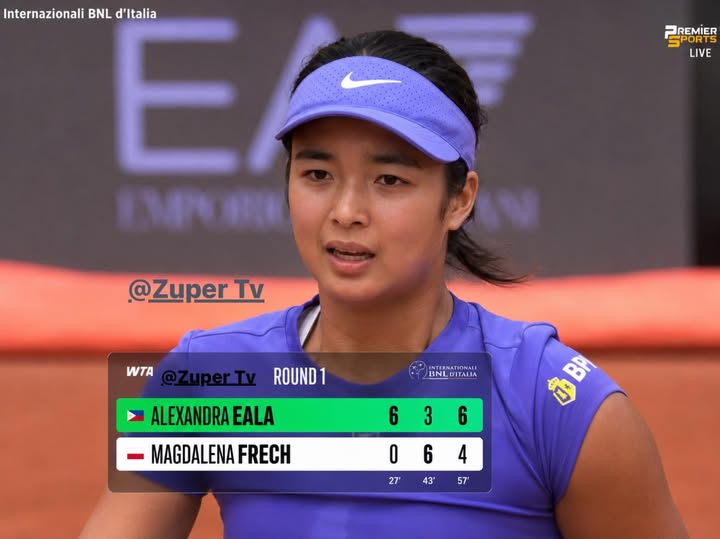
Filipina makes another history record again . The crowd in Rome witnessed something special. At the prestigious Italian Open WTA 1000, young Filipino tennis sensation Alex Eala showed not only talent, but maturity, tactical intelligence, emotional control, and elite-level adjustment under pressure.
Against Magdalena Fręch, Alex faced a difficult battle that tested every aspect of her game. The scoreboard only tells part of the story. What made this victory exciting was the way Alex adapted during the match — especially in the decisive third set.
This was not simply a match won through power.
It was won through adjustment.
A Match Full of Momentum Swings
The match started with nervous energy from both players. Clay courts in Rome are unforgiving. Points become longer, rallies become physical, and patience becomes one of the biggest weapons.
Magdalena Fręch entered the match with experience and consistency. Ranked slightly ahead, she relied on controlled rally construction, deep returns, and counterpunching tennis. Her game style forced Alex to work hard for every point.
Alex, meanwhile, brought aggressive intent.
From the opening games, she tried to dictate play early using:
- Heavy crosscourt forehands
- Early backhand timing
- Aggressive return positioning
- Fast transition into offense
However, the first part of the match revealed an important tactical issue.
Alex was hitting too close to Fręch’s strike zone.
Instead of pushing her opponent outside the court, many rallies stayed neutral. Fręch thrives in neutral exchanges because she redirects pace extremely well.
That became the first chess battle of the match.
The Early Tactical Problem
During the first set exchanges, Fręch successfully absorbed Alex’s pace.
Why?
Because Alex initially attacked too flat through the middle at times.
On clay, middle-ball aggression can become dangerous if the opponent has strong timing. Fręch began reading patterns:
- Backhand crosscourt exchanges
- Predictable forehand acceleration
- Similar serve placement on key points
As a result, Fręch settled into rhythm.
Once a counterpuncher gains rhythm on clay, rallies become physically exhausting for the aggressor.
Alex needed a solution.
And this is where her tennis IQ became visible.
The Adjustment Phase Began
Great players adjust during matches.
Elite players adjust emotionally and tactically at the same time.
Instead of panicking after difficult rallies, Alex slowly changed several details in her game.
Not dramatic changes.
Small, intelligent adjustments.
Those changes transformed the match.
Adjustment #1 — Changing Forehand Height and Shape
One of the biggest turning points came from Alex’s forehand trajectory.
Earlier in the match, many forehands traveled flatter and faster. While aggressive, they also allowed Fręch to redirect pace comfortably.
In the later stages, Alex increased:
- Net clearance
- Topspin rotation
- Heavy crosscourt angles
This forced Fręch farther behind the baseline.
Instead of striking comfortably at waist level, Fręch started hitting shoulder-high defensive balls.
That changed the geometry of the rallies completely.
The heavier topspin also slowed the court interaction after the bounce, giving Alex more recovery time between shots.
This is high-level clay court tennis.
Tennis Stroke Analysis — Alex Eala’s Forehand
Alex’s forehand mechanics are ideal for modern clay-court aggression.
Key technical strengths:
Compact Preparation
Her backswing remains controlled rather than oversized. This allows:
- Faster timing
- Better handling of heavy topspin
- Easier redirection under pressure
Explosive Hip Rotation
Much of Alex’s power comes from lower-body rotation.
When she steps into the forehand correctly:
- The hips open aggressively
- Weight transfers forward
- Racquet acceleration increases late
This creates deceptive pace.
Wrist Relaxation
Alex generates racquet-head speed through relaxed wrist mechanics rather than muscular forcing.
This allows:
- Better topspin production
- Late acceleration
- Improved angle creation
During the third set, this forehand became her primary weapon.
Adjustment #2 — Smarter Return Positioning
Another important tactical shift involved return positioning.
Early in the match, Alex stood too close on certain second serves. Fręch exploited this by serving with kick and body placement.
Later, Alex adjusted by:
- Standing half a step farther back
- Reading toss direction earlier
- Using higher net clearance on returns
This reduced unforced errors.
More importantly, it allowed her to start rallies neutrally instead of defensively.
Sometimes tennis improvement is not about hitting harder.
It is about creating a better first ball after the serve.
Alex understood this perfectly.
The Psychological Battle
The third set was not only tactical.
It became emotional warfare.
Momentum in tennis is fragile.
One double fault can change confidence.
One break point can change body language.
One long rally can drain energy.
Throughout the match, Alex displayed increasing emotional discipline.
Instead of rushing between points, she slowed down.
She:
- Reset mentally
- Controlled breathing
- Focused on point construction
- Avoided emotional overreaction
This composure became critical late in rallies.
Young players often try to finish points too early under pressure.
Alex resisted that temptation in the deciding stages.
That maturity may have been the biggest improvement of all.
Adjustment #3 — Attacking the Fręch Backhand Corner
As the match progressed, Alex identified a strategic opening.
Rather than exchanging evenly crosscourt forever, she began targeting deeper patterns into the backhand corner.
This achieved several things:
- Forced Fręch wider off the court
- Opened inside-out forehand space
- Reduced Fręch’s offensive redirection angles
Once Alex controlled that diagonal, she could step inside the baseline more confidently.
This was especially visible during extended rallies.
The rally sequence often became:
- Heavy crosscourt forehand
- Deep backhand pressure
- Short reply from Fręch
- Alex attacks open court
That pattern slowly tilted the match.
Clay Court Intelligence
Clay tennis is different from hard-court tennis.
Power alone rarely wins consistently.
Players must understand:
- Spin variation
- Height variation
- Patience
- Court geometry
- Physical endurance
Alex showed improving clay-court intelligence throughout the match.
One of the smartest adjustments was her use of rally tolerance.
Instead of forcing winners from impossible positions, she accepted longer exchanges.
That patience frustrated Fręch.
Eventually the pressure reversed.
Instead of Alex overhitting, Fręch began taking bigger risks.
That is a sign of successful tactical control.
Backhand Stability Under Pressure
Alex’s two-handed backhand was another major factor.
Technically, her backhand remained remarkably stable during high-pressure moments.
Key strengths included:
Early Ball Contact
She took the ball relatively early, preventing Fręch from dominating court position.
Excellent Shoulder Rotation
Her upper-body mechanics stayed balanced even during defensive exchanges.
Down-the-Line Surprise
At key moments, Alex changed direction effectively with the backhand down the line.
This prevented predictable rally patterns.
When a player can redirect confidently under pressure, opponents hesitate during recovery positioning.
That hesitation creates openings.
Fitness and Movement
One underrated aspect of the match was physical conditioning.
Clay courts expose movement weaknesses immediately.
Alex moved exceptionally well during the third set because of:
- Better recovery steps
- Efficient sliding
- Lower center of gravity
- Improved anticipation
As Fręch began tiring slightly, Alex increased court coverage intensity.
This forced one extra shot repeatedly.
And often in tennis, one extra shot changes everything.
The Turning Point of the Third Set
The emotional turning point came during a critical service game midway through the deciding set.
Alex faced pressure.
Instead of retreating, she became more aggressive selectively.
This is an important distinction.
Not reckless aggression.
Selective aggression.
She attacked:
- Short second serves
- Mid-court balls
- Weak defensive replies
But remained patient during neutral rallies.
That balance is extremely difficult for young players.
This moment shifted momentum permanently.
Serve Improvement During the Match
Alex’s serve evolved during the match as well.
Early on:
- First-serve percentage fluctuated
- Placement became predictable
- Second serve occasionally sat short
Later, she adjusted by:
- Using wider serve placement
- Mixing body serves
- Adding more spin variation
The purpose was not necessarily aces.
The purpose was disrupting Fręch’s return rhythm.
And it worked.
A strong serve is not always about speed.
It is often about creating uncomfortable first-contact situations.
Tactical Maturity Beyond Her Age
Perhaps the most exciting part of this victory is what it says about Alex’s future.
Young players usually rely heavily on natural shot-making.
But Alex demonstrated:
- Tactical awareness
- Mid-match adaptation
- Emotional resilience
- Point construction intelligence
Those qualities separate talented juniors from future elite professionals.
Winning one match is important.
Learning how to solve problems during a match is even more important.
That is what made this performance special.
What This Victory Means for Filipino Tennis
For Filipino tennis fans, this victory carries emotional significancto.
The Philippines has long searched for a globally recognized tennis star capable of competing consistently at the highest level.
Alex represents:
- Hope
- International competitiveness
- Modern Filipino athletic development
Young athletes watching this match learned something valuable:
World-class tennis is not only about talent.
It is about adaptation, discipline, and intelligence.
Lessons Young Tennis Players Can Learn From Alex Eala
1. Adjust During Matches
Do not continue repeating losing patterns.
Observe:
- Opponent tendencies
- Rally success rates
- Serve effectiveness
Then adapt.
2. Use Height Variation
Heavy topspin and net clearance are powerful tools on clay.
Flat hitting alone is not enough.
3. Stay Emotionally Stable
Body language matters.
Emotional control protects tactical decision-making.
4. Construct Points Patiently
Winning tennis is often strategic, not spectacular.
5. Fitness Creates Opportunities
Movement and recovery win hidden points.
Why the Third Set Showed Her Potential
The third set revealed something deeper than shot-making.
It revealed competitive growth.
Many players can hit winners when confident.
But elite competitors:
- solve problems,
- survive pressure,
- and evolve during battle.
Alex did exactly that.
Her adjustments were subtle but intelligent:
- more topspin,
- smarter court positioning,
- better point selection,
- emotional composure,
- tactical patience.
That combination turned the match around.
The scoreboard may record this as simply another victorye.
But tennis fans who watched carefully saw something bigger.
At the Italian Open WTA 1000, Alex Eala displayed the kind of mid-match tactical evolution that coaches love to see from future champions.
She did not rely purely on power.
She analyzed.
She adapted.
She responded.
And in the third set, those adjustments became the difference.
The thrill of this match came from watching a young player think her way through pressure and slowly take control against an experienced opponent.