
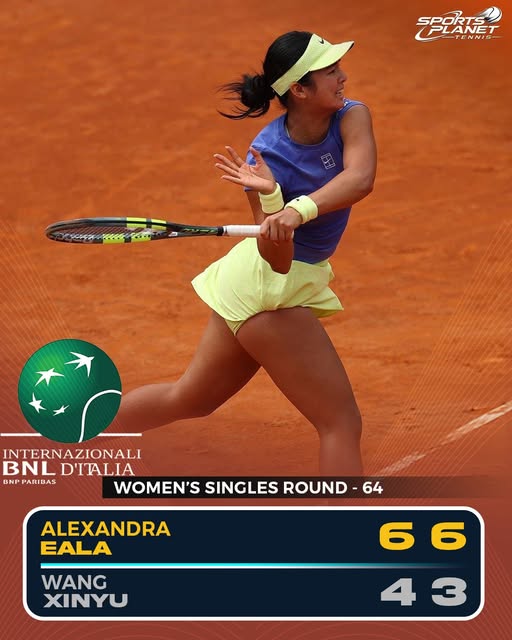
Alex Eala is no longer playing like a teenager trying to survive on the professional tour.
She is now competing with the mindset of a player who believes she belongs on the biggest stage in tennis.
Her straight-sets victory over Wang Xinyu at the Italian Open was more than just another win on clay. It felt like a signal. A warning. A glimpse into what could happen if her momentum keeps building deeper into the tournament.
The scoreline looked simple: 6-4, 6-3.
But underneath those numbers was something much bigger happening inside her game.
The movement looked calmer. The shot selection looked mature. The emotional control looked different. And perhaps most importantly, the fear that many young players carry against experienced opponents was almost gone.
Alex Eala is starting to play with a dangerous combination:
belief, patience, and controlled aggression.
That combination changes everything in modern tennis.
The Biggest Change Is Not Physical — It Is Mental
Most fans first notice the forehand.
Others focus on her speed.
Some look at her left-handed angles and heavy topspin.
But the real transformation happening in Eala’s game is inside her mind.
A few years ago, there were moments where she played brilliant tennis but struggled to maintain emotional stability during pressure situations. Like many young talents, she sometimes rushed points, overhit during key rallies, or allowed momentum swings to affect her rhythm.
That version of Eala still had talent.
But this version has composure.
And composure wins major matches.
Against Wang Xinyu, there were moments where rallies became physical and uncomfortable. Instead of panicking, Eala absorbed the pressure and waited for the right opening. That is the behavior of a player learning how to manage elite-level matches.
Great players do not always hit harder.
Sometimes they simply think clearer under stress.
That is what makes the current version of Alex Eala extremely dangerous on clay.
Clay Court Tennis Rewards Intelligent Players
Clay is unforgiving.
It exposes weak movement.
It punishes impatience.
It destroys players who rely only on power.
To survive on clay, players need tactical intelligence and emotional discipline.
Eala’s recent matches suggest she is beginning to understand how to construct points at a much higher level.
Instead of forcing immediate winners, she is extending rallies with purpose. She is changing direction better. She is defending deeper shots with improved balance. She is also using height and spin to reset difficult exchanges.
These are small details.
But in professional tennis, small details separate early exits from semifinal runs.
Many young players arrive on tour with explosive games but no emotional structure. They try to end points too early because they become frustrated during long rallies.
Eala appears to be evolving beyond that stage.
Her patience is becoming part of her weapon system.
That is a terrifying development for future opponents.
The Rome Atmosphere Is Changing Her Confidence
Rome has a unique energy.
The crowd is emotional. Loud. Passionate.
Players who gain confidence early in the tournament often ride massive momentum swings because the environment feeds emotion and adrenaline.
Eala seems to be thriving inside that atmosphere.
Every victory increases her belief.
Every difficult hold strengthens her nerve.
Every completed comeback teaches her something valuable about surviving under pressure.
Confidence in tennis is not built through speeches.
It is built through surviving real moments.
And Rome is giving Eala those moments.
The scary part for the rest of the field is this:
young players often improve rapidly during tournaments once belief enters the system.
One breakthrough match can suddenly unlock another level.
The Adoption of a Higher-Level Game
There is a visible tactical mutation happening in Eala’s style.
Earlier in her career, she often relied heavily on rhythm hitting. Now she is beginning to disrupt rhythm instead of simply participating in it.
That change matters enormously.
High-level tennis is about adaptation.
Elite players constantly adjust:
- spin height
- court positioning
- tempo
- serve direction
- rally tolerance
- return depth
- defensive transitions
Eala is starting to show those advanced layers.
Against aggressive hitters, she is using shape and angles to redirect pressure.
Against defensive players, she is stepping inside the baseline earlier.
Against big servers, she is improving anticipation on return games.
These are signs of tennis maturity.
The modern women’s game is incredibly fast. Players who cannot adapt tactically disappear quickly. But players who learn how to change patterns during matches become long-term threats.
That is why coaches around the tennis world are paying closer attention to Eala’s development.
Her ceiling is rising.
Why Her Left-Handed Game Creates Problems
Left-handed players naturally create uncomfortable patterns.
The serve angles are different.
Crosscourt exchanges feel awkward.
Spin trajectories move differently.
But Eala is now using those left-handed advantages with more strategic intelligence.
Instead of simply hitting hard crosscourt forehands, she is opening space patiently before attacking the opposite corner.
That patience creates physical exhaustion for opponents.
Clay courts magnify this effect because rallies become longer.
By the second set against Wang Xinyu, there were moments where Eala looked physically fresher and mentally sharper.
That is not accidental.
That is controlled energy management.
Elite players understand how to conserve emotional energy during long matches. Eala’s improved body language suggests she is learning that lesson quickly.
The Silent Weapon: Emotional Control
One of the most underrated aspects of championship tennis is emotional neutrality.
Fans often celebrate emotional intensity.
But coaches understand something deeper:
players who stay emotionally stable during chaos usually win more consistently.
Eala showed impressive emotional control during difficult moments.
After missed opportunities, she reset quickly.
After losing points, she did not spiral emotionally.
After momentum changes, she stayed composed.
That behavior may sound simple, but it is one of the hardest skills in professional sports.
Many athletes lose matches mentally before losing them physically.
The higher Eala climbs in the rankings, the more valuable this mental stability becomes.
Because at elite tournaments, nearly everybody can hit powerful shots.
The difference often comes from who handles stress better.
The Thrill Story Developing in Rome
Every tournament has one player that slowly captures attention.
The unexpected run.
The dangerous outsider.
The young athlete suddenly playing fearless tennis against established names.
Alex Eala is beginning to create that storyline in Rome.
The excitement is building match by match.
Fans are starting to believe something special could happen.
Commentators are beginning to discuss her potential deeper run.
Opponents are starting to realize they are not facing a simple prospect anymore.
They are facing a player evolving in real time.
That is what makes sports thrilling.
Transformation happening under pressure.
The atmosphere becomes electric when a rising player stops fearing the stage and starts owning it.
Rome has seen many breakthrough moments in tennis history.
And Eala may be writing her own chapter right now.
Can She Reach the Semifinal?
The prediction no longer feels impossible.
Earlier this year, a semifinal conversation may have sounded unrealistic.
Now it feels attainable if she continues winning with this level of focus and tactical discipline.
The path will still be brutal.
The WTA tour is unforgiving.
One bad service game can change an entire match.
One emotional lapse can destroy momentum.
But Eala’s current trajectory suggests she is developing the tools needed to survive those storms.
To reach a semifinal at a major-level event, several elements must align:
- physical endurance
- emotional control
- tactical flexibility
- confidence under pressure
- efficient recovery
- fearless mentality
Eala is beginning to show all of those qualities simultaneously.
That is why the belief around her is growing rapidly.
The Hunger Behind the Rise
One thing separates truly elite competitors from temporary sensations:
deep internal hunger.
Eala’s recent performances suggest she is no longer satisfied with participation alone.
She wants bigger stages.
Bigger wins.
Bigger moments.
You can see it in the way she chases difficult balls. You can see it in her movement after long rallies. You can see it in her refusal to mentally disappear during pressure games.
Championship-level ambition changes how players train, think, and compete.
And once that mentality becomes permanent, rankings often rise quickly afterward.
Why the Philippines Is Watching Closely
The Philippines has produced talented athletes across many sports, but tennis remains a difficult global battlefield because of its financial and developmental demands.
That is why Eala’s rise carries enormous significance.
She represents possibility.
Young Filipino players watching her matches now see something powerful:
a pathway.
Her success is not only personal.
It is inspirational.
Every deep tournament run creates more attention for tennis in the Philippines. More kids pick up racquets. More families believe international success is possible.
That cultural impact matters.
Sport changes when one athlete proves the impossible can be done.
The Most Dangerous Thing About Momentum
Momentum in tennis can become explosive.
Once a player starts believing they can beat anybody, their level often jumps dramatically.
Serves become freer.
Movement becomes lighter.
Decision-making becomes faster.
Fear disappears.
That is the stage Eala may be approaching right now.
And if she fully enters that psychological zone during Rome, the tournament could become extremely interesting.
Because dangerous players are not always the highest-ranked ones.
Sometimes the most dangerous player is the one evolving fastest during the event itself.
A New Era May Be Starting
It is still early.
There will still be losses, difficult matches, and painful learning experiences ahead.
That is normal in professional tennis.
But something important feels different now.
Alex Eala is no longer only a promising young player with potential.
She is beginning to look like a genuine high-level competitor capable of threatening established names on big stages.
The mental transformation is becoming visible.
The tactical maturity is improving.
The emotional stability is growing stronger.
And perhaps most importantly, the belief is becoming real.
If she continues this path, the Rome semifinal prediction may stop sounding bold very soon.
It may simply sound accurate.