
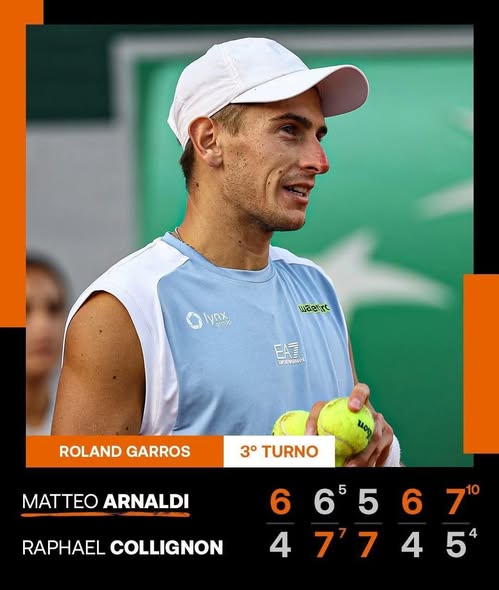
Italian tennis continues to enjoy one of the greatest periods in its history. While the absence of world-class stars can sometimes leave a nation worried about who will carry the flag forward, tournaments often reveal new heroes. In this case, Matteo Arnaldi answered the call.
In a dramatic five-set battle against rising Belgian Raphael Collignon, Arnaldi demonstrated the qualities that separate talented professionals from true competitors. The scoreboard showed a narrow 3-2 victory, but the deeper story was about adaptation, tactical intelligence, emotional control, and the willingness to suffer for every point.
With injured Italian leader Jannik Sinner temporarily sidelined, Italy needed players capable of embracing responsibility. Arnaldi delivered exactly that.
The victory was not merely about advancing to the next round. It was about proving that Italian men's tennis remains deep, competitive, and capable of producing fighters who refuse to surrender.
The Pressure of Representing Italy
When a nation's top star is absent, expectations shift.
For years, Italian tennis fans have enjoyed the remarkable rise of Sinner. His consistency, professionalism, and championship mentality have elevated Italian tennis to new heights.
However, major tournaments do not stop when stars are injured.
The challenge becomes clear:
Who steps forward?
Against Collignon, Arnaldi entered the court carrying more than his racket. He carried expectations.
ATP analysts in the United States often emphasize that depth is what separates great tennis nations from temporary success stories.
A former American ATP coach recently summarized the situation perfectly:
"Champions inspire a generation. Depth sustains a generation."
Italy is now experiencing that depth.
Arnaldi's victory showed that the country's success is not dependent on one player alone.
Raphael Collignon Was Far From an Easy Opponent
Many casual fans underestimate Collignon.
That would be a mistake.
The Belgian possesses:
- Excellent baseline consistency
- Strong physical conditioning
- Smart point construction
- Ability to absorb pace
- High competitive intensity
Throughout the match, Collignon repeatedly forced Arnaldi into uncomfortable situations.
Whenever Arnaldi attempted to dominate quickly, Collignon found ways to extend rallies.
Whenever momentum appeared to swing decisively, Collignon fought back.
Five-set matches are rarely won by talent alone.
They become tests of:
- Patience
- Endurance
- Decision-making
- Emotional control
Collignon passed many of those tests himself.
That is why Arnaldi's victory deserves significant respect.
First Set Analysis: Establishing Court Position
The opening set often functions as a tactical information-gathering phase.
Both players entered cautiously.
Arnaldi focused on:
- Deep crosscourt forehands
- Safe first-serve percentages
- Heavy topspin patterns
- Long rally tolerance
Collignon responded with:
- Solid defensive positioning
- Counterpunching
- Consistent depth
- Intelligent directional changes
Early exchanges revealed a key tactical battle.
Arnaldi wanted to dictate.
Collignon wanted to neutralize.
The first set became a contest of patience.
Rather than chasing winners, Arnaldi worked to establish court control.
ATP experts frequently note that modern clay-court and slow-court tennis rewards the player willing to build points rather than rush them.
Arnaldi embraced that principle.
Collignon's Mid-Match Adjustments
The Belgian deserves tremendous credit.
Many players lose momentum after dropping difficult sets.
Collignon instead adapted.
His adjustments included:
Taking Returns Earlier
He moved closer to the baseline.
This reduced Arnaldi's preparation time.
Redirecting Backhands Down the Line
Instead of remaining trapped crosscourt, he changed directions more aggressively.
Increasing Forehand Aggression
He looked for shorter balls and attacked sooner.
Improving Court Position
Rather than retreating defensively, he began holding ground.
These changes shifted the momentum.
Suddenly, Arnaldi was no longer controlling every exchange.
The match became a genuine battle.
Matteo Arnaldi's Best Adjustment
Every high-level tennis match eventually asks one question:
Can you adjust when your original plan stops working?
Arnaldi answered yes.
His most effective tactical change involved varying ball speed.
Many players panic under pressure and swing harder.
Arnaldi became smarter instead.
He began mixing:
- Heavy topspin
- Flatter drives
- Higher trajectories
- Short angles
This variation disrupted Collignon's rhythm.
American ATP analysts frequently describe rhythm as one of the most dangerous weapons in professional tennis.
When a player becomes comfortable with the pace and pattern, confidence grows rapidly.
Arnaldi recognized that danger and removed it.
Instead of giving Collignon repetitive looks, he forced constant adaptation.
That tactical intelligence became one of the decisive factors in the match.
The Mental Battle Was Even Bigger Than the Tactical Battle
Physical tennis can be trained.
Mental tennis is much harder.
Five-set matches expose everything.
They reveal:
- Confidence
- Fear
- Discipline
- Frustration
- Belief
Throughout the encounter, Arnaldi displayed remarkable composure.
There were moments when momentum shifted.
There were moments when Collignon appeared ready to seize control.
There were moments when the crowd could feel tension building.
Yet Arnaldi consistently returned to the same mental routine:
One point at a time.
Elite ATP coaches often repeat a simple concept:
"Pressure comes from thinking about outcomes instead of executions."
Arnaldi stayed committed to execution.
He focused on:
- Serve placement
- Footwork
- Rally patterns
- Shot selection
Not the scoreboard.
That distinction matters enormously.
Why Many Players Lose Five-Set Matches
American tennis experts often discuss a fascinating trend.
Many players do not lose because they become physically exhausted.
They lose because they become mentally impatient.
Common mistakes include:
Forcing Winners Too Early
Players try ending points before creating opportunities.
Abandoning Successful Patterns
A strategy works for two sets.
Pressure arrives.
The player suddenly changes everything.
Emotional Decision-Making
Frustration replaces logic.
Fear of Losing
The player becomes defensive.
Arnaldi avoided these traps.
His decision-making remained surprisingly stable throughout the contest.
That consistency became one of his greatest strengths.
The Importance of Body Language
One underrated aspect of tennis is visual communication.
Opponents constantly observe each other.
They watch:
- Walking speed
- Facial expressions
- Energy levels
- Reactions after errors
Strong body language can become a weapon.
Arnaldi consistently projected confidence.
Even after difficult games, he appeared composed.
That sends a message:
"I am still here."
ATP veterans understand this psychological battle well.
An opponent who looks defeated often becomes defeated.
An opponent who continues showing belief remains dangerous.
Arnaldi never looked ready to surrender.
Physical Endurance and Recovery
Five-set victories require extraordinary conditioning.
The modern ATP game demands:
- Explosive movement
- Repeated acceleration
- Lateral recovery
- Core stability
- Cardiovascular endurance
Arnaldi's movement remained effective deep into the match.
This suggests excellent preparation.
Several ATP fitness specialists in the United States often emphasize a key statistic:
Late-match footwork frequently determines outcomes more than shot quality.
When legs slow down:
- Timing suffers
- Balance suffers
- Accuracy suffers
Arnaldi maintained enough physical energy to execute under pressure.
That is rarely accidental.
It reflects months of preparation.
Representing the Italian Blues
Italian tennis has become one of the most respected forces in men's tennis.
The country's success comes from:
- Strong coaching systems
- Competitive junior development
- Professional training environments
- Rising player depth
With Sinner absent, the spotlight naturally shifts.
Arnaldi's victory demonstrates that Italy possesses multiple players capable of competing on major stages.
Fans often focus exclusively on superstars.
However, championship nations require more.
They need:
- Reliable competitors
- Tough match winners
- Players who thrive under pressure
Arnaldi displayed all three qualities.
What ATP Experts in the United States Are Saying
Many American analysts admire players who solve problems during matches.
Raw talent attracts attention.
Problem-solving wins matches.
Arnaldi's performance reflected several traits ATP experts consistently praise:
Tactical Flexibility
He adjusted patterns effectively.
Emotional Stability
He controlled reactions.
Competitive Toughness
He accepted long rallies.
Physical Durability
He sustained intensity.
Situational Awareness
He recognized momentum changes.
Former ATP professionals frequently emphasize that Grand Slam success often depends on these qualities more than pure shot-making ability.
Arnaldi's victory reinforced that belief.
Lessons Recreational Players Can Learn
Club players can learn a great deal from this match.
Lesson 1: Patience Wins Matches
You do not need a winner on every ball.
Build points.
Lesson 2: Adjust When Necessary
If a pattern stops working, adapt.
Lesson 3: Control Emotions
Anger rarely improves performance.
Lesson 4: Focus on the Next Point
Forget mistakes quickly.
Lesson 5: Fitness Matters
Good decision-making becomes difficult when exhausted.
Arnaldi demonstrated all of these principles.
Looking Ahead
The most encouraging aspect of this victory is not simply the result.
It is the manner in which the result was achieved.
Winning comfortably is one thing.
Winning when challenged is another.
Arnaldi faced:
- Momentum swings
- Tactical pressure
- Physical demands
- Mental stress
And still found solutions.
Those are the experiences that build confidence for future rounds.
Every difficult victory teaches lessons.
Every five-set battle strengthens belief.
Every challenge survived becomes evidence that future challenges can also be overcome.
Matteo Arnaldi's 3-2 victory over Raphael Collignon was much more than a scoreline. It was a demonstration of modern ATP tennis at its finest: tactical adjustments, mental resilience, physical endurance, and unwavering competitive spirit.
With Jannik Sinner absent due to injury, Italy needed players willing to carry responsibility. Arnaldi embraced that challenge and represented the Italian Blues with pride.
Raphael Collignon pushed him to the limit, forcing constant adaptation and resilience. Yet Arnaldi's ability to remain composed, adjust strategically, and compete fearlessly ultimately made the difference.
For ATP observers in the United States and around the world, this performance confirmed what many have suspected for years: Italy's strength extends far beyond a single superstar.
The future of Italian tennis remains bright because players like Matteo Arnaldi continue proving that talent, intelligence, preparation, and heart can win even the toughest battles.