
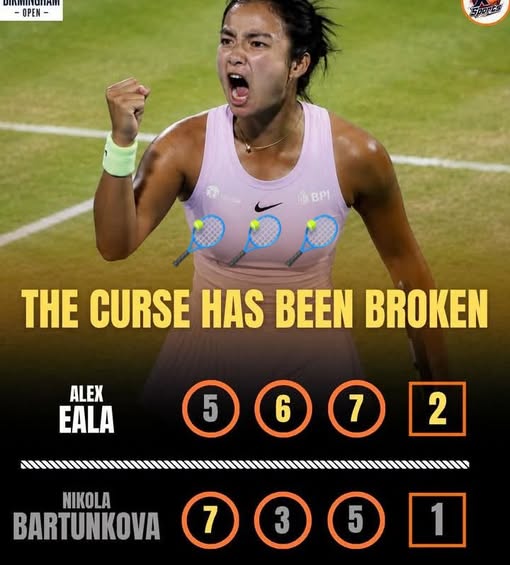
The Curse Has Been Broken
For years, Philippine tennis fans have waited for the moment when Alex Eala would fully translate her immense potential into consistent victories on the professional stage. Against Nikola Bartunkova, Eala delivered a performance that felt bigger than a single win. It was a declaration that she belongs among the sport's rising stars. In the past many have doubt this filipina is only a climax game winning but not conistently winning the matches.
After a hard-fought three-set battle, Eala emerged victorious 5-7, 6-3, 7-5. The scoreline alone tells a story of resilience, but the deeper story lies in the adjustments, mental strength, physical endurance, and competitive maturity she displayed when the match reached its most critical moments.
From an ATP coaching perspective in the United States, this victory showcased something every future champion must possess: the ability to stay composed when the match refuses to go according to plan.
Champions are not defined by how they play when everything is working.
They are defined by what they do when everything becomes difficult.
Against Bartunkova, Eala showed exactly that.
The First Set: Learning the Battlefield
The opening set was a classic feeling-out process.
Both players entered the match with clear game plans.
Bartunkova attempted to dictate play early by using aggressive baseline patterns. Her objective was simple:
- Attack first
- Control center court
- Shorten rallies
- Apply pressure on Eala's backhand side
Initially, the strategy worked.
Eala was creating opportunities but was slightly late pulling the trigger on attacking shots. Instead of fully committing to offensive patterns, she occasionally allowed Bartunkova to dictate the tempo.
At the professional level, hesitation often becomes expensive.
Bartunkova captured the first set 7-5.
Many young players would have mentally drifted after losing such a close opening set.
Eala did not.
Instead, she treated the first set as valuable information.
This is one of the biggest differences between elite competitors and average competitors.
Average players react emotionally.
Elite players gather data.
The Champion's Mindset
When Eala walked to her chair after losing the first set, she faced a critical decision.
She could focus on frustration.
Or she could focus on solutions.
She chose solutions.
This mindset shift is often invisible to spectators.
The crowd sees forehands and serves.
Coaches see decisions.
A player's internal dialogue can determine the outcome of a match.
Instead of thinking:
"I lost the set."
Elite competitors think:
"What is working?"
"What is not working?"
"What adjustment will change momentum?"
This mentality allowed Eala to remain emotionally stable.
Her body language never suggested panic.
She remained composed.
Focused.
Patient.
Confident.
That confidence would become increasingly important as the match progressed.
Tactical Adjustment Number One: Taking Time Away
One of the biggest changes Eala made in the second set was her court positioning.
She moved slightly closer to the baseline.
This adjustment may seem small.
In reality, it changes everything.
Standing closer to the baseline allows a player to:
- Take time away from opponents
- Redirect pace earlier
- Increase pressure
- Prevent opponents from establishing rhythm
Bartunkova enjoyed more comfort during the first set.
In the second set, that comfort disappeared.
Suddenly she was receiving balls earlier.
Faster.
Deeper.
More aggressively.
Eala was no longer reacting.
She was initiating.
That subtle shift changed the entire match dynamic.
The Evolution of Eala's Forehand
Perhaps the most impressive technical feature of Eala's game was her forehand.
Over recent seasons, her forehand has evolved significantly.
Earlier in her development, the shot was reliable.
Today it is becoming a weapon.
Against Bartunkova, Eala used her forehand to:
- Open angles
- Push opponents wide
- Create short balls
- Control rally patterns
Most importantly, she trusted the shot under pressure.
Confidence in stroke production separates high-level players from elite players.
When a player fully trusts a stroke, they swing freely.
The ball travels cleaner.
Timing improves.
Decision-making accelerates.
Throughout the second and third sets, Eala's forehand became the foundation of her offensive game.
Backhand Stability Under Pressure
Champions build victories on stable foundations. The pressure give you focus when the fire is on but when doubt the game also falls faster and scale in loosing.
For Eala, that foundation was her backhand.
The shot repeatedly absorbed pressure from Bartunkova's attacks.
Instead of breaking down, Eala's backhand redirected pace effectively.
The backhand served three important purposes:
Defense
When Bartunkova attempted to attack, Eala neutralized the pressure.
Transition
The backhand allowed her to shift from defense to offense.
Consistency
Long rallies often ended in Eala's favor because she remained disciplined.
Professional tennis is often decided by who can maintain quality under pressure.
Eala's backhand provided that stability.
The Physical Battle
Three-set matches reveal more than technique.
They reveal conditioning.
As the contest extended deeper into the third set, physical preparation became increasingly important.
Eala demonstrated excellent endurance throughout the match.
Her movement remained efficient.
Her footwork remained sharp.
Her recovery between points stayed consistent.
Many players experience technical breakdowns when fatigue arrives.
Footwork slows.
Balance deteriorates.
Shot selection declines.
Eala avoided those pitfalls.
This indicates strong physical preparation and growing professional maturity.
Fitness is not simply about running longer.
It is about maintaining quality under stress.
Eala did exactly that.
Alpha Frequency and Competitive Flow
Sports psychologists often discuss concepts related to mental performance states.
One commonly discussed idea is entering a highly focused state where the athlete becomes completely immersed in execution.
Many refer to this as "flow."
Some sports-performance researchers associate relaxed concentration with increased alpha brainwave activity, although performance outcomes depend on many factors beyond brainwave patterns alone.
What mattered during this match was Eala's ability to maintain:
- Calm concentration
- Emotional control
- Tactical awareness
- Competitive intensity
She appeared fully present.
Point by point.
Shot by shot.
Moment by moment.
This mental state often produces elite performances because the athlete stops worrying about outcomes and begins focusing entirely on execution.
That is exactly what Eala demonstrated.
Confidence Is Earned
Confidence is frequently misunderstood.
Many people believe confidence comes before success.
In reality, confidence comes from preparation.
Eala's confidence was visible throughout the match.
She trusted her movement.
She trusted her forehand.
She trusted her conditioning.
She trusted her ability to solve problems.
This type of confidence cannot be faked.
It is built through:
- Training sessions
- Physical preparation
- Match experience
- Repetition
- Success under pressure
When the third set became tense, Eala's confidence became one of her greatest weapons.
The Third Set: Where Champions Are Made
The third set represented the ultimate examination.
Both players understood the importance of the moment.
Neither wanted to give ground.
Every game became more intense.
Every point carried greater significance.
This is where many matches are decided mentally rather than technically.
The pressure rises.
The crowd becomes louder.
The consequences become bigger.
Players begin thinking about winning.
That can be dangerous.
The athletes who perform best under pressure focus on process rather than outcome.
Eala appeared committed to the process.
She continued building points patiently.
She continued trusting her patterns.
She continued believing in her game.
That discipline ultimately carried her across the finish line.
Managing Momentum Swings
Tennis is a sport of momentum.
Momentum can shift rapidly.
One break point.
One winner.
One double fault.
Everything changes.
Throughout the match, Eala handled momentum swings exceptionally well.
When she lost games, she recovered quickly.
When Bartunkova built pressure, Eala remained composed.
This emotional stability is increasingly becoming one of her strengths.
Professional tennis careers are often determined by how players manage adversity.
Eala's response to adversity was impressive.
She never allowed frustration to become distraction.
Strategic Intelligence
One underrated aspect of Eala's development is her tennis intelligence.
Elite tennis is not only about athletic ability.
It is also about solving puzzles.
Every opponent presents different challenges.
Against Bartunkova, Eala demonstrated strong strategic awareness.
She recognized:
- Which patterns were succeeding
- Which rallies favored her
- Which areas needed adjustment
This ability to adapt mid-match is critical for future success.
The best players constantly evolve during competition.
Eala showed signs of developing that elite skill.
Handling Pressure Points
The most important moments in tennis are often the shortest.
Break points.
Set points.
Match points.
Pressure points.
These moments reveal character.
Throughout the contest, Eala displayed remarkable composure.
Rather than becoming passive, she continued playing assertive tennis.
This is essential.
Pressure should not change identity.
Champions trust the game that brought them success.
Eala trusted her game.
That trust produced victory.
The Growth of a Future Star
From an ATP coaching perspective, several areas of growth were evident.
Improved Shot Selection
Her decision-making continues to mature.
Better Court Positioning
She is becoming more proactive.
Greater Physical Endurance
Her movement remains effective deep into matches.
Enhanced Emotional Control
She handles adversity more effectively than before.
Increased Competitive Belief
She now competes with genuine confidence.
These improvements collectively indicate a player moving in the right direction.
Why This Victory Matters
Some wins are worth more than ranking points.
This felt like one of those victories.
The scoreline reflected persistence.
The performance reflected growth.
The response to adversity reflected maturity.
For young players attempting to climb the rankings, these victories become foundational experiences.
They reinforce belief.
They validate preparation.
They accelerate development.
Eala's victory over Bartunkova may ultimately be remembered as another important step in her evolution toward the highest levels of professional tennis.
The Road Ahead
The challenge now becomes consistency.
One victory creates momentum.
Sustained excellence creates careers.
The world's best players repeatedly demonstrate:
- Mental toughness
- Tactical adaptability
- Physical durability
- Competitive confidence
Eala displayed all four qualities during this match.
If she continues refining her game and accumulating experience, there is every reason to believe she can continue climbing the professional ranks.
The raw talent has always been there.
Now the mental and tactical maturity are beginning to catch up.
That combination is dangerous for opponents.
ATP USA Coach Assessment
From the perspective of an ATP-level coach in the United States, this performance was encouraging because it showcased the traits that cannot easily be taught.
Forehands can be improved.
Serves can be refined.
Fitness can be developed.
But competitive courage is different.
Competitive courage appears when a player loses the first set and continues believing.
Competitive courage appears when fatigue arrives and effort remains unchanged.
Competitive courage appears when pressure points emerge and aggression remains intact.
Alex Eala demonstrated that courage throughout this match.
Her ability to adapt tactically, trust her strokes, maintain physical intensity, and remain mentally composed ultimately produced a deserved victory.
The scoreline reads 5-7, 6-3, 7-5.
But the larger story is about growth.
A young player faced adversity.
She made adjustments.
She trusted her preparation.
She embraced the battle.
And she found a way to win.
That is the mindset of future champions.
For Alex Eala, the curse may indeed be broken.
More importantly, a stronger and more complete competitor appears to be emerging—one capable of handling pressure, solving problems, and winning the matches that shape careers.
The tennis world should pay attention.
Because performances like this suggest that Alex Eala's best tennis may still be ahead of her.