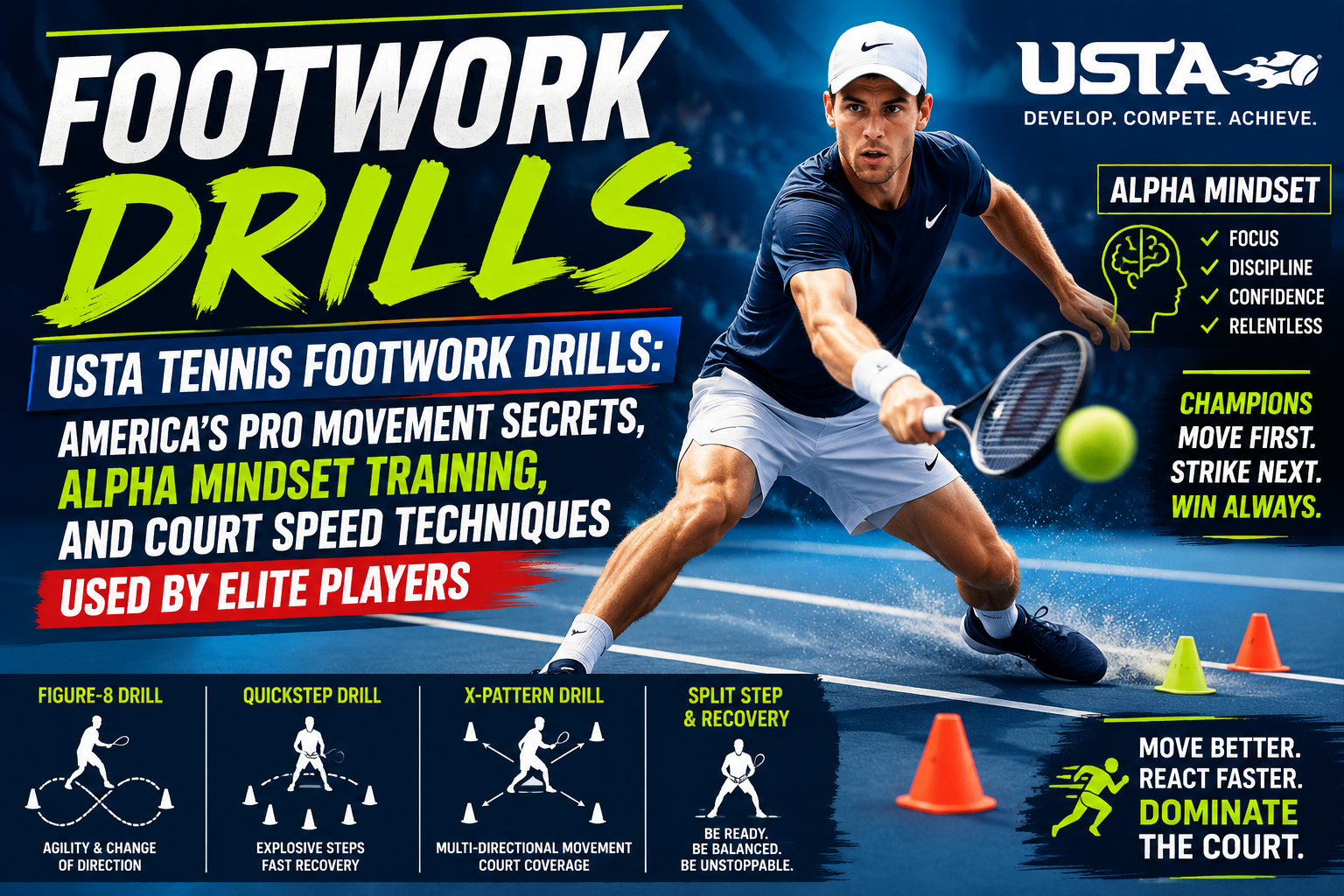
Move Like a Champion: USTA Pro Footwork Drills, Alpha Mindset Training, and Elite Court Movement Used by America's Top Tennis Professionals
Tennis is often described as a game of strokes, but experienced coaches know the truth: matches are won with the feet before they are won with the racket. Every explosive forehand winner, every impossible defensive retrieval, and every perfectly timed volley begins with exceptional movement.
Watch the world's greatest players, and one thing becomes obvious—they rarely appear rushed. They glide effortlessly across the court because their footwork places them in the perfect hitting position before the racket even begins its swing.
The United States Tennis Association (USTA) Player Development program emphasizes that elite movement is not about simply running faster. It is about efficiency, anticipation, explosive first steps, controlled balance, intelligent recovery, and an Alpha mindset that refuses to surrender a single ball.
Professional players don't chase tennis balls.
They hunt them.
That difference in mentality separates good players from champions.
The Alpha Mindset Begins Before the First Point
Every professional match begins long before the first serve.
Elite American players prepare mentally before they even step onto the court.
Instead of thinking:
"I hope I play well today."
Champions think:
"Every ball belongs to me."
That mindset changes everything.
An Alpha competitor expects to move.
Expects to fight.
Expects long rallies.
Expects pressure.
Rather than fearing difficult situations, they welcome them because they have trained for them thousands of times.
Movement becomes confidence.
Confidence becomes aggression.
Aggression becomes controlled dominance.
Why Footwork Wins More Matches Than Bigger Strokes
Many recreational players spend hours improving forehands and serves.
Professional coaches often spend even more time improving movement.
Why?
Because poor positioning destroys every stroke.
Late preparation causes:
- Mishits
- Short balls
- Weak serves
- Poor balance
- Missed volleys
- Defensive positioning
Even the world's biggest forehand becomes ineffective if contact is made while off balance.
Professional tennis rewards positioning first.
Power comes second.
Drill 1 – The Figure-8 Drill
One of the most effective movement exercises used in USTA development programs is the Figure-8 Drill.
Place two cones approximately six to eight feet apart near the baseline.
Begin in an athletic position.
Shuffle around one cone.
Cross over toward the second.
Loop around it.
Continue tracing a smooth figure-eight pattern.
Keep:
- Knees bent
- Chest upright
- Eyes forward
- Hips low
- Feet constantly active
The purpose isn't simply speed.
It teaches smooth directional changes while maintaining balance.
Advanced players add live ball feeds during each turn, forcing immediate adjustment before striking.
Professional players rarely move in straight lines.
They constantly curve, recover, adjust, and reposition.
This drill develops those exact patterns.
Drill 2 – The Quickstep Semi-Circle Drill
Professional baseline players constantly recover toward the middle after every shot.
The Quickstep Drill trains that habit.
Arrange five cones in a semicircle.
Stand at the center "home position."
Sprint to each cone.
Shadow a forehand.
Recover immediately.
Repeat.
Finish with a backhand movement.
This teaches:
- Explosive acceleration
- Efficient recovery
- Proper split-step timing
- Directional control
Every recovery should happen with urgency.
Elite players never admire their shots.
The moment the racket finishes, the feet begin moving again.
Drill 3 – The X Pattern Drill
Modern tennis requires explosive multidirectional movement.
The X Pattern develops exactly that.
Arrange four cones:
- Two baseline corners
- Two service box positions
Begin in the center.
Perform a split step.
Sprint toward the called cone.
Stop under control.
Shadow the stroke.
Recover immediately using crossover steps.
Repeat continuously.
This drill mimics real match situations where players constantly move diagonally.
It develops:
- First-step explosion
- Controlled deceleration
- Balance under pressure
- Court coverage
Professional movement is about changing speed instantly.
Not merely running fast.
Off-Court Training Builds Champions
Champions continue improving even when no tennis court is available.
Professional American academies incorporate portable movement drills almost daily.
Great movement is built through repetition.
Not convenience.
The Line Drill
One painted line can produce world-class foot speed.
Perform each sequence for 10–15 seconds.
Exercises include:
Double-Leg Hops
Hop rapidly over the line.
Land softly.
Maintain rhythm.
Single-Leg Hops
Develop ankle stability.
Improve balance.
Increase lower-leg strength.
Stagger Steps
Alternate which foot crosses the line first.
This develops coordination while mimicking recovery movements during rallies.
Quick feet create quick reactions.
The Cross Drill
Draw a large cross on the ground.
Number each quadrant.
Perform jumping patterns:
Clockwise
Counterclockwise
Diagonal X-patterns
Forward-backward combinations
This drill strengthens:
- Reaction time
- Spatial awareness
- Coordination
- Lower-body explosiveness
Professional tennis demands instant body control.
This exercise builds it.
Agility Ladder Training
Nearly every professional academy in the United States includes ladder drills.
They improve:
- Rhythm
- Coordination
- Speed
- Balance
- Timing
One favorite is the Ickey Shuffle.
The pattern requires:
Two feet inside.
One foot outside.
Repeat continuously.
Players quickly learn to move efficiently without wasting energy.
Fast feet become automatic.
Automatic movement frees the brain to focus on tactics.
The Split Step: The Most Important Movement in Tennis
Ask elite coaches what separates professionals from club players.
Many will answer with one word:
Split step.
The split step occurs precisely as the opponent contacts the ball.
Players perform a small hop.
Land softly.
Immediately explode toward the incoming shot.
Without it:
Players react late.
Weight remains flat-footed.
Recovery becomes slower.
Balance disappears.
Timing the split step correctly makes players appear much faster—even without improving sprint speed.
Professional players are not always quicker.
They simply move sooner.
Adjustment Steps Create Perfect Contact
One of the biggest mistakes amateurs make is taking giant final strides toward the ball.
Professionals do the opposite.
As they approach contact, they use several small adjustment steps.
These tiny movements fine-tune spacing.
Benefits include:
- Better balance
- Cleaner contact
- Improved rotation
- More consistent timing
Elite players rarely stop moving until the instant the racket strikes the ball.
Their feet continue making microscopic corrections.
That precision creates consistency.
Mastering the Recovery Step
After every shot comes the next movement.
The first recovery step should often be a powerful crossover.
Instead of shuffling immediately, professionals cross the outside leg over the inside leg to cover distance rapidly.
Then they transition into side shuffles.
Efficient recovery allows players to:
Reach the next shot earlier.
Maintain offensive positioning.
Conserve energy.
Recovering poorly forces constant defensive play.
Movement Saves Energy
Many players assume professionals possess endless stamina.
The truth is different.
Professionals move more efficiently.
Efficient movement means:
Less wasted running.
Less unnecessary braking.
Better balance.
Lower heart rate.
Reduced fatigue.
After three hours, efficient movers often feel fresher than players who have actually covered less distance.
Energy conservation wins long tournaments.
Alpha Focus During Every Rally
Movement begins with attention.
Elite competitors never mentally relax between shots.
Instead, they maintain laser focus.
Every point follows a mental routine.
Observe.
Split step.
Move.
Adjust.
Hit.
Recover.
Repeat.
Distractions disappear.
Crowd noise disappears.
Previous mistakes disappear.
Only the next ball matters.
That is Alpha concentration.
Building Competitive Confidence
Confidence is earned through preparation.
Every completed drill teaches the brain:
"I've done this before."
Pressure no longer feels unfamiliar.
When facing break point or match point, trained movement becomes instinctive.
Players stop thinking.
They simply react.
That freedom creates aggressive tennis.
Weekly USA Pro Footwork Training Plan
A simple weekly structure can dramatically improve court movement.
Monday
- Figure-8 Drill
- Ladder Training
- Split Step Practice
Tuesday
- X Pattern Drill
- Recovery Step Drills
- Live Ball Movement
Wednesday
- Line Drill
- Core Strength
- Dynamic Stretching
Thursday
- Quickstep Drill
- Adjustment Step Training
- Point Simulation
Friday
- Ladder Speed
- Sprint Intervals
- Reaction Training
Saturday
- Match Play
- Footwork Analysis
- Video Review
Sunday
- Recovery
- Mobility
- Visualization
Consistency matters far more than intensity.
Twenty focused minutes every day beats one exhausting workout each week.
The Championship Difference
Professional tennis is not built upon miraculous talent.
It is built upon disciplined habits repeated thousands of times.
Every split step.
Every recovery.
Every adjustment step.
Every sprint.
Every drill builds another layer of confidence.
The greatest players appear calm because preparation has replaced uncertainty.
When pressure arrives, they trust their training.
That trust produces fearless tennis.
Final Thoughts
USTA Player Development emphasizes that elite movement is the foundation of modern tennis. Powerful strokes are only effective when your feet consistently place you in the ideal position. Whether you're practicing the Figure-8 Drill, sharpening your reactions with agility ladders, or mastering the split step and crossover recovery, every repetition develops habits that translate directly into match performance.
Adopt an Alpha mindset every time you step on the court. Attack each drill with purpose, stay mentally engaged between every shot, and never allow your feet to become passive. Champions are not defined by a single spectacular winner—they are defined by relentless preparation, disciplined movement, and unwavering focus. Master your footwork, and your strokes, confidence, and results will rise to a completely new level.