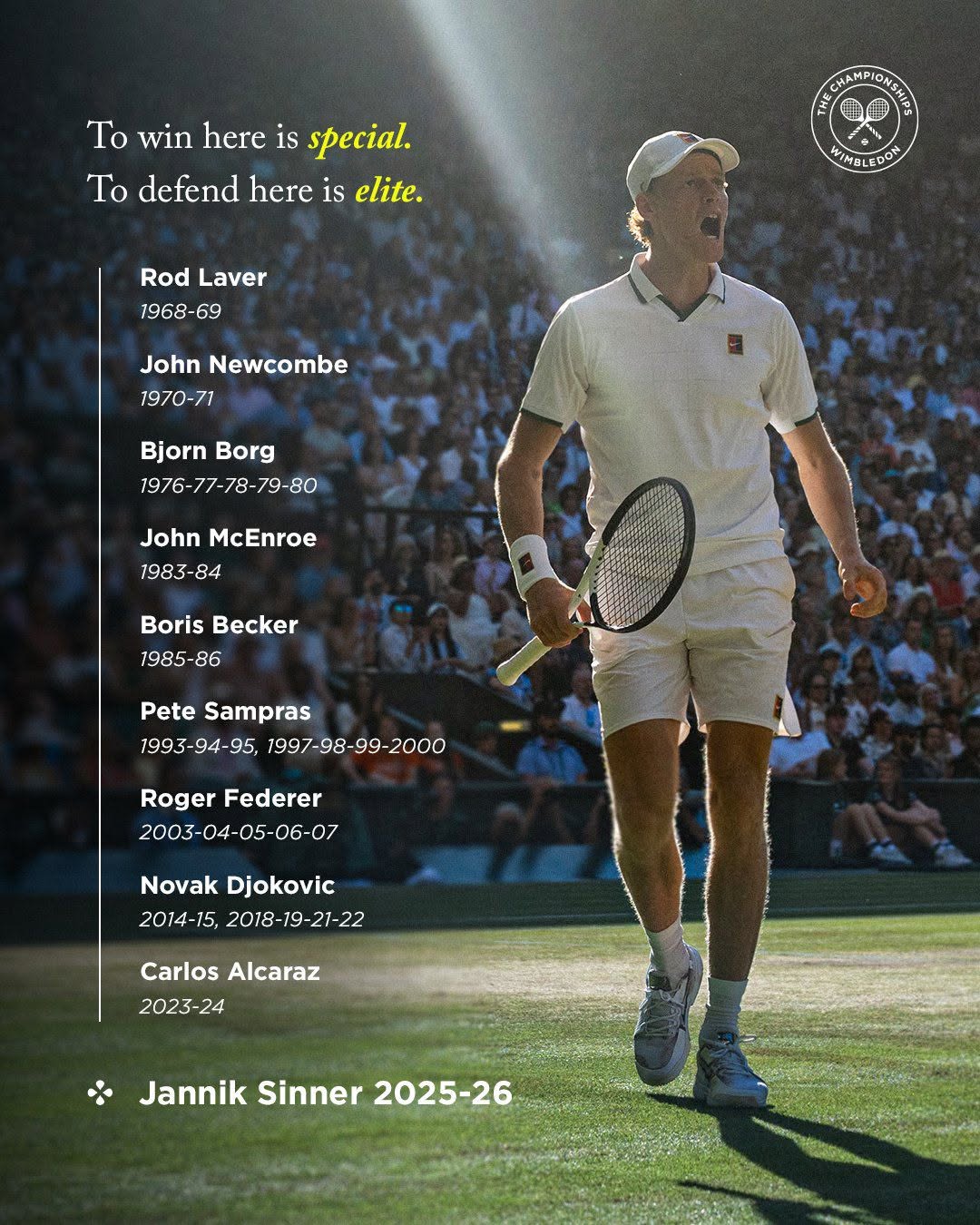
The lawns of Wimbledon have witnessed generations of greatness. From Rod Laver's dominance to Björn Borg's ice-cold composure, Pete Sampras' serve-and-volley mastery, Roger Federer's elegance, and Novak Djokovic's relentless resilience, only a select few have managed to defend the most prestigious title in tennis.
In 2026, Jannik Sinner etched his name permanently into that legendary list.
Winning Wimbledon once is extraordinary.
Winning it twice in succession defines a champion.
The Path of a Champion
Just weeks before arriving in London, Jannik Sinner experienced one of the toughest disappointments of his career.
His campaign at Roland-Garros ended far earlier than expected, raising questions from critics and fans alike. Could he quickly recover mentally? Would the setback linger?
Champions answer those questions not with words—but with performances.
From his opening match at Wimbledon until lifting the trophy on Centre Court, Sinner displayed remarkable emotional control and unwavering belief. Throughout the entire fortnight, he never lost more than one set in any match, demonstrating consistency rarely seen on tennis's biggest stage.
Every round became another statement.
Not through dramatic celebrations.
Not through emotional outbursts.
But through disciplined execution.
That quiet confidence became his greatest weapon.
Every Match Was a Mental Examination
Grass rewards aggressive tennis, but it also punishes hesitation.
Every point lasts only seconds.
Every mistake can cost a set.
Sinner embraced those conditions perfectly.
His movement was exceptionally balanced.
His timing never wavered.
His shot selection reflected patience instead of panic.
Against every opponent, he maintained the same philosophy:
One point. One game. One match at a time.
That mindset separated him from the rest of the field.
The Championship Final: A Battle Worthy of Wimbledon
Standing across the net was Alexander Zverev, the newly crowned French Open champion.
Confidence radiated from both players.
From the very first rally, the final resembled a heavyweight boxing match fought with rackets instead of gloves.
Long baseline exchanges.
Explosive forehands.
Towering serves.
Perfect defense.
Neither player blinked.
The opening set became an unforgettable tiebreak filled with fearless shot-making and extraordinary pressure.
Zverev eventually edged it 9–7, taking the opening set after nearly flawless tennis.
For many players, losing such a dramatic first set in a Grand Slam final could become mentally overwhelming.
Not for Jannik Sinner.
The Adjustment That Changed Everything
Great champions recognize problems faster than everyone else.
Rather than forcing riskier winners, Sinner made subtle tactical adjustments.
He increased the precision of his first serve.
He attacked shorter second serves more aggressively.
He stepped slightly closer during return games.
Most importantly, he trusted his movement.
The changes were almost invisible to casual fans.
But they transformed the match.
Momentum Swings Toward Greatness
The second-set tiebreak belonged entirely to Sinner.
His serving became nearly untouchable.
His backhand repeatedly redirected pace.
His forehand dictated every important rally.
He stormed through the breaker 7–2, leveling the championship.
Suddenly, Centre Court sensed the momentum had shifted.
Championship tennis often turns on only a handful of points.
Sinner won nearly all of them.
Mastering the Wind, Mastering the Moment
The third set presented another challenge.
Changing winds made timing difficult.
Many players struggled to control the ball.
Sinner adapted beautifully.
His footwork became even sharper.
His spacing remained flawless.
He patiently constructed rallies before attacking at precisely the right opportunity.
An early service break proved enough.
Every hold afterward carried increasing psychological weight.
The defending champion never looked back.
One Final Forehand
The fourth set captured everything that defines modern championship tennis.
Intensity.
Precision.
Patience.
Courage.
Then came the decisive moment.
Sinner unleashed a breathtaking forehand down the line, struck with complete conviction, leaving Zverev rooted to the baseline.
Centre Court erupted.
The defending champion had done it again.
Championship Statistics
| Category | Jannik Sinner | Alexander Zverev |
|---|---|---|
| Aces | 15 | 17 |
| First Serve Percentage | 64% | 76% |
| First Serve Points Won | 80% | 72% |
| Break Points Converted | 2/5 | 0/1 |
| Total Points Won | 145 | 130 |
Although Zverev landed more first serves and fired more aces, Sinner excelled in the moments that mattered most.
Championships are rarely decided by raw numbers alone.
They are decided by winning the biggest points.
A Historic Milestone
This Wimbledon final represented another landmark achievement.
- 100th career Grand Slam match victory
- 10 consecutive victories over Alexander Zverev
- Second consecutive Wimbledon title
- Fifth Grand Slam championship overall
Those milestones reflect not just talent, but sustained excellence at the highest level of the sport.
Joining Tennis Royalty
Only a handful of players in Wimbledon history have successfully defended their men's singles crown.
The exclusive group includes:
- Rod Laver
- John Newcombe
- Björn Borg
- John McEnroe
- Boris Becker
- Pete Sampras
- Roger Federer
- Novak Djokovic
- Carlos Alcaraz
- Jannik Sinner (2025–2026)
Each champion represents a different era.
Each dominated in a different style.
Now Sinner's name stands proudly alongside them.
More Than Power—The Mind of a Champion
Sinner's greatest strength wasn't simply his serve.
It wasn't only his backhand.
It wasn't even his athleticism.
It was his ability to remain emotionally steady under relentless pressure.
Championship tennis demands clarity when fatigue sets in.
It demands belief after losing crucial points.
It demands courage when an entire stadium is watching.
Sinner embodied every one of those qualities throughout the tournament.
The Legacy Begins
Every Wimbledon champion becomes part of history.
Few become part of its tradition.
By successfully defending the most prestigious title in tennis, Jannik Sinner has demonstrated that sustained excellence—not a single brilliant fortnight—is the true measure of greatness.
His 2026 triumph was more than another Grand Slam victory. It was a testament to resilience after disappointment, tactical intelligence under pressure, and the unwavering mindset required to perform on the sport's grandest stage.
The path to becoming a champion is difficult.
The path to remaining one is even harder.
At Wimbledon, Jannik Sinner proved he could do both.