"Champions are not defined by the shots they hit, but by the positions they create before striking the ball."
In modern tennis, power grabs the headlines.
Forehand winners.
200 km/h serves.
Explosive backhands.
Yet behind every spectacular winner lies something even more important—footwork.
No player demonstrates this better than Jannik Sinner.
While fans marvel at his effortless power from both wings, coaches and sports scientists are equally fascinated by the movement patterns that make those shots possible. His ability to slide on clay, hard courts, and even grass has redefined what elite court movement can look like.
Sliding was once considered a technique reserved almost exclusively for clay-court specialists.
Today, Sinner has transformed it into an offensive and defensive weapon on every surface.
Movement Wins Championships
Every tennis shot begins with the feet.
The racket simply finishes what the legs have already prepared.
Elite players understand that positioning determines options.
Poor positioning forces defensive shots.
Perfect positioning creates attacking opportunities.
Sinner has mastered this principle better than almost anyone in the modern game.
Instead of reacting to the ball, he often appears to arrive exactly where he needs to be, perfectly balanced and ready to strike.
The Hidden Foundation: Growing Up as a Champion Skier
Long before becoming a Grand Slam champion, Jannik Sinner was one of Italy's most promising alpine ski racers.
Many people see skiing and tennis as completely different sports.
Sports scientists see something else.
Both demand exceptional balance, lower-body control, and the ability to manage speed while changing direction.
Years spent racing downhill taught Sinner skills that now define his tennis.
Learning to Control Momentum
Alpine skiing is built around one principle:
Control speed without losing balance.
Rather than stopping suddenly, skiers continuously redirect momentum through controlled edges and smooth body positioning.
That exact principle now appears in Sinner's movement on court.
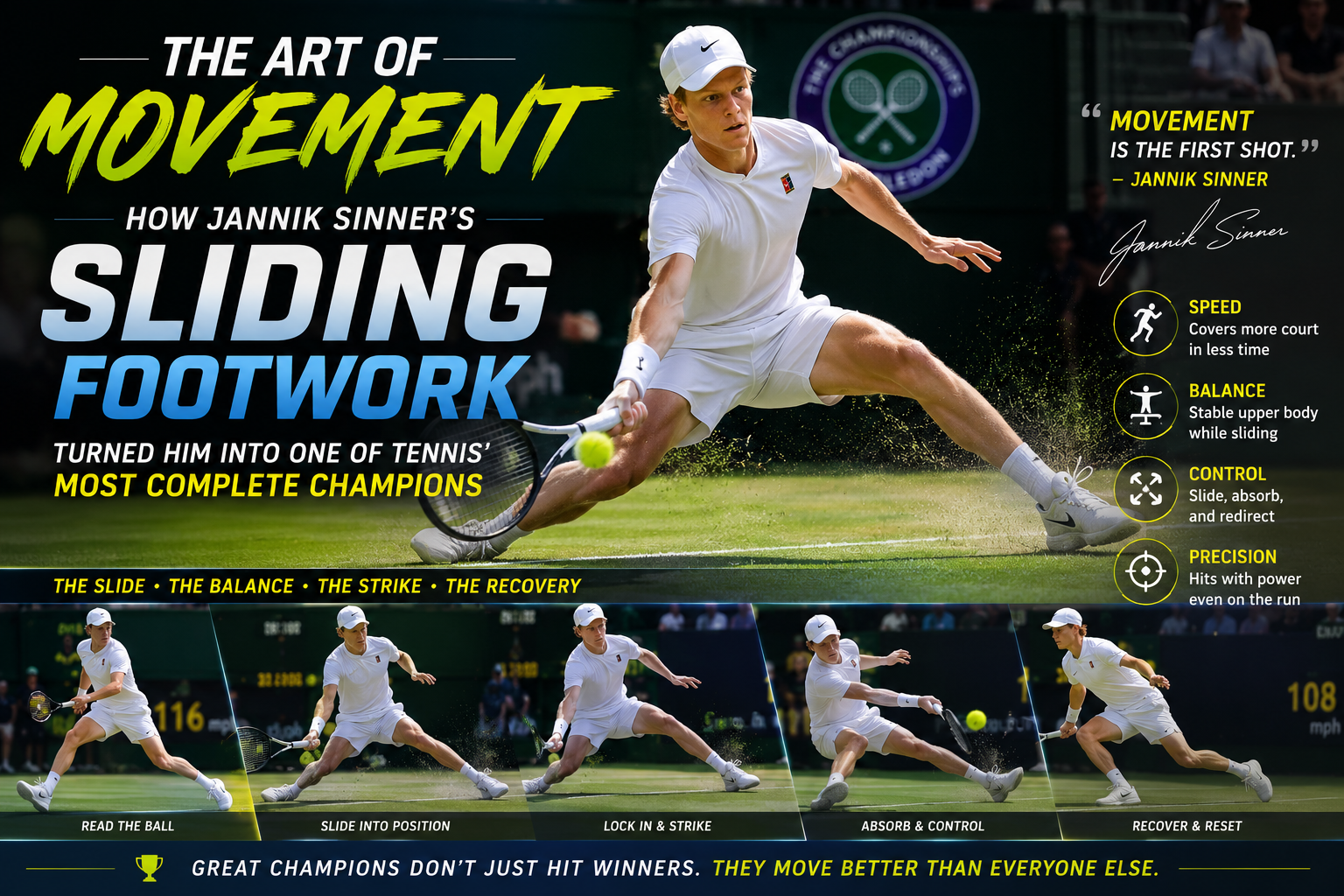
Instead of abruptly planting his foot after a sprint, he slides naturally into position.
The slide slows his body progressively while keeping him balanced for the next movement.
Rather than fighting momentum...
He uses it.
Elite Lateral Balance
One remarkable feature of Sinner's movement is how quiet his upper body remains.
Even while sliding at full speed, his head stays remarkably stable.
His shoulders remain level.
His torso stays upright.
This allows his eyes to track the ball with extraordinary precision.
That balance was refined long before professional tennis through years of alpine skiing, where maintaining posture while moving at high speed is essential.
Defensive Sliding: Turning Impossible Balls Into Playable Shots
When opponents stretch Sinner far outside the singles lines, many players would simply lunge.
Sinner does something different.
He slides.
Saving Precious Time
Traditional recovery requires multiple adjustment steps.
Every step costs time.
Sliding eliminates many of those extra movements.
Instead of:
Run...
Brake...
Adjust...
Plant...
Hit...
Sinner often performs:
Run...
Slide...
Strike...
Recover.
The difference may only be fractions of a second.
At professional speeds, those fractions determine whether a point continues or ends.
Protecting the Body
Stopping instantly places enormous stress on ankles, knees, and hips.
Sliding distributes those braking forces gradually across the court.
Rather than violently absorbing momentum through one joint, Sinner allows friction to reduce speed progressively.
This smoother deceleration not only helps recovery but may also reduce the impact of repeated abrupt stops during long matches, although it still requires excellent technique and physical conditioning.
Offensive Sliding: The Modern Revolution
Most players slide to survive.
Sinner slides to attack.
That distinction separates him from nearly everyone else on tour.
Creating a Stable Hitting Platform
One of the biggest challenges in tennis is generating power while running.
When players sprint full speed, their bodies often lean sideways.
Balance disappears.
Power disappears.
Control disappears.
Sinner solves this problem through sliding.
As he enters the shot, his outside leg becomes a stable anchor.
His slide widens his base of support.
Instead of reaching awkwardly, he arrives in a balanced position that allows his hips and shoulders to rotate freely.
Even while moving at full speed, he can still produce explosive forehands and backhands.
Redirecting Pace
Modern tennis rewards players who can use an opponent's pace rather than creating all of their own.
Sinner excels at this.
During a slide, his lower body remains remarkably stable while his upper body rotates smoothly through contact.
This allows him to redirect a fast incoming ball with incredible precision.
One moment he appears defensive.
The next moment he has driven a flat backhand down the line or a heavy cross-court forehand that instantly reverses the rally.
Defense becomes offense within a single movement.
Why Sliding on Hard Courts Is So Difficult
Sliding on clay is expected.
Sliding on hard courts is entirely different.
Hard courts provide less loose material, creating higher friction and greater demands on the body.
Without proper technique, attempting to slide can increase the risk of ankle, knee, or hip injuries.
That is why only a handful of elite players consistently use this movement pattern.
It requires exceptional timing, flexibility, strength, and body awareness.
Built for Modern Tennis
Standing approximately 6'4" (193 cm), Sinner combines height with remarkable mobility.
His long limbs help him cover enormous distances.
His lean frame allows rapid acceleration and deceleration.
Most importantly, his flexibility enables him to reach extreme positions while maintaining balance.
Physical size alone does not create elite movement.
His body has been developed specifically for modern tennis.
The Training Behind the Movement
Sinner's movement reflects years of highly specialized athletic preparation.
His training emphasizes:
- Hip mobility for greater range of motion.
- Ankle flexibility to safely absorb lateral forces.
- Core stability to keep the torso balanced during high-speed changes of direction.
- Single-leg strength for explosive recovery after wide slides.
- Dynamic balance drills that reinforce stability during movement.
These qualities allow him to perform movements that would be difficult—and potentially unsafe—for recreational players to imitate.
Why Opponents Feel Like the Court Is Smaller
One of Sinner's greatest tactical advantages is psychological.
Opponents often believe they have created an opening.
They hit a powerful angle.
They stretch him wide.
They expect a defensive reply.
Instead...
Sinner slides effortlessly into position and sends the ball back with equal or greater pace.
What looked like a winning shot suddenly becomes another neutral rally.
After experiencing this repeatedly, opponents begin taking greater risks to finish points.
Greater risks inevitably lead to more unforced errors.
This is how movement alone can influence the outcome of a match.
The Evolution of Modern Footwork
Tennis has evolved dramatically over the past two decades.
Today's champions must defend like sprinters, attack like power hitters, and recover with extraordinary efficiency.
Jannik Sinner represents the next stage of that evolution.
By combining the balance and edge control developed through alpine skiing with cutting-edge tennis biomechanics, he has transformed sliding from a defensive necessity into a complete tactical system.
Every slide has a purpose.
Every recovery creates another opportunity.
Every movement places him in position to dictate the next shot.
His footwork is not simply athletic—it is strategic.
In an era where matches are decided by the smallest margins, Sinner has shown that greatness begins not with the racket, but with the feet. His movement has become a masterclass in efficiency, precision, and intelligent adaptation, setting a new standard for the next generation of champions.