
By a USA Tennis Performance Analyst
Alex Eala has already achieved what many rising stars spend years chasing—a breakthrough title on the WTA Tour. Yet champions rarely stop after one trophy. They immediately ask one question:
"What's next?"
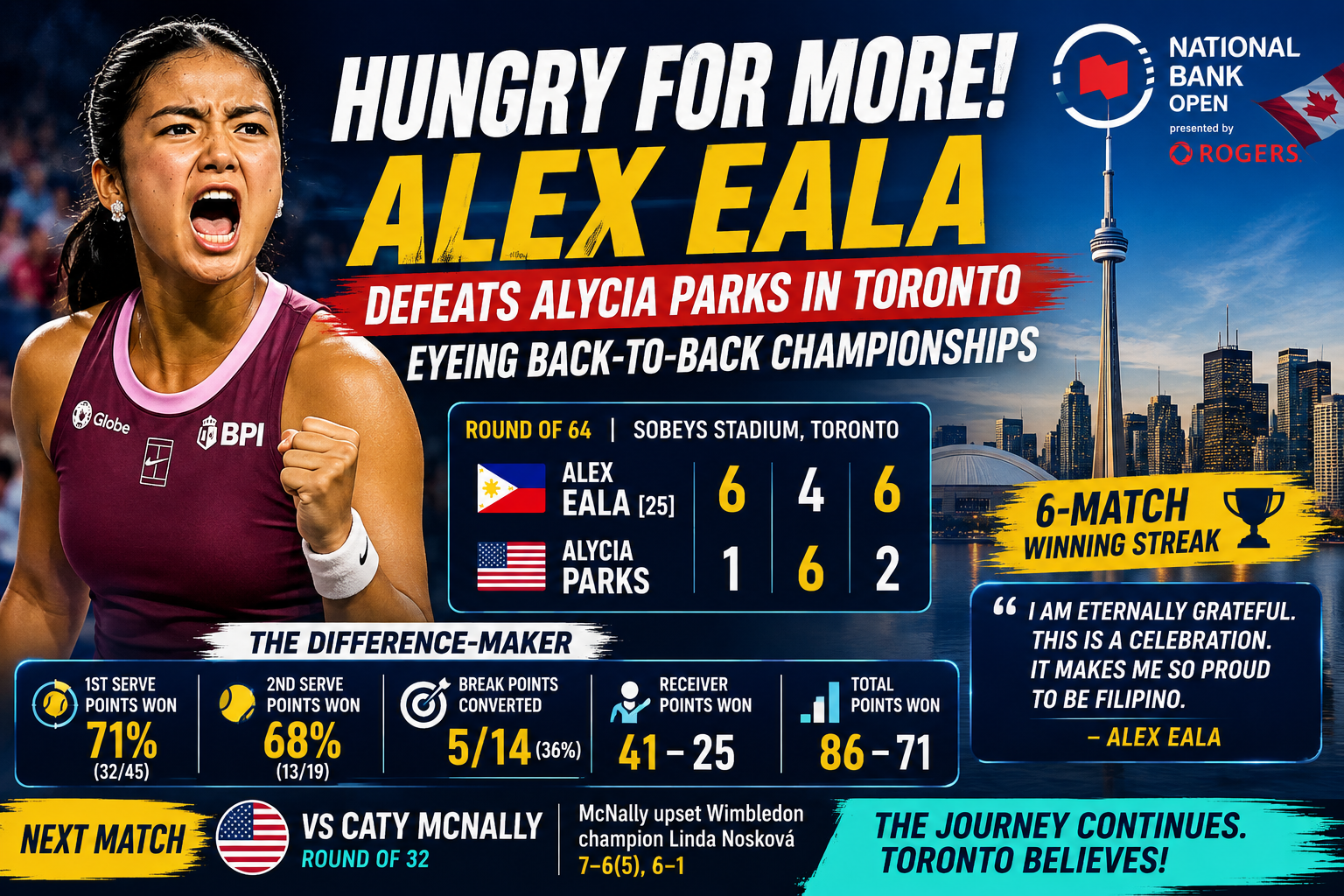
After defeating American Alycia Parks 6-1, 4-6, 6-2 in the second round of the National Bank Open in Toronto, Eala has put herself in position to make another deep run at one of the biggest tournaments outside the Grand Slams.
The bigger question now is whether she can capture back-to-back championships.
From a tennis analyst's perspective, the answer is simple:
Yes, she absolutely has a realistic chance.
However, winning a WTA 1000 requires surviving one of the toughest draws in professional tennis.
The Championship Momentum Is Real
Momentum matters in tennis.
Confidence cannot be measured on a scoreboard, but it changes everything.
Players begin serving bigger.
Decision-making becomes clearer.
Movement becomes lighter.
Pressure suddenly feels like opportunity.
That is exactly where Alex Eala currently finds herself.
Her Washington title was not merely a confidence boost.
It fundamentally changed how she walks onto the court.
She no longer looks like a player hoping she belongs among the elite.
She looks like someone expecting to win.
That psychological transformation is often the final step before consistent Top-20 success.
Revenge Shows Maturity
Alycia Parks defeated Eala earlier this season at the Australian Open.
Many young players carry those memories into rematches.
Instead, Eala approached Toronto with a completely different tactical blueprint.
Rather than attempting to overpower one of the biggest servers on tour, she focused on:
- Neutralizing serve pace.
- Extending rallies.
- Moving Parks side-to-side.
- Forcing uncomfortable second shots.
- Creating repeated break opportunities.
That is the hallmark of player development.
She didn't simply play better.
She solved the puzzle.
The Numbers Tell the Story
Statistics rarely lie over nearly two hours of tennis.
Statistic
Alex Eala
Alycia Parks
First Serve Points Won
71%
60%
Second Serve Points Won
68%
56%
Receiver Points Won
41
25
Total Points Won
86
71
Break Point Chances
14
2
These numbers reveal several encouraging signs.
Elite Return Game
Generating 14 break-point opportunities against one of the tour's biggest servers demonstrates outstanding anticipation, return positioning, and tactical discipline.
Elite returners create pressure even when they do not immediately convert break points.
That sustained pressure eventually wears opponents down.
Better Second-Serve Performance
Winning 68% of second-serve points is exceptional.
Second serves often determine who wins close matches.
When players consistently protect second serves, they remove one of the biggest opportunities opponents have to attack.
Total Point Differential
Winning 86 points to 71 indicates that Eala controlled the overall flow of the match rather than simply winning the biggest moments.
Over the course of a tournament, players who consistently post positive point differentials tend to make deep runs.
Why Her Game Is Built for Hard Courts
Toronto rewards complete players.
The surface is fast enough to reward aggressive tennis but slow enough for elite defenders to extend rallies.
That combination perfectly complements Eala's game.
She possesses:
- Heavy left-handed topspin.
- Excellent return of serve.
- Elite court coverage.
- Outstanding counterpunching.
- Improved offensive transitions.
Perhaps most importantly, she now finishes points more decisively than she did one year ago.
Instead of waiting for mistakes, she increasingly creates winners herself.
The Crowd Is Becoming a Real Advantage
One of the most overlooked aspects of Eala's recent success has been the atmosphere surrounding her matches.
Large Filipino communities have turned many North American tournaments into emotionally supportive environments for her.
That energy matters.
Crowd support cannot hit forehands.
It cannot serve aces.
But it can influence momentum.
Players often feed off positive energy during physically demanding matches, particularly in deciding sets.
Against Parks, the crowd's enthusiasm appeared to reinforce Eala's confidence during the final stages of the match.
Supportive crowds are helpful—but championships are ultimately won through execution. Eala's shot selection, movement, and tactical discipline remain the primary reasons for her success.
The Next Challenge: Caty McNally
The next obstacle will not be easy.
McNally enters the match full of confidence after stunning reigning Wimbledon champion Linda Nosková.
That victory demonstrated tremendous resilience.
McNally mixes:
- Slice backhands.
- Net attacks.
- Variety.
- Tactical creativity.
She plays a completely different style from Parks.
Eala will need another tactical adjustment.
Fortunately, adapting has become one of her greatest strengths.
Can Alex Eala Win the Toronto Championship?
Every tournament contains uncertainty, and a WTA 1000 draw features many world-class opponents. No analyst can reliably predict a champion before the Round of 32.
Based on her current form, the level she displayed in Washington, and her opening-round performance in Toronto, here is a reasoned assessment:
Estimated Chances (Opinion-Based Analysis)
- Reach Quarterfinals: 70%
- Reach Semifinals: 45–55%
- Reach the Final: 25–35%
- Win the Championship: 15–25%
These are analytical estimates rather than probabilities based on an official predictive model. They reflect current form, confidence, likely opposition, and the difficulty of winning multiple matches against elite players in a WTA 1000 event.
If Eala continues serving efficiently, returning at the level she showed against Parks, and making effective in-match adjustments, her chances would naturally improve with each round.
What Must Continue for a Title Run?
To lift the trophy in Toronto, several key elements need to remain consistent:
First-Serve Efficiency
Her first serve does not need overwhelming speed.
It needs consistent placement and a high percentage.
Return Pressure
Creating double-digit break opportunities every match forces opponents to play under constant stress.
Physical Recovery
Winning consecutive tournaments demands managing fatigue as much as beating opponents.
Recovery between matches may become one of the most important factors.
Tactical Flexibility
Every opponent presents a different challenge.
Champions adjust match by match.
Eala has shown growing confidence in doing exactly that.
Final Verdict
Alex Eala is no longer simply an exciting young talent—she is playing like a genuine contender. Her victory over Alycia Parks highlighted several encouraging signs: improved shot selection, better second-serve protection, tactical adaptability, and the composure to respond after dropping the second set.
Can she win the National Bank Open?
Yes. She has shown the level required to challenge any player in the draw.
Is she the favorite?
Not yet. The tournament still features multiple top-five players and former champions, and winning a WTA 1000 title requires sustaining elite tennis over several more rounds.
A semifinal appearance is certainly within reach if she maintains her current level, and a run to the final—or even the championship—cannot be ruled out. What is clear is that Eala has entered the conversation as a legitimate threat, and with each victory, belief in her title chances continues to grow.