
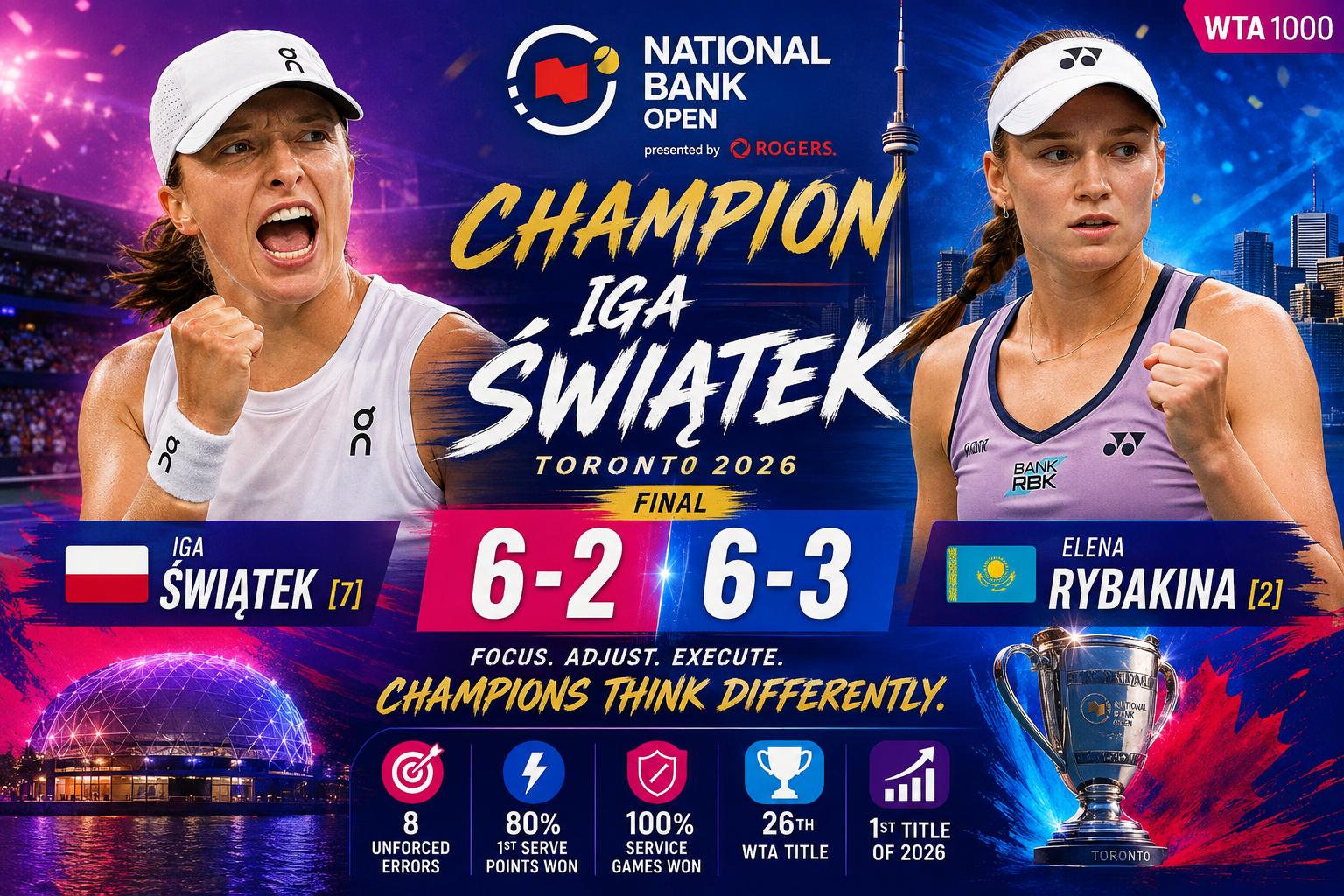
National Bank Open 2026 WTA 1000 Final — Toronto, Canada
Iga Świątek [7] def. Elena Rybakina [2], 6–2, 6–3
From a U.S. high-performance tennis perspective, this was not simply a straight-set victory. It was a championship-level demonstration of adjustment, discipline, and point-by-point control.
Iga Świątek entered the National Bank Open final carrying a very different story from Elena Rybakina. Świątek was playing her first final of the 2026 season, while Rybakina arrived as the No. 2 seed and Australian Open champion. Yet when the match began, ranking and reputation quickly became secondary.
Świątek did not try to overpower Rybakina.
She solved her.
The final ended 6–2, 6–3 in approximately 75 minutes, with Świątek winning her first title of the 2026 season and the 26th WTA title of her career.
The Story of the Match: From Pressure to Control
The biggest question before the final was simple:
Could Świątek prevent Rybakina from turning the match into a first-strike power contest?
Rybakina's tennis is extremely dangerous when she receives a comfortable ball and gets to unload her first two or three shots. Her serve creates immediate pressure, and her flat, penetrating groundstrokes can take time away from an opponent.
Świątek's solution was not to enter that battle blindly.
Instead, she built the match around three priorities:
- Make Rybakina hit under pressure.
- Take away comfortable attacking positions.
- Make every point physically and mentally demanding.
That strategy produced an extraordinary statistical difference.
Świątek made only 8 unforced errors, compared with 23 from Rybakina, while Świątek won 56 total points to Rybakina's 41. She also won 80% of her first-serve points and did not lose her serve.
That is the fingerprint of a player who controlled the match's structure.
Set One: Świątek Takes the Steering Wheel
The opening set was where the championship direction became clear.
Świątek broke immediately and refused to give Rybakina the comfortable scoreboard position she needed.
This was strategically important.
Against a player like Rybakina, allowing her to establish a rhythm at 1–0 or 2–1 can be dangerous. The server begins to feel comfortable, the first strike becomes more aggressive, and the opponent starts playing from behind.
Świątek reversed that dynamic immediately.
The adjustment
Instead of attempting to finish points too quickly, Świątek emphasized height, depth, movement, and repetition.
She wanted Rybakina to generate her own pace.
That is a critical high-level tennis principle:
Against a power player, don't give power players the perfect ball to attack.
Świątek's heavy groundstrokes forced Rybakina to repeatedly adjust her contact point.
When Rybakina was slightly late, the quality of her attacking shot dropped.
When her first strike missed, Świątek was already ready for the next ball.
The first set lasted only 29 minutes and finished 6–2.
At that moment, Świątek had done something extremely important:
She had turned Rybakina from an attacking player into a player trying to escape pressure.
The Serve: A Quiet Weapon
One of the most impressive aspects of Świątek's performance was her serving.
Her serve does not have to match Rybakina's raw velocity to be effective.
It needs to create uncertainty.
Świątek served at an 80% first-serve percentage and won 76% of those first-serve points. She also saved both break points she faced. Rybakina, meanwhile, landed only 57% of her first serves and faced five break points, converting just one.
This changed the tactical equation.
Świątek's serving objective
Rather than thinking:
"I need an ace."
The better objective was:
"I need a serve that prevents Elena from starting the point in control."
Placement became more important than pure speed.
A well-placed serve can produce a weak return.
A weak return allows the server to establish the rally.
And once Świątek established the rally, her movement and heavy groundstrokes became increasingly difficult to break down.
The Rybakina Problem: Power Without Rhythm
Rybakina's biggest weapon can also become a source of pressure.
Her game is built around taking time away.
But to do that consistently, she needs a stable contact zone.
Świątek repeatedly disrupted that zone.
Rybakina finished with 13 winners, actually three more than Świątek's 11. But winners alone did not determine this final.
The critical number was unforced errors: 23 to 8.
That difference tells the story.
Rybakina was forced to attempt difficult shots more often.
Świątek was able to play within a more reliable tactical framework.
This is why the match looked more one-sided than the winner count might suggest.
Set Two: Rybakina Searches for a Way Back
Championship matches are rarely won simply because the first set goes well.
The real test is what happens after the opponent changes strategy.
Rybakina needed a response.
She needed to shorten points.
She needed to protect her service games.
She needed to prevent Świątek from establishing long, repetitive patterns.
For a brief period, the second set became more competitive.
But Świątek did not panic.
That was one of the most important elements of her championship performance.
The 2–2 Adjustment
At 2–2 in the second set, Świątek found the decisive opening and broke again.
That was the moment the match effectively tilted back toward her.
The important point was not simply the break itself.
It was the timing.
Rybakina needed that game to establish belief.
Instead, Świątek took it away.
From a coaching perspective, this is what I call scoreboard pressure management.
When you're leading, you don't necessarily need spectacular tennis.
You need to prevent your opponent from creating momentum.
Świątek continued to make Rybakina work for every opportunity.
The result was a 6–3 second set and the championship.
The Championship Mindset
There was another layer to this victory.
Świątek did not arrive in Toronto having dominated the 2026 season.
She had experienced inconsistency and significant external pressure. Reuters reported that she had also dealt with media criticism and a coaching change earlier in the season.
That makes this title psychologically important.
A player can have the strokes.
A player can have the fitness.
A player can have the ranking.
But championship tennis requires something different:
the ability to stay committed to the plan when the match becomes emotionally uncomfortable.
Świątek demonstrated that quality throughout the final.
Game Control: The Four-Phase Formula
From a U.S. high-performance coaching perspective, Świątek's victory can be broken into four phases.
Phase 1 — Neutralize
Do not allow Rybakina to attack comfortably.
Use depth, spin and placement to create difficult contact.
Phase 2 — Move
Make Rybakina hit from different positions.
Do not repeatedly give her the same ball.
Phase 3 — Pressure
Once Rybakina's court position deteriorates, increase the pressure.
Attack the shorter ball.
Do not attack prematurely.
Phase 4 — Close
When ahead, eliminate unnecessary risk.
Make the opponent earn every point.
This is championship tennis.
Why Świątek Won the Tactical Battle
The final was essentially a battle between two different philosophies.
Rybakina:
- Serve big
- Take time away
- Strike early
- Finish quickly
Świątek:
- Return aggressively
- Create uncomfortable contact
- Use heavy spin and depth
- Move the opponent
- Wait for the correct attacking opportunity
The winning strategy was not necessarily more spectacular.
It was more repeatable.
Świątek repeatedly placed herself in situations where she could execute her strengths.
Rybakina was increasingly forced into lower-percentage situations.
That is why the error count became so decisive.
What Amateur Players Can Learn From This Final
There is an important lesson here for club players.
Many players believe winning means hitting harder.
It doesn't.
Winning often means making your opponent play the match you want.
If your opponent has a bigger serve, don't compete only on serve speed.
If your opponent hits harder, don't automatically hit harder.
Instead ask:
Where does my opponent dislike hitting from?
Which ball produces the weakest response?
Where does their movement break down?
What happens when I make them hit one more ball?
Świątek's Toronto final is an excellent example of this principle.
The Championship Focus
The most impressive part of this performance was not one spectacular forehand.
It was the absence of panic.
Świątek remained committed to the match plan.
She served effectively.
She returned aggressively.
She minimized errors.
She protected her serve.
She attacked at the correct moments.
And most importantly, she never allowed Rybakina to fully establish the match on Rybakina's terms.
That is what separates a good performance from a championship performance.
Final Assessment: A Complete Tactical Performance
Iga Świątek 6–2, 6–3 Elena Rybakina
Serve
Świątek: A
Excellent first-serve percentage and strong first-serve effectiveness. She did not surrender her serve.
Return
Świątek: A+
She consistently put Rybakina under scoreboard pressure and converted one of the most important tactical advantages of the match: forcing Rybakina to defend rather than attack.
Baseline game
Świątek: A+
Heavy, consistent and disciplined. The eight unforced errors were extraordinary in a final against a player of Rybakina's level.
Movement
Świątek: A+
Her ability to repeatedly recover and make Rybakina play additional shots was central to the match.
Mental game
Świątek: A+
The biggest victory may have been psychological. After a difficult 2026 season, she played the final with clarity rather than desperation.
Championship execution
Świątek: A+
She identified the tactical problem, applied the solution and maintained the strategy until the trophy was secured.
Final Word From a U.S. Tennis Expert
This was not simply a case of Iga Świątek playing better.
It was a case of Świątek controlling what kind of tennis was being played.
Rybakina entered the final with enormous weapons.
Świątek entered with a plan.
And on championship day, the plan won.
The 6–2, 6–3 scoreline reflects more than dominance. It reflects discipline under pressure, tactical adjustment, superior error management and championship-level focus.
For Świątek, the Toronto trophy is especially meaningful because it represents her first title of 2026 and her 26th career WTA title. It also provides a major confidence boost heading into the U.S. Open hard-court swing.
The message from Toronto is clear:
When Świątek combines her physical intensity with controlled decision-making, she doesn't just play the match. She controls the match.
And that is exactly the kind of tennis required to win championships.