
Tennis Doctor & Tennis Expert Guide
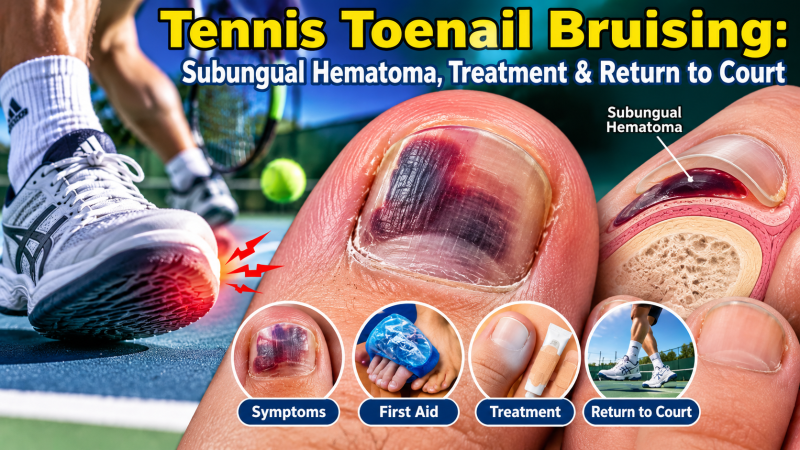
If you've ever finished a long tennis session and discovered that one of your toenails has turned dark purple, red, brown, or black, you may have experienced a subungual hematoma—commonly called a bruised toenail.
For tennis players, this isn't always caused by one dramatic injury.
Sometimes the problem develops gradually from thousands of small impacts as your toes repeatedly slide forward inside your tennis shoes during sprints, split steps, sudden stops, and aggressive changes of direction.
The result can be pressure, throbbing pain and eventually discoloration underneath the toenail.
The good news is that most uncomplicated subungual hematomas heal without major complications.
Quick Overview
A subungual hematoma occurs when blood collects underneath the nail after trauma.
For tennis players, there are two major mechanisms:
Acute Trauma
A sudden impact, such as:
-
Stubbing your toe
-
Dropping something on your foot
-
Hitting the toe against a hard object
-
A significant impact during sport
Repetitive Tennis Trauma
This is especially important for tennis players.
During aggressive court movement, your foot can slide forward inside the shoe. Your toes repeatedly contact the front of the toe box.
Over time:
Forward sliding → repeated impact → nail-bed trauma → bleeding underneath the nail.
This is sometimes described as a "runner's toenail" in endurance athletes, but the same basic mechanism can occur during sports involving repetitive stopping and directional changes.
What Does a Bruised Toenail Look Like?
1. Nail Discoloration
The first obvious sign is usually a color change underneath the nail.
It can progress from:
Red → purple → dark brown → black
as the blood changes and clots.
The discoloration may cover only a small portion of the nail or a much larger area.
2. Throbbing Pain and Pressure
One of the classic symptoms is pressure beneath the nail.
The nail plate is relatively rigid, so blood collecting underneath it can create pressure and pain.
You may notice:
-
Throbbing
-
Aching
-
Sharp tenderness
-
Pain when wearing tennis shoes
-
Pain when pushing off
-
Discomfort when pressing the nail
A painful hematoma can be particularly annoying because every step repeatedly compresses the injured area.
3. Nail Loosening
A significant injury can cause the nail to partially or completely separate from the nail bed.
Don't panic if the damaged nail eventually falls off.
A new nail can grow underneath it, although toenails grow slowly, so complete replacement can take months.
Why Tennis Players Get Bruised Toenails
1. Your Toes Are Hitting the Front of the Shoe
This is one of the biggest tennis-specific mechanisms.
Imagine:
Split step → sprint → emergency stop → toes slide forward.
Now repeat that hundreds of times.
If your shoe doesn't hold the heel securely, your foot can repeatedly move forward and your toes can repeatedly strike the front of the shoe.
That repeated micro-trauma can eventually damage the nail bed.
2. Tennis Shoes That Are Too Short
A shoe can feel comfortable when you're standing still and still be too short during tennis.
Remember:
Your feet expand and your movement changes when you exercise.
You need enough room in front of the longest toe while maintaining a secure heel.
A properly fitted tennis shoe should allow adequate toe room without allowing excessive forward sliding.
3. Poor Heel Lock
If your heel isn't securely held inside the shoe, the entire foot can move forward during sudden deceleration.
This is why learning a heel-lock or runner's-knot lacing technique can be useful for players who experience excessive forward movement.
The objective is simple:
Keep the heel stable → reduce forward foot movement → reduce toe impact.
4. Toenails That Are Too Long
Long toenails can repeatedly contact the front of the shoe.
For tennis players who train frequently, keeping toenails appropriately trimmed can reduce unnecessary pressure.
Avoid cutting them extremely short or aggressively into the corners.
What If Only One Toenail Turns Black?
If it happens immediately after a tennis session and you remember repeated pressure or trauma, a subungual hematoma is a reasonable possibility.
But a dark nail should not automatically be assumed to be trauma.
A dark streak or pigmentation that:
-
Develops without an obvious injury
-
Persists without moving outward as the nail grows
-
Has an unusual pattern
-
Extends onto the surrounding skin
-
Changes progressively
may require examination to rule out other causes, including subungual melanoma, a rare form of nail melanoma.
How Is a Subungual Hematoma Diagnosed?
Most uncomplicated cases can be diagnosed through:
Medical History
A clinician may ask:
-
Did you recently play tennis?
-
Was there a direct impact?
-
Did you change tennis shoes?
-
Are the shoes too short?
-
How long has the discoloration been present?
-
Is there significant pain?
Physical Examination
The clinician examines:
-
Nail color
-
Nail attachment
-
Surrounding skin
-
Swelling
-
Tenderness
-
Signs of infection
-
Possible nail-bed injury
X-Ray
An X-ray may be appropriate if there was significant trauma or concern about an underlying toe fracture.
Treatment: What Should a Tennis Player Do?
Small and Painless Hematoma
If the discoloration is small and you're experiencing little or no pain, treatment may simply be:
Protect it and let it grow out.
Many uncomplicated bruised nails heal without intervention.
The discoloration will gradually move toward the end of the nail as the nail grows.
What If the Nail Is Extremely Painful?
This is where medical treatment can make a significant difference.
A painful acute subungual hematoma may be treated with nail trephination.
Trephination involves a healthcare professional creating a small opening in the nail plate so the trapped blood can drain and pressure can decrease.
Important Tennis Doctor Warning
Don't drill, puncture or burn your toenail at home.
Online videos may make this look simple, but inappropriate technique can cause infection or additional injury.
Cleveland Clinic specifically advises that subungual hematoma drainage should be performed by a healthcare provider.
When Should You Consider Medical Evaluation?
Seek medical assessment when:
-
Pain is severe or increasing
-
The hematoma is extensive
-
The toe is significantly swollen
-
You cannot comfortably walk
-
The nail is badly damaged or detached
-
You suspect a fracture
-
There is an open wound
-
You develop increasing redness or warmth
-
Pus develops
-
You develop fever
-
The discoloration appeared without obvious trauma
A clinician can determine whether the injury is simply a hematoma or whether there is an associated fracture, nail-bed injury or another condition.
Can I Put Ice on It?
For a fresh traumatic injury, wrapped ice can help reduce pain and swelling.
Never put ice directly against the skin.
Use a cloth barrier and short applications rather than prolonged exposure.
What About Ibuprofen?
An over-the-counter pain reliever may help some people with acute discomfort.
However, medications such as ibuprofen aren't appropriate for everyone.
Consider factors such as:
-
Kidney disease
-
Stomach ulcers
-
Blood-thinning medication
-
Certain cardiovascular conditions
-
Allergies
-
Other medications
If you're unsure, ask a doctor or pharmacist before taking an NSAID.
How to Prevent Tennis Toenail Bruising
This is where tennis players can make the biggest difference.
1. Check Your Shoe Length
You want adequate room in front of the longest toe.
But don't simply buy a much larger shoe.
A shoe that is too large can allow excessive foot movement and create other friction problems.
The goal:
Enough toe room + secure heel + appropriate width.
2. Check Your Shoe Width
If your toes are being squeezed together, the problem may not be length.
It may be width.
Players with wider forefeet may need a wide-fit tennis shoe.
Your toes should have enough room to spread naturally without being compressed against one another.
3. Use a Heel-Lock Lacing Technique
A heel-lock or runner's-knot technique can help reduce forward movement of the foot inside the shoe.
This can be particularly useful for players who experience repeated toe jamming during:
-
Hard stops
-
Baseline sprints
-
Direction changes
-
Sliding
-
Long matches
4. Trim Your Toenails Properly
Keep toenails at a moderate length.
Avoid allowing them to become long enough to repeatedly contact the front of your tennis shoe.
5. Choose Appropriate Tennis Socks
Look for socks that:
-
Fit securely
-
Don't bunch up
-
Manage moisture
-
Reduce excessive sliding
-
Provide appropriate cushioning
A good sock should work together with your shoe—not create additional movement inside it.
Tennis Doctor's Shoe Test
Before blaming your toenails, test your tennis shoes.
Stand normally.
Then perform:
Split step → forward sprint → sudden stop → lateral cut.
Ask yourself:
Are my toes repeatedly hitting the front of the shoe?
If yes, investigate:
-
Shoe length
-
Shoe width
-
Heel lockdown
-
Lacing technique
-
Sock thickness
-
Foot swelling during prolonged play
Sometimes the solution isn't another painkiller.
It's fixing the shoe-foot interface.
Returning to Tennis After a Bruised Toenail
You don't necessarily have to wait for the nail to look completely normal.
The more important question is:
Can your toe tolerate tennis movement without significant pain or further trauma?
Stage 1 — Normal Walking
You should be able to walk comfortably.
If every step causes significant throbbing, you're not ready for intense tennis.
Stage 2 — Tennis Shoes
Put on your tennis shoes and walk around.
Check:
-
Toe pressure
-
Nail tenderness
-
Forward sliding
-
Shoe fit
If the shoe immediately causes significant pain, don't ignore it.
Stage 3 — Light Court Movement
Begin with:
-
Easy walking
-
Gentle footwork
-
Light split steps
-
Short movement drills
Avoid immediately testing yourself with maximum-speed sprints.
Stage 4 — Controlled Tennis
Progress to:
-
Mini-tennis
-
Easy groundstrokes
-
Short rallies
-
Controlled court movement
Monitor the toe afterward.
Stage 5 — Full Tennis
Return to aggressive:
-
Baseline movement
-
Hard stops
-
Rapid direction changes
-
Sliding
-
Competitive matches
only when the toe tolerates the workload without significant pain.
Protecting the Toe During Your Return
If the toe remains sensitive, appropriate padding or a protective toe covering may reduce contact with the shoe.
But don't use bulky padding that makes the shoe excessively tight.
Remember:
Protection should reduce pressure—not create more pressure.
What Happens to the Nail After the Injury?
The dark discoloration doesn't disappear overnight.
Instead, the damaged area generally moves toward the end of the nail as the nail grows.
A toenail grows relatively slowly, so the nail may take several months to completely replace the damaged portion.
The important thing is that the discoloration should behave like a nail injury as it grows outward.
If a dark area remains fixed near the base of the nail or develops without an obvious injury, have it evaluated.
Tennis Expert's Prevention Checklist
Before your next long tennis session:
☑ Adequate toe-box space
☑ Secure heel fit
☑ Correct shoe width
☑ Proper heel-lock lacing
☑ Toenails trimmed appropriately
☑ Comfortable moisture-managing socks
☑ No repeated toe jamming
☑ No new shoe used immediately for a major match
☑ Check your toes after long sessions
The Tennis Doctor's Bottom Line
A bruised toenail may seem like a cosmetic problem, but for a tennis player it can become a genuine performance problem when pressure and pain interfere with movement.
The key is to understand why the toe was repeatedly traumatized.
If your toes are constantly hitting the front of your shoe, don't simply treat the bruised nail.
Fix the cause.
Think:
Better shoe fit → better heel lockdown → less forward sliding → less toe trauma → healthier toenails → better movement.
And remember:
Your feet are the foundation of your tennis game. If your toes hurt, your footwork suffers—and when your footwork suffers, your entire game can change.
Medical Disclaimer
This article is for general educational purposes and does not replace an examination by a qualified healthcare professional. Severe pain, significant swelling, suspected fracture, nail-bed injury, infection, or unexplained persistent nail discoloration should be evaluated by a medical professional.