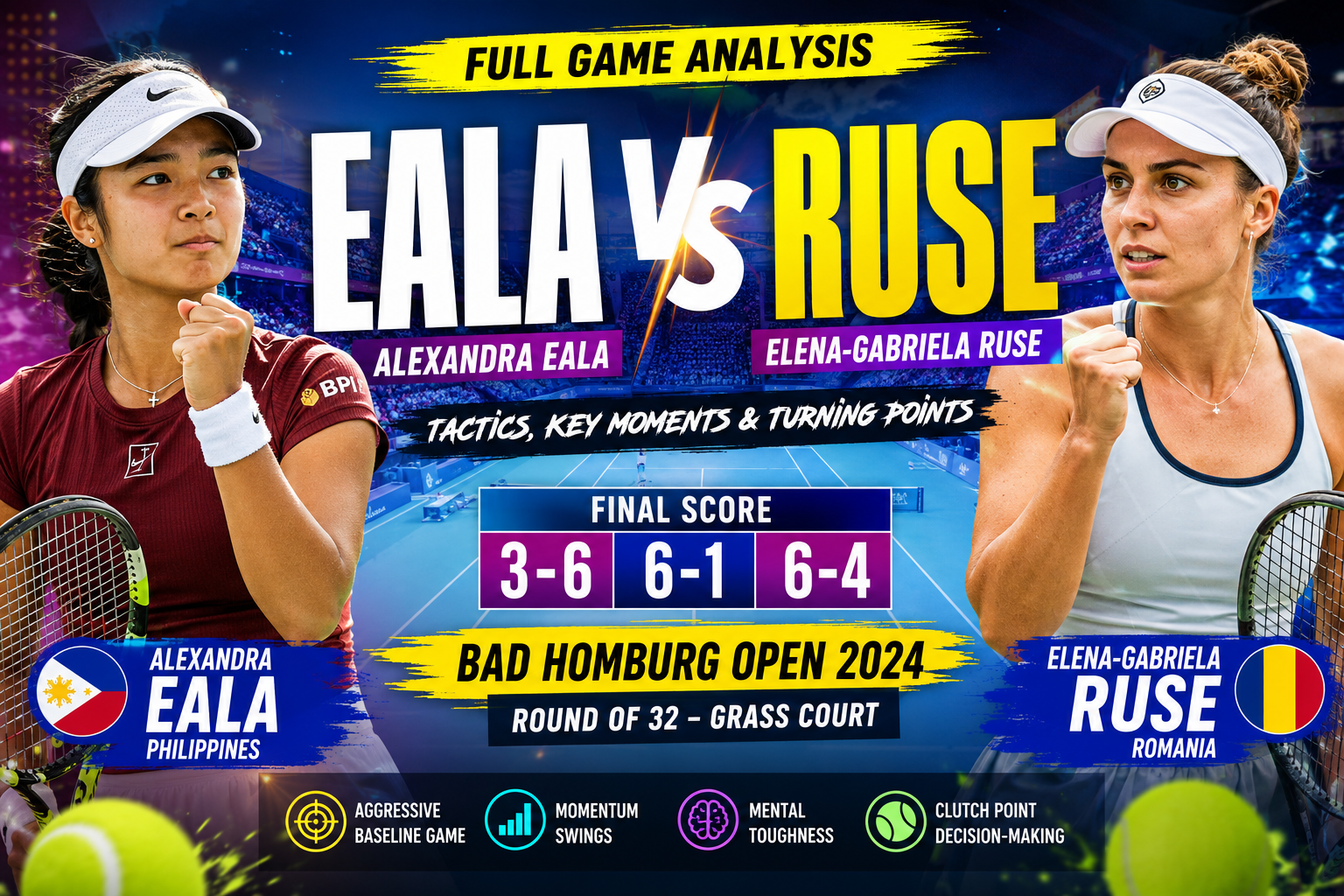
The Alexandra Eala vs. Elena-Gabriela Ruse match at the 2024 US Open qualifying tournament was one of the most dramatic matches of Eala's early professional career.
Eala entered the third and final qualifying round with an opportunity to reach her first Grand Slam main draw. Ruse, the No. 20 qualifying seed and a former world No. 51, stood between the young Filipina and that breakthrough.
Final result:
Elena-Gabriela Ruse defeated Alexandra Eala 3–6, 6–1, 6–4
The match lasted approximately 2 hours and 8 minutes and was played on the hard courts of the USTA Billie Jean King National Tennis Center in New York.
The score tells the basic story, but it does not fully explain how the match changed direction.
This was essentially a three-stage contest: Eala controlled the opening, Ruse completely changed the momentum in the second set, and Eala fought back in the third before Ruse's experience and pressure management decided the final stretch.
First Set: Eala Establishes Control
Eala started the match with excellent competitive intensity.
The opening games were closely contested, with both players looking to establish control of the baseline. Eala gradually became more comfortable with the pace and began finding the range on her groundstrokes.
Her left-handed game created a particularly interesting tactical problem for Ruse.
Eala's ability to create angles from the left side of the court allowed her to move Ruse laterally and then attack the open court. Rather than simply trying to overpower the Romanian, Eala was using court positioning and directional changes to construct points.
Once Eala established her rhythm, she was able to put Ruse under increasing pressure.
The critical development was that Eala became the player dictating the first shot after the serve.
That is extremely important on a hard court.
When a player can serve, receive the next ball in a comfortable position and immediately take control of the rally, the opponent is forced into defensive positioning.
Eala eventually took the first set 6–3.
Expert assessment
From a coaching perspective, Eala's first-set performance demonstrated three important strengths:
- aggressive baseline positioning
- ability to redirect the ball effectively
- confidence attacking after the serve
She was not simply waiting for Ruse to make mistakes.
She was creating pressure.
Second Set: Ruse Changes the Match
The second set was the turning point.
Ruse responded with a completely different level of intensity.
Instead of allowing Eala to dictate from the baseline, the Romanian increased the pressure on Eala's service games and began taking control of rallies much earlier.
The scoreboard quickly reflected the tactical change.
Ruse raced to a 4–0 lead.
That was a major psychological shift.
Eala was suddenly forced to play from behind rather than control the direction of the match.
Ruse's experience became particularly important here. She had already reached a career-high ranking of No. 51 and was significantly more experienced in professional Grand Slam qualifying situations.
Eala did not simply collapse.
At 4–1, she received medical attention for what was reported as discomfort around the hip area, adding another physical and tactical complication to the match.
Ruse nevertheless maintained her pressure and closed the second set 6–1.
The match was now completely reset.
What Ruse Did Better in the Second Set
The most important tactical adjustment was pressure on Eala's second phase of the rally.
Ruse was not allowing Eala to comfortably establish her preferred baseline pattern.
That forced Eala into more difficult positions.
When a player is pushed backward or forced to hit while moving, three things can happen:
- Shot depth decreases.
- Error probability increases.
- The opponent receives a shorter ball to attack.
That sequence appeared repeatedly during Ruse's second-set comeback.
The Romanian also demonstrated an important professional skill: momentum management.
After losing the first set, Ruse did not become rushed.
She reset the match and played with greater authority.
That is often the difference between a promising young player and a seasoned professional in a pressure match.
Third Set: Eala Fights Back
The deciding set became much more competitive.
Eala recovered from the second-set setback and found enough rhythm to make the match a genuine contest again.
This is one of the most encouraging aspects of the performance.
After losing a set 6–1, a young player can easily lose emotional control.
Eala did not.
Instead, she continued competing and forced Ruse to earn the victory.
The third set eventually went to Ruse 6–4.
That final set is important when evaluating Eala's performance.
The result was a loss, but the match was not simply a case of an experienced player overwhelming a younger opponent from beginning to end.
Eala won the opening set, lost control in the second, then recovered sufficiently to challenge Ruse again in the third.
The Biggest Tactical Battle: Who Controlled the Baseline?
The central tactical question was simple:
Who could dictate the first two or three shots of each rally?
When Eala controlled that sequence, she looked dangerous.
When Ruse controlled it, Eala was forced into defensive tennis.
This is especially important for Eala because her game is built around aggressive baseline tennis and creating openings with pace and angles.
Her objective should be to avoid getting trapped into long defensive exchanges.
Ruse's objective was essentially the opposite.
The Romanian benefited when she could make Eala hit one more ball from an uncomfortable position.
That battle eventually favored Ruse often enough to decide the match.
Serve and Return Battle
The serve itself was not the only issue.
The more important factor was what happened after the serve.
For Eala, the ideal sequence was:
Serve → aggressive first groundstroke → move Ruse → attack open court.
For Ruse, the objective was to disrupt that pattern.
A strong return or deep second ball prevented Eala from immediately taking control.
That changed the geometry of the rally.
This is a valuable lesson for developing players: tennis matches are often decided not by spectacular winners, but by who controls the first three shots.
Mental Game Analysis
This match also provides an excellent example of competitive maturity.
Eala was playing for a major milestone: a place in the US Open main draw.
That creates enormous psychological pressure.
She had already won two qualifying matches, defeating Maddison Inglis and then Nuria Parrizas Diaz to reach the final qualifying round.
The opportunity was therefore very real.
But Ruse had been in similar professional situations before.
The Romanian's ability to recover from losing the first set demonstrated strong emotional control.
For Eala, the match was valuable because it exposed an important area of development:
How do you maintain your tactical identity after the opponent suddenly changes the momentum?
That skill becomes increasingly important as a player moves deeper into the WTA Tour.
Why Ruse Won
From an expert perspective, Ruse's victory can be attributed to four major factors.
1. She changed the match after losing the first set
Ruse did not continue playing the same tactical match.
She increased the pressure and disrupted Eala's rhythm.
2. She controlled the second set
The 6–1 second set was the decisive momentum swing.
It gave Ruse both scoreboard control and psychological confidence.
3. She handled the deciding set better
Eala recovered, but Ruse maintained enough control to close the match 6–4.
4. Experience mattered
Ruse was a former Top-51 player and the No. 20 seed in qualifying. Eala was still developing her professional game.
In a match where momentum repeatedly changed, that experience became valuable.
What Eala Could Learn From This Match
The loss was painful, but technically it was an extremely useful match for Eala.
1. Protect momentum after winning a set
Winning the first set is only half the job.
The beginning of the second set is often one of the most dangerous periods because the opponent is likely to make tactical adjustments.
Eala needs to recognize that transition earlier.
2. Improve the response to pressure on serve
When an opponent begins attacking the serve, the player needs a reliable second pattern.
That could involve changing serve placement, increasing margin over the net or using a more conservative first ball.
3. Avoid allowing the opponent to dictate the rally
Eala's best tennis comes when she is taking the ball aggressively and controlling court position.
The more she is forced backward, the more difficult her game becomes.
4. Continue developing physical resilience
The reported hip discomfort during the second set added another challenge. Developing physical conditioning and recovery strategies is particularly important for a young player transitioning into the demands of the WTA Tour.
Bigger Picture: Why This Match Matters Today
Looking back at the match from the perspective of Eala's development, the result has a very different meaning.
In 2024, Eala was still trying to reach her first Grand Slam main draw.
By 2026, she had become a significantly more established WTA player.
Her development included a breakthrough run at Wimbledon, where she reached the fourth round, followed by a historic Washington Open title in August 2026. She defeated Jessica Pegula in the final to become the first player from the Philippines to win a WTA Tour-level singles title.
That progression makes the Ruse match particularly interesting.
The young Eala who struggled to close out the 2024 US Open qualifying match is not the same player competing at the top level in 2026.
Her ability to defeat elite opponents and handle pressure has developed dramatically.
Final Expert Verdict
Elena-Gabriela Ruse defeated Alexandra Eala 3–6, 6–1, 6–4.
But the most important lesson is not the final score.
The match demonstrated the difference between starting strongly and sustaining tactical control for three sets.
Eala showed that she had the weapons to trouble an experienced professional. Her first-set tennis was aggressive, composed and effective.
Ruse showed why experience matters.
After losing the opening set, she changed the rhythm, increased pressure on Eala and forced the young Filipina to play outside her preferred patterns.
For Eala, this was not simply a missed opportunity.
It was a valuable developmental match.
Two years later, her career trajectory shows how much she learned from matches like this.
The 2024 defeat against Ruse was a setback.
The 2026 Eala is a much more complete competitor.
And that is perhaps the most important story behind this match.