Quick Overview
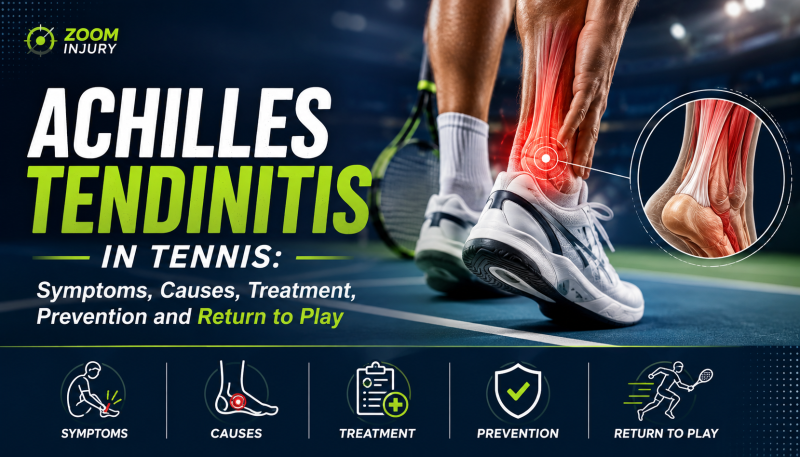
Achilles tendinitis is an overuse injury affecting the Achilles tendon, the strong band of tissue connecting the calf muscles to the heel bone. In tennis, the tendon is repeatedly loaded during sprinting, sudden stops, lunges, jumping and pushing off for the next shot.
The condition often develops gradually rather than from one obvious injury. Early treatment is important because continuing to play through increasing Achilles pain can worsen the tendon and prolong recovery.
Achilles tendinitis is sometimes referred to as Achilles tendinopathy, particularly when symptoms have been present for a longer period and involve changes in the tendon rather than simple inflammation.
Symptoms
Common symptoms include:
- Pain or stiffness at the back of the ankle or lower calf
- Pain when starting to walk or exercise, particularly after rest
- Tenderness when pressing on the Achilles tendon
- Stiffness in the morning
- Pain during running, jumping or pushing off
- Swelling or thickening of the tendon
- Increased pain after tennis rather than during the early stages of activity
- Reduced ability to accelerate, stop or change direction comfortably
A tennis player may initially notice only mild discomfort during warm-up. If the workload continues to increase, the pain can become more persistent.
Sudden severe Achilles pain, a popping sensation, or difficulty pushing off or walking requires urgent medical assessment because an Achilles tendon rupture may have occurred.
Causes
Tennis places considerable stress on the Achilles tendon. Common contributing factors include:
Sudden Increase in Training
Rapidly increasing court time, match frequency, running or conditioning can overload the tendon before it has adapted.
Repeated Sprinting and Direction Changes
Explosive acceleration, deceleration and lateral movement place substantial loads through the calf-Achilles complex.
Tight or Weak Calf Muscles
Limited calf flexibility or inadequate calf strength can increase the demands placed on the Achilles tendon.
Poor Training Progression
Returning to tennis too quickly after an injury or taking a long break and immediately training at previous intensity can contribute to tendon overload.
Footwear and Court Factors
Changing tennis shoes, playing on a different court surface, or using worn-out footwear can alter the loads experienced by the lower leg.
Age and Tendon Adaptation
Tendons generally become less tolerant of sudden high loads with age. This does not mean older players should avoid tennis, but workload progression becomes particularly important.
Diagnosis
Achilles tendinitis is usually diagnosed through a medical history and physical examination.
A healthcare professional may assess:
- The location and pattern of pain
- Achilles tendon tenderness and thickening
- Calf strength
- Ankle movement
- Ability to perform heel raises
- Walking, running and jumping mechanics
- Training history and recent changes in workload
Ultrasound or MRI may sometimes be used when the diagnosis is uncertain, symptoms are persistent, or a more serious tendon injury needs to be investigated.
Treatment
Treatment depends on the severity and duration of symptoms.
1. Reduce Irritating Activities
Temporarily reduce activities that significantly increase Achilles pain, particularly:
- Sprinting
- Jumping
- Repeated lunging
- High-intensity tennis
- Hill running
- Explosive conditioning
Complete rest is not always necessary. The goal is generally to reduce excessive tendon loading while maintaining appropriate activity.
2. Progressive Calf Strengthening
Strength rehabilitation is one of the most important parts of recovery.
A rehabilitation program may progress through:
- Isometric calf exercises
- Double-leg heel raises
- Single-leg heel raises
- Slow controlled calf strengthening
- Heavier resistance exercises
- Sport-specific explosive exercises
The progression should be individualized according to symptoms, strength and functional ability.
3. Manage Training Load
Once symptoms begin improving, tennis activity should gradually increase rather than jumping immediately back to full match intensity.
A useful principle is:
Increase load progressively → monitor symptoms → allow recovery → increase again.
4. Pain Management
Ice or other short-term pain-relief strategies may help some players manage symptoms, but they should not replace rehabilitation.
Medication should be discussed with an appropriate healthcare professional, particularly if pain is persistent or significant.
5. Address Contributing Factors
A rehabilitation professional may evaluate:
- Calf strength
- Ankle mobility
- Lower-limb strength
- Movement mechanics
- Tennis workload
- Footwear
- Training surfaces
- Recovery between sessions
Prevention
Tennis players can reduce their risk by gradually developing the capacity of the Achilles tendon.
Warm Up Properly
Before tennis, progressively increase intensity with:
- Easy jogging
- Dynamic calf movements
- Controlled skipping
- Tennis-specific movement
- Short progressive accelerations
Strengthen the Calves
Regular calf strengthening can help the tendon tolerate the high forces associated with tennis.
Include both straight-knee and bent-knee calf exercises to train different parts of the calf complex.
Increase Training Gradually
Avoid suddenly doubling court time, running volume or match frequency.
After a long break, rebuild gradually instead of immediately returning to previous training intensity.
Recover Between Hard Sessions
Allow adequate recovery after intense matches, sprint sessions and jumping workouts.
Maintain Appropriate Tennis Footwear
Use tennis shoes appropriate for the court surface and replace heavily worn footwear.
Return to Tennis
Returning to tennis should be based on function and tolerance, not simply the number of days since the injury.
Before returning to full competition, a player should generally be able to perform progressively demanding activities without significant worsening of symptoms.
A typical progression might be:
Stage 1 — Rehabilitation
Calf strengthening and controlled lower-leg exercises.
Stage 2 — Court Movement
Easy hitting with limited movement and intensity.
Stage 3 — Controlled Tennis
Progressively increase court coverage, acceleration and change of direction.
Stage 4 — High-Intensity Training
Introduce harder rallies, repeated sprints, lunges and explosive movements.
Stage 5 — Match Play
Begin with controlled or shorter matches before returning to unrestricted competition.
The player should monitor symptoms during activity and particularly over the following 24 hours. A significant increase in pain or stiffness may indicate that the workload has progressed too quickly.
Many tennis players never take the time to learn about common tennis injuries. They may ignore early pain, continue playing, and allow a small problem to become a much more serious injury.
Educate yourself about tennis injuries. Understanding the symptoms, causes, treatment and proper return-to-play process can help you make better decisions and support a safer, stronger recovery.
Listen to your body, learn about your injury, and give it the right time and care to heal.
Important Warning
Do not try to "play through" worsening Achilles pain. Persistent or increasing symptoms should be assessed by a sports medicine professional or physiotherapist. Sudden Achilles pain with a pop, major swelling, or inability to push off the foot is an emergency requiring prompt medical evaluation.
Bottom line: Achilles tendinitis in tennis is usually a load-management and rehabilitation problem. Gradual strengthening, sensible training progression and a carefully controlled return to court are more important than simply resting until the pain disappears.