
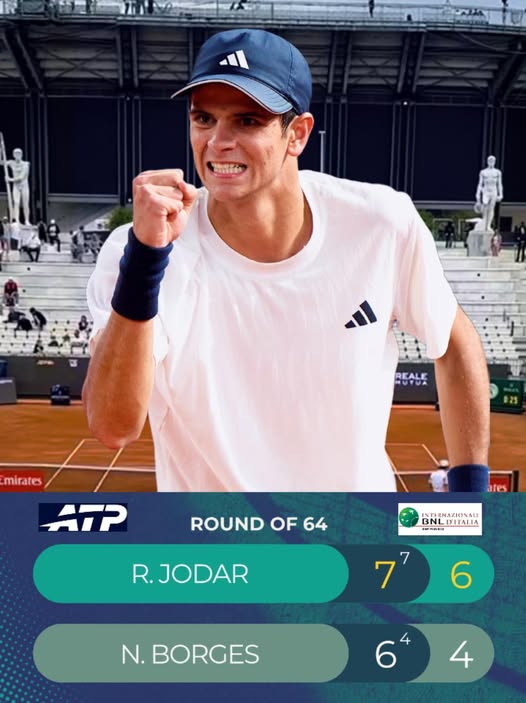
Rafael Jodar may still be early in his professional journey, but inside the tennis world, more coaches and analysts are starting to whisper the same thing:
“This kid has the structure and movement of a future elite player.”
After battling through a difficult opening set, Jodar defeated Nuno Borges 7-6, 6-4 to advance into the Round of 32 at the Italian Open. On paper, it looked like a solid win. But deeper tennis analysis reveals something more important than the score itself.
Jodar showed composure.
He showed physical endurance.
Most importantly, he showed the kind of calm competitive behavior often seen in future top-level champions.
The match against Borges became another reminder that the younger generation is arriving fast, and Rafael Jodar may become one of the most dangerous long-term projects in world tenniz.
The Match Was Tougher Than the Score Suggests
The opening set revealed the true difficulty of the battle.
Borges came out aggressive:
- attacking early returns
- stepping inside the baseline
- forcing fast exchanges
- testing Jodar’s movement immediately
For many young players, this kind of pressure creates panic.
But Jodar remained patient.
Instead of forcing risky winners, he accepted long rallies and gradually settled into the pace of the match. That maturity became the turning point of the first set.
The tiebreak especially revealed his growing mental strength.
Young players often rush points under pressure. Jodar did the opposite:
- he controlled rally tempo
- used safe margin over the net
- waited for the correct opening
- stayed balanced emotionally
Winning the first set 7-6 may have changed the entire emotional direction of the match.
Once he gained confidence, his body language became noticeably stronger entering the second set.
Why Coaches Are Comparing His Physical Structure to Djokovic and Sinner
Some tennis fans immediately noticed something familiar when watching Jodar move around the court.
His body structure resembles the modern elite athletic model seen in players like:
- Novak Djokovic
- Jannik Sinner
Not identical — but similar in important ways.
Jodar possesses:
- long athletic limbs
- lean muscle composition
- flexible movement patterns
- excellent court reach
- natural sliding balance
This body type has become extremely valuable in modern tennis because it allows players to:
- recover quickly
- defend wide angles
- generate controlled power
- absorb physical stress better
- sustain long rallies
The modern game rewards elastic movement more than raw size.
Heavy muscular builds can generate power, but flexible athletes often survive longer physically during brutal ATP seasons.
That is one reason tennis coaches are paying close attention to Jodar’s development.
The New Generation Is Built Differently
Tennis has evolved dramatically in the last decade.
The younger generation trains from childhood with:
- sports science technology
- movement efficiency systems
- flexibility programs
- explosive footwork drills
- advanced recovery methods
Jodar appears to fit naturally into this new athletic era.
His movement already looks polished for a young player:
- smooth lateral recovery
- efficient sliding
- balanced defensive stance
- stable open-stance hitting
These are not accidental qualities.
They usually indicate years of intelligent athletic development.
A former American ATP development coach recently explained:
“The modern elite player is no longer just powerful. The body must move like a machine while staying flexible under pressure.”
Jodar’s physical tools strongly fit that description.
His Calmness Is Becoming One of His Biggest Weapons
Many rising stars possess talent.
Fewer possess emotional stability.
Against Borges, Jodar showed something that impressed analysts even more than his strokes:
calm decision-making under pressure.
When the first set tightened, he did not panic.
He continued:
- constructing points carefully
- using rally tolerance
- avoiding reckless shot selection
- staying disciplined tactically
That behavior resembles mature professionals rather than inexperienced prospects.
One major reason top players succeed long-term is emotional energy control.
The ATP Tour is mentally exhausting.
Players constantly face:
- travel fatigue
- pressure moments
- hostile crowds
- ranking stress
- physical pain
Young athletes who can remain calm early in their careers usually develop faster over time.
Jodar appears to be building that foundation already.
The Influence of Spanish Tennis Culture
Coming from Spain carries special meaning in professional tennis.
Spain developed a reputation for producing:
- disciplined clay-court players
- physically strong competitors
- mentally resilient athletes
- tactical point constructors
Players from the Spanish system often grow up learning patience before power.
That philosophy remains visible in Jodar’s game.
He does not seem obsessed with low-percentage highlight shots.
Instead, he focuses on:
- court geometry
- intelligent rally construction
- movement efficiency
- point management
Those habits create strong long-term development.
The influence of Spanish tennis culture can still be seen clearly in his approach.
Jodar’s Movement Might Become Elitte
Movement is often the hidden separator between good players and future champions.
Many fans focus mainly on forehands and serves.
Coaches study feet.
Against Borges, Jodar’s recovery movement stood out repeatedly:
- balanced center recovery
- quick adjustment steps
- stable defensive slides
- efficient weight transfer
These details matter enormously at ATP level.
When players face elite opponents, even half-second recovery delays become dangerous.
Jodar already looks physically comfortable moving on clay.
That is a huge advantage for long-term growth.
The Djokovic and Sinner Comparison Explained Properly
Comparisons to Djokovic and Sinner should be understood carefully.
No young player should automatically be labeled the next version of another legend.
But certain physical similarities are impossible to ignore:
- lean athletic frame
- fluid movement
- court elasticity
- long reach
- controlled balance
Djokovic used flexibility and endurance to dominate physically for years.
Sinner combines length with explosive shot timing.
Jodar appears to possess pieces of both styles physically, although his complete identity as a player is still developing.
What matters most is not copying legends.
It is building a sustainable game around his own strengths.
Right now, his athletic profile gives coaches reason for excitement.
The Borges Match Showed Growing Tactical Intelligence
The second set revealed another important area:
adjustment ability.
After surviving the first-set tiebreak, Jodar began changing patterns more intelligently.
He started:
- using deeper crosscourt balls
- moving Borges wider
- controlling rally height better
- forcing longer defensive exchanges
This prevented Borges from dictating quick points consistently.
Young players often struggle making tactical changes during matches.
Jodar adapted well.
That flexibility in thinking may become one of his strongest long-term qualities.
Why Patience Matters in Modern Tennis
Today many young players try to become stars too quickly.
Social media pressure creates unrealistic expectations.
But tennis development takes time.
The most dangerous players usually improve gradually:
- physically
- mentally
- tactically
- emotionally
Jodar’s current path looks healthier than many rushed prospects because his game appears balanced rather than over-dependent on one weapon.
He does not rely only on:
- serving power
- one-shot aggression
- emotional momentum
Instead, he builds points patiently.
That style tends to age better professionally.
The Physical Side of ATP Tennis Is Brutal
Modern ATP tennis is physically relentless.
A player must survive:
- long seasons
- hard-court pounding
- clay sliding stress
- travel fatigue
- constant recovery cycles
Body structure matters more now than ever before.
Jodar’s lean frame may help him:
- avoid unnecessary physical strain
- recover faster
- move more efficiently
- reduce injury pressure
This is one reason flexible athletic builds dominate modern tennis increasingly often.
Explosive movement without excessive bulk has become extremely valuable.
Confidence Changes Everything for Young Players with huger spirit
Victories like this matter beyond rankings.
Winning difficult matches teaches players they belong at higher levels.
That psychological growth becomes criticalle.
After defeating Borges, Jodar now gains:
- belief under pressure
- tournament confidence
- emotional momentum
- experience managing expectations
Every rising star experiences moments where self-belief suddenly expands.
This tournament may become one of those moments for him.
His Serve Still Has Room to Grow
One exciting detail for coaches is that Jodar still appears far from physically complete.
As his body matures, several areas could improve:
- first-serve power
- core strength
- point-ending aggression
- net transition confidence
That means his ceiling may still be much higher than current results suggest.
Many dangerous players become elite only after fully growing into their physical strength during their early twenties.
Jodar appears to still be entering that process.
Why Tennis Scouts Are Watching Closely
Scouts look for different things than casual fans.
They analyze:
- movement patterns
- emotional behavior
- recovery balance
- adaptability
- physical sustainability
Jodar checks many of those boxes already.
Especially important is how natural his movement looks under pressure.
Some players move beautifully in practice but become rigid during matches.
Jodar stayed fluid during tense moments against Borges.
That is an encouraging sign.
The Future of Tennis Is Becoming More Athletic
The future ATP player may look increasingly similar physically:
- tall but lean
- flexible
- explosive
- endurance-based
- tactically adaptable
Tennis no longer rewards only brute power.
Movement intelligence is becoming equally important.
Jodar fits this modern blueprint extremely well.
That does not guarantee superstardom.
But it gives him a strong platform for growth.
The Biggest Challenge Ahead
The real difficulty begins now.
Once young players show promise, expectations increase quickly.
Opponents study weaknesses.
Pressure rises.
Media attention grows.
The challenge for Jodar will be maintaining:
- patience
- discipline
- healthy physical progression
- emotional stability
Many prospects struggle after early success because pressure changes decision-making.
The next phase of his development may matter more than the breakthrough itself.
Why Rome Could Become an Important Career Memory
Some tournaments become emotional turning points.
Not necessarily because of championships.
But because players suddenly feel they belong.
Rome carries special atmosphere:
- passionate crowds
- historic clay courts
- demanding physical conditions
Performing well there can boost confidence enormously.
For Jodar, this win over Borges may become one of those early career moments he remembers years later.
The moment where belief started becoming real.
The ATP Tour Is Searching for New Faces
As older legends gradually move toward retirement, tennis needs new stars to carry the sport forward.
Fans are searching for:
- new rivalries
- fresh personalities
- exciting athleticism
- long-term contenders
Jodar’s rise arrives during an important transition period for men’s tennis.
The younger generation is beginning to take center stage.
Players who combine:
- athletic movement
- emotional composure
- tactical intelligence
- physical endurance
will likely dominate the next decade.
Jodar appears capable of joining that conversation if development continues correctly.
Final Analysis: Rafael Jodar May Be Only the Beginning of His Story
Defeating Nuno Borges 7-6, 6-4 was more than a simple Round of 64 victory.
The match revealed deeper signs of potential:
- composure under pressure
- intelligent point construction
- physical fluidity
- modern athletic structure
- emotional control
Those are qualities coaches notice immediately.
The comparisons to Novak Djokovic and Jannik Sinner are not about claiming he will become identical to them.
They are about recognizing a body type and movement system that fits the demands of modern elite tennis.
And in today’s ATP Tour, where speed, endurance, and flexibility increasingly dominate, that matters enormously.
Rafael Jodar is still young.
Still learning.
Still developing physically and mentally.
But after Rome, more people inside tennis are beginning to believe his rise may be real.
And perhaps this victory is only the first chapter of something much bigger waiting aheade.