
ATP USA Expert Analysis
Grand Slam quarterfinals are where dreams collide with reality.
One player arrives carrying years of ATP Tour experience, deep Grand Slam runs, and championship expectations.
The other arrives carrying youthful ambition, fearless confidence, and the belief that a breakthrough moment may be only one match away.
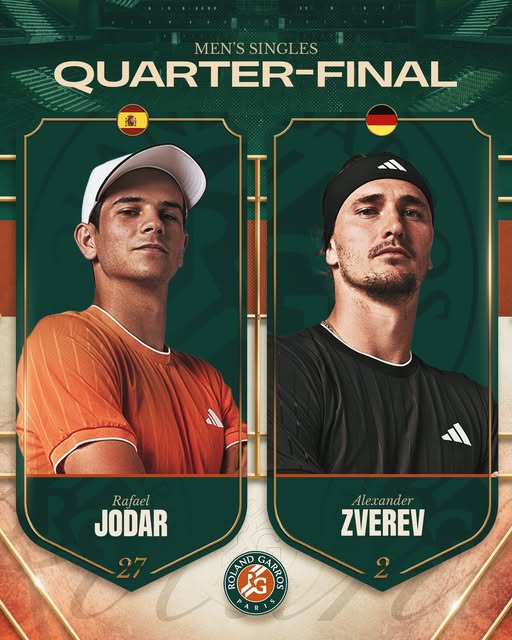
That is exactly what makes the Roland Garros quarterfinal between Rafael Jódar and Alexander Zverev such a fascinating contest.
On paper, the matchup appears straightforward.
Zverev is the established star.
Jódar is the emerging challenger.
However, tennis has repeatedly demonstrated that quarterfinals are not won on paper.
They are won through execution.
They are won through composure.
They are won through physical endurance and mental strength when pressure reaches its highest level.
From an ATP USA expert perspective, this matchup presents a classic battle between experience and youthful momentum.
The central question becomes:
Can Rafael Jódar handle the pressure of his biggest career match, or will Alexander Zverev's experience prove too much to overcome?
The Story Behind the Match
Every Grand Slam creates unexpected stories.
Every year, one young player breaks through and captures attention.
At Roland Garros, Rafael Jódar has become one of those stories.
The Spanish rising talent has demonstrated courage, consistency, and maturity beyond his years.
His journey to the quarterfinals has surprised many observers.
However, inside professional tennis circles, his progress is less shocking.
Coaches have long recognized his potential.
His movement, court awareness, and competitive mentality have attracted attention for years.
Now he faces the biggest test of his career.
Alexander Zverev: The Established Force
Alexander Zverev enters the match as one of the most accomplished players remaining in the tournament.
The German has spent years competing against the best players in the world.
His resume includes:
- ATP Masters 1000 titles
- Deep Grand Slam runs
- Olympic success
- Victories over elite opponents
Most importantly, he understands what quarterfinal pressure feels like.
Experience matters.
Especially in Grand Slam tennis.
Strength Comparison
Let us examine how both players compare across critical areas.
Serve Advantage
Alexander Zverev
Zverev possesses one of the most effective serves on the ATP Tour.
Key strengths include:
- High first-serve percentage
- Powerful flat serves
- Excellent placement
- Ability to earn free points
When serving well, Zverev can control entire sets.
His height allows him to create difficult angles that challenge even elite returners.
Rafael Jódar
Jódar's serve continues to develop.
While not yet as explosive as Zverev's, it remains effective.
His strengths include:
- Good disguise
- Consistent placement
- Intelligent variation
However, in pure serving power, the advantage belongs to Zverev.
Edge: Zverev
Baseline Power
Zverev
The German thrives from the baseline.
His heavy groundstrokes allow him to dictate rallies.
Particularly dangerous is his:
- Two-handed backhand
- Crosscourt consistency
- Defensive stability
Few players strike cleaner backhands.
Jódar
Jódar compensates with timing and athleticism.
His game is built around:
- Court intelligence
- Shot variety
- Smart point construction
While he may not possess equal raw power, he often creates opportunities through tactical creativity.
Edge: Slightly Zverev
Movement and Agility
Clay-court tennis rewards movement.
This category becomes extremely important.
Jódar
The Spanish player moves exceptionally well.
His strengths include:
- Fast recovery steps
- Efficient sliding
- Defensive coverage
- Court anticipation
These qualities are ideal for Roland Garros.
Zverev
Zverev is surprisingly mobile for his size.
His movement has improved significantly over recent seasons.
However, pure agility favors younger players.
Edge: Jódar
Mental Game Analysis
This may become the deciding factor.
Alexander Zverev's Mental Strength
Experience provides advantages.
Zverev has survived:
- Grand Slam semifinals
- Championship matches
- Olympic pressure
- ATP Finals battles
He understands how to manage nerves.
He understands how momentum changes.
He understands how to recover from mistakes.
This knowledge cannot be taught quickly.
It requires years of competition.
Rafael Jódar's Mental Strength
Youth often brings fearlessness.
Young players sometimes benefit from lower expectations.
Jódar enters the match with freedom.
He has already exceeded many expectations.
That freedom can be dangerous.
Players who feel they have nothing to lose often play their best tennis.
The challenge is handling the emotional intensity of a quarterfinal.
That experience is entirely new territory.
Mental Edge: Zverev
Stamina Comparison
Quarterfinal matches frequently become physical battles.
The player who manages energy most effectively often prevails.
Zverev's Conditioning
One of the most underrated aspects of Zverev's game is his endurance.
Despite his height, he covers the court extremely well.
His physical preparation includes:
- Elite conditioning
- Recovery management
- Match endurance
- Long-rally resilience
He has repeatedly demonstrated the ability to survive five-set battles.
Jódar's Conditioning
Youth provides advantages.
Younger athletes generally recover quickly.
Jódar appears physically strong and energetic.
However, the intensity of a Roland Garros quarterfinal is different.
The emotional stress adds another layer of fatigue.
This is often where experience matters.
Stamina Edge: Slightly Zverev
Pressure Situations
Pressure creates opportunities and problems.
The player who handles pressure better often wins.
Big Points
Important moments include:
- Break points
- Tiebreaks
- Set points
- Match points
These situations separate contenders from champions.
Zverev has experienced thousands of high-pressure points.
Jódar is still building that experience.
The German's familiarity with pressure becomes a significant advantage.
Tactical Adjustments
One of the most fascinating aspects of this match will be adaptation.
Neither player will execute a perfect game plan from start to finish.
Adjustments become essential.
What Jódar Must Do
To create an upset, Jódar should:
Extend Rallies
Long rallies increase physical demands.
Use Variety
Mix pace and spin.
Attack Movement Patterns
Force Zverev into uncomfortable positions.
Stay Aggressive
Passive tennis against Zverev rarely succeeds.
What Zverev Must Do
The German's objectives are different.
Protect Service Games
Avoid unnecessary pressure.
Control Court Position
Remain inside the baseline when possible.
Use the Backhand
The backhand remains one of his strongest weapons.
Manage Momentum
Prevent the younger player from gaining confidence.
The Psychological Battle
The match will not be decided solely by strokes.
Psychology matters.
Imagine the opening stages.
If Jódar starts strongly:
- Crowd energy increases
- Confidence grows
- Pressure shifts toward Zverev
If Zverev starts strongly:
- Experience takes control
- Doubt enters the challenger
- Momentum becomes difficult to reverse
Early games could influence the entire contest.
ATP USA Expert Perspective
American analysts frequently discuss a concept called "match ownership."
Elite players impose their identity on matches.
The question becomes:
Whose style dominates?
If rallies become physical and chaotic, Jódar gains opportunities.
If the match becomes structured and controlled, Zverev benefits.
The first player to establish preferred conditions gains an important advantage.
Hidden Factors That Could Decide the Match
Several smaller factors deserve attention.
Crowd Influence
French crowds often support underdogs.
A strong start from Jódar could generate significant energy.
Crowd momentum occasionally influences matches.
First-Serve Percentage
If Zverev serves effectively, he controls many points immediately.
If his percentage drops, opportunities emerge.
Return Games
Jódar must create pressure on return.
Without return success, upsetting a player like Zverev becomes extremely difficult.
Emotional Control
The player who remains calmer during critical moments will likely gain an advantage.
What a Victory Would Mean
For Jódar, victory would represent a career-changing breakthrough.
It would:
- Increase confidence
- Improve ranking
- Generate global attention
- Accelerate development
For Zverev, victory would reinforce his status as a serious title contender.
The stakes are enormous for both competitors.
Prediction: Who Handles the Pressure Better?
Based on current evidence:
Experience Advantage
Alexander Zverev
Power Advantage
Alexander Zverev
Serve Advantage
Alexander Zverev
Movement Advantage
Rafael Jódar
Youthful Energy Advantage
Rafael Jódar
Pressure Management Advantage
Alexander Zverev
Overall Edge
Alexander Zverev
However, Grand Slam quarterfinals are rarely predictable.
If Jódar plays freely, serves effectively, and embraces the occasion, he possesses the athleticism and confidence to create problems.
Final Thoughts
The Roland Garros quarterfinal between Rafael Jódar and Alexander Zverev represents one of tennis' most compelling storylines: youth versus experience, ambition versus achievement, potential versus proven success.
Jódar enters with momentum, athleticism, and the fearless attitude that often fuels breakthrough performances. Zverev arrives with superior experience, greater tactical knowledge, stronger serving power, and a deeper understanding of how to navigate the pressure of major tournaments.
From an ATP USA expert perspective, Zverev remains the favorite because of his ability to manage difficult moments, make in-match adjustments, and maintain high performance under pressure. Yet the beauty of Grand Slam tennis lies in its unpredictability.
If Rafael Jódar can maintain belief, trust his movement, and embrace the biggest challenge of his career, the quarterfinal could become far more competitive than many expect.
One player seeks to continue a title pursuit.
The other seeks to announce himself to the tennis world.
That combination is exactly what makes Roland Garros unforgettable.