
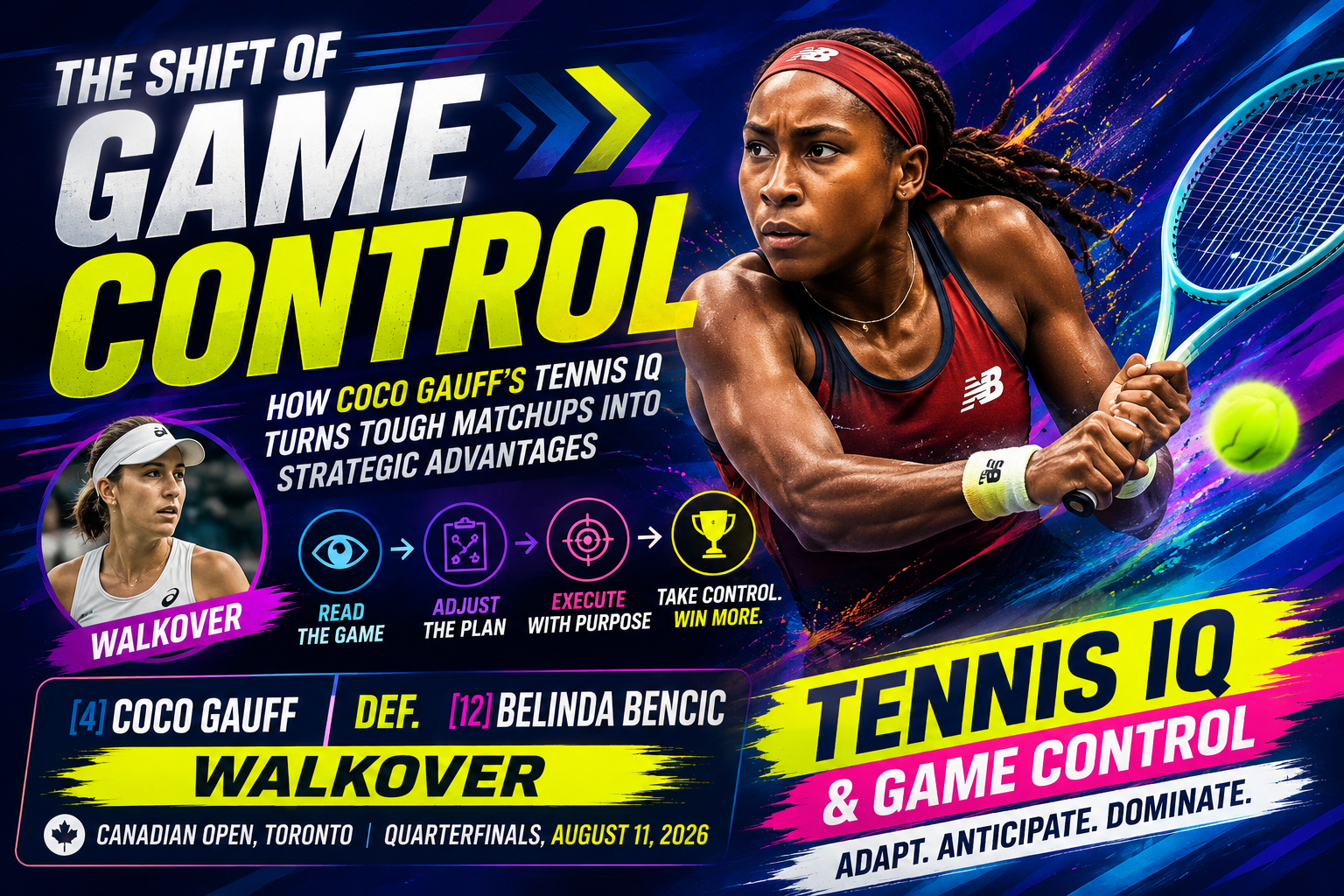
[4] Coco Gauff def. [12] Belinda Bencic — Walkover
Canadian Open, Toronto — Quarterfinals, August 11, 2026
The Result That Wasn’t Played — But Still Changed the Tournament
There are tennis matches where the decisive moment happens at 30-all.
There are matches decided by a change of direction, a return position, a change of height, or one courageous decision at 5-4.
And then there are matches that never begin.
That is what happened in Toronto when No. 4 seed Coco Gauff advanced to the semifinals after No. 12 Belinda Bencic withdrew with a hip injury. Gauff therefore won by walkover without hitting a competitive ball in the quarterfinal.
But from a coaching perspective, calling this simply "Gauff won by walkover" misses the larger story.
The more interesting question is:
What does a top player do when the game plan suddenly changes before the first ball is struck?
This is where tennis IQ becomes more than shot selection.
It becomes the ability to shift from competition mode to preparation mode without losing competitive sharpness.
Gauff entered Toronto looking increasingly comfortable with the tactical adjustments she has been introducing into her game. Reuters reported that she had not dropped a set in the tournament before the quarterfinal withdrawal and had been incorporating new tactical elements into her tennis.
That makes the walkover strategically important.
She gets through the quarterfinal without spending physical energy, while gaining additional time to prepare for the semifinal.
And that can be a major competitive advantage at the WTA 1000 level.
Game Control Is Not Always About Winning Points
One of the biggest misconceptions among recreational players is that game control means hitting harder than your opponent.
It doesn't.
Game control is the ability to influence:
- where the next ball goes,
- how much time your opponent has,
- which patterns are repeated,
- where the opponent is forced to defend,
- when you change direction,
- when you accelerate,
- and when you refuse to give your opponent the shot they want.
A high-level player is constantly asking:
"Who is controlling the next decision?"
That is the heart of tennis IQ.
You can lose a rally and still control the match.
You can win a spectacular rally and still be losing the tactical battle.
And this distinction becomes extremely important when studying Gauff.
The Gauff-Bencic Matchup: A Perfect Tennis IQ Laboratory
Although the Toronto quarterfinal was a walkover, Gauff and Bencic have already produced several important tactical battles.
Their 2026 Wimbledon Round of 16 meeting provides an excellent example.
Gauff lost the opening set 6-4 before changing the momentum and winning 4-6, 6-3, 6-4. The match lasted 2 hours and 18 minutes and finished only two minutes before Wimbledon's 11 p.m. curfew.
That match demonstrated something every developing player should understand:
The first game plan does not have to be the final game plan.
At Wimbledon, Gauff initially struggled to impose herself.
Bencic took the first set.
But Gauff adjusted.
The important lesson isn't simply that she "fought back."
The lesson is that she changed the tactical relationship between the two players.
That is what elite tennis players do.
Adjustment No. 1: Stop Playing the Opponent's Preferred Match
Every opponent wants a particular match.
Some players want short points.
Some want extended baseline exchanges.
Some want you to attack.
Some want you to overhit.
Some want you standing behind the baseline.
Some want you moving forward.
Bencic is particularly dangerous when she can establish rhythm and use her compact, clean ball striking to redirect pace.
Against that type of opponent, giving her predictable balls can be dangerous.
The solution isn't necessarily to hit harder.
The solution is to change the information she receives.
Different height.
Different direction.
Different depth.
Different pace.
Different recovery position.
Different return location.
Different rally tolerance.
This is tennis IQ.
Adjustment No. 2: Change the Geometry Before Changing the Power
Young players often respond to losing control by increasing racquet-head speed.
That's usually the wrong first adjustment.
The better question is:
Can I change the geometry of the rally?
For example:
Pattern A
Crosscourt → crosscourt → crosscourt → down-the-line.
Pattern B
Heavy crosscourt → higher ball → short angle → attack.
Pattern C
Deep return → first ball to the weaker movement direction → open court.
The objective is to make your opponent solve a different problem.
That's what separates ball striking from match management.
Adjustment No. 3: Use Height as a Tactical Weapon
Height is often misunderstood.
Players think hitting higher means playing defensively.
Not necessarily.
A high, heavy ball can:
- push an opponent backward,
- disrupt timing,
- reduce their ability to attack,
- change contact height,
- create more recovery time,
- and force a different swing path.
A player who normally takes the ball early may become uncomfortable when the ball arrives higher and heavier.
So the adjustment isn't:
"Hit harder."
It becomes:
"Change the contact point."
That is a much more sophisticated tactical decision.
Adjustment No. 4: Return Position Is Part of Game Control
The return is one of the most underrated components of tennis IQ.
Where you stand tells your opponent what kind of point you want.
Stand too far back and you may surrender court position.
Stand too far forward and you may struggle against a big first serve.
The elite player constantly calibrates.
Against a first serve:
What percentage of returns can I realistically make?
Against a second serve:
Can I step inside and take control immediately?
Against a wide serve:
Do I protect the angle or attack the open court?
Against a body serve:
Can I create enough space to use my strongest return?
These are not isolated technical questions.
They are game-control questions.
Tennis IQ Adjustment: Recognize the Difference Between a Ball and a Situation
This is where experienced players begin to separate themselves from technically talented players.
A technically good player sees:
Forehand.
A tactically advanced player sees:
Short forehand after moving my opponent wide.
Those are completely different perceptions.
The first player sees the shot.
The second player sees the situation.
That is tennis IQ.
A forehand at 2-2, 30-all is not automatically the same as a forehand at 5-4, 30-30.
The score changes the value of the decision.
The opponent's position changes the value.
The physical state of both players changes the value.
The previous three points change the value.
The weather changes the value.
The court surface changes the value.
The match context changes the value.
Elite tennis is therefore not simply:
Shot → Shot → Shot.
It is:
Information → Decision → Execution → New information → Adjustment.
The Dynamic Shift of Game Control
Let's simplify elite match management into five stages.
Stage 1 — Observe
The first objective is information.
How does the opponent serve?
Where does the return go?
What happens when you attack the forehand?
What happens when you attack the backhand?
Can the opponent defend while moving backward?
What happens when you change height?
How quickly do they recover?
Stage 2 — Test
Now you begin experimenting.
You don't need to reveal your entire game plan immediately.
Test the opponent.
Give them:
- crosscourt balls,
- high balls,
- low balls,
- deep balls,
- short balls,
- changes of direction.
You are collecting information.
Stage 3 — Identify the Pattern
Eventually something becomes obvious.
Maybe the opponent struggles when pulled wide.
Maybe they struggle with height.
Maybe they attack short balls extremely well.
Maybe they become passive behind the baseline.
Maybe their second serve becomes vulnerable under pressure.
This is where tennis IQ begins to convert information into strategy.
Stage 4 — Attack the Pattern
Once the weakness is identified, stop experimenting unnecessarily.
Repeat the successful pattern.
This is where many amateur players make a mistake.
They discover something that works...
Then immediately abandon it.
Why?
Because they want to hit something spectacular.
Professional tennis is often the opposite.
If the pattern works, repeat it until the opponent proves they can solve it.
Stage 5 — Anticipate the Adjustment
This is the highest level.
Now you are thinking:
"She knows what I'm doing."
So what happens next?
Your opponent changes position.
You change your target.
Your opponent changes return position.
You change your serve pattern.
Your opponent starts attacking the net.
You change your passing-shot trajectory.
This is counter-adjustment.
And this is where tennis becomes chess played at 100 miles per hour.
Why the Toronto Walkover Still Matters
The quarterfinal result against Bencic cannot be analyzed as a tactical match because there was no competitive match played.
There was no rally.
No return pattern.
No break-point battle.
No momentum shift.
No tactical adjustment during competition.
That distinction matters.
But strategically, the walkover still has enormous value.
Gauff saves the physical cost of a quarterfinal while advancing to the semifinals. Reuters reported that the withdrawal gave Gauff additional time to fine-tune her game ahead of the U.S. Open.
At this level, recovery is part of the game plan.
Rest is training.
Film study is training.
Serve practice is training.
Return practice is training.
Tactical discussion with the coaching team is training.
And sometimes, not playing is itself a competitive advantage.
The Real Shift: From Match Preparation to Opponent Preparation
When a player expects to compete, the preparation usually looks like:
Warm-up → activation → tactics → match.
A walkover changes the schedule.
Now the player can shift toward:
Recovery → analysis → tactical rehearsal → opponent scouting → semifinal preparation.
That changes the entire decision-making environment.
Gauff can prepare for the next opponent without having spent three sets solving Bencic.
That is a luxury every professional player wants.
The Rybakina Problem
The Toronto semifinal now gives Gauff a completely different tactical challenge.
Elena Rybakina advanced after coming back from a set and a break down against Naomi Osaka, winning 4-6, 7-6(5), 6-4. She will face Gauff in the semifinal.
This is where the walkover becomes strategically interesting.
Rybakina has just played a demanding quarterfinal.
Gauff hasn't.
But Rybakina enters the semifinal with something Gauff cannot replicate in practice:
live competitive rhythm.
That creates an interesting tactical balance.
Gauff has:
freshness + preparation.
Rybakina has:
competitive rhythm + recent match pressure.
Neither advantage guarantees victory.
Gauff's Potential Game Plan Against Rybakina
Against a player with Rybakina's serve and first-strike power, Gauff's game plan should not be built around trying to out-hit her on every ball.
That would be a dangerous strategy.
Instead, the objective should be to break the connection between Rybakina's serve and first forehand.
That means the return becomes critical.
The first question is:
Can Gauff make enough returns to force Rybakina into extended points?
If yes, the tactical battle changes.
The longer the rally becomes, the more opportunities exist to move the opponent, change height and direction, and create a second or third decision.
The Three-Ball Rule
For recreational players, here's an extremely useful concept.
Don't think about winning the point.
Think about controlling the next three balls.
Ball 1 — Start the pattern
Serve or return with a clear objective.
Ball 2 — Apply pressure
Use the next shot to move the opponent or attack a weakness.
Ball 3 — Take the advantage
Now you decide whether to:
- change direction,
- attack,
- approach,
- use an angle,
- or reset.
This is much better than trying to hit a winner on Ball 1.
What Advanced Tennis IQ Looks Like
A high-level player isn't constantly asking:
"Can I hit a winner?"
They are asking:
"What shot gives me the highest probability of controlling the next shot?"
That single change in thinking can transform a player's tennis.
Instead of:
Winner mentality
you develop:
Control mentality.
When Should You Change the Game Plan?
Here's a simple coaching rule:
If you're losing points because of execution:
Fix the technique or reduce the risk.
If you're losing points because of positioning:
Change your court position.
If you're losing points because of predictable patterns:
Change direction or height.
If you're losing points because you're rushed:
Create more time.
If you're losing points because your opponent is attacking:
Improve depth and recovery.
If you're losing points because your opponent has figured out your pattern:
Counter-adjust.
That is practical tennis IQ.
The Environment Effect: Why Better Players Accelerate Your Tennis IQ
This connects directly to a larger principle:
You improve faster when your environment forces you to make better decisions.
Hitting with better players exposes you to:
- faster ball speed,
- better depth,
- earlier contact,
- stronger serves,
- better movement,
- fewer free points,
- more pressure,
- and more sophisticated patterns.
But the biggest improvement isn't physical.
It's cognitive.
You begin to recognize situations earlier.
You start anticipating the next ball.
You stop panicking when the opponent accelerates.
You learn when to defend.
You learn when to reset.
You learn when to attack.
And eventually, the game starts to slow down mentally even while the ball is moving faster physically.
That is one of the clearest signs that your tennis IQ is improving.
The Most Important Lesson From Gauff's Current Run
Gauff's Toronto quarterfinal walkover should not be presented as evidence that she "outplayed" Bencic.
She didn't.
There was no match.
But it is a useful reminder that professional tennis is bigger than individual points.
Tournament management matters.
Recovery matters.
Preparation matters.
Adaptability matters.
And tennis IQ includes knowing how to use circumstances to prepare for the next battle.
Gauff has now advanced to another WTA 1000 semifinal without playing her quarterfinal, and Reuters notes that she is pursuing her first title of 2026 while continuing to refine her tactical game.
The Coach's Final Take
If I were explaining this to a competitive junior or adult player, I would put it very simply:
Don't measure your tennis IQ by how many winners you hit.
Measure it by how quickly you understand what the match is asking from you.
When your opponent changes, you change.
When the conditions change, you change.
When your first strategy fails, you don't panic.
You collect information.
You adjust.
You create a new pattern.
Then you test it.
That is dynamic game control.
And that is why the best players don't necessarily look like they have one perfect game.
They look like they have multiple versions of their game available at the right time.
The goal isn't to play one style of tennis perfectly.
The goal is to recognize which version of your tennis the moment requires.
That's tennis IQ.
That's adjustment.
And ultimately, that's how control of a match shifts.
Key Takeaways for Your Own Tennis
1. Observe before forcing.
The first few games are information.
2. Don't confuse power with control.
Court position, depth, direction and time are forms of control.
3. Change geometry before increasing power.
Height, angle and depth can disrupt an opponent more effectively than simply hitting harder.
4. Build three-ball patterns.
Think about controlling the next three shots rather than winning immediately.
5. Attack discovered weaknesses repeatedly.
Don't abandon a successful pattern just because you want variety.
6. Expect counter-adjustments.
When your opponent solves your pattern, change the question.
7. Use better players as your classroom.
Faster opponents force faster decisions.
8. Remember that recovery is part of strategy.
A walkover isn't a played match, but avoiding unnecessary physical load can influence what comes next.
9. Develop your tennis IQ, not just your stroke production.
A technically beautiful shot is useless if it is the wrong decision.
10. Learn to shift the game.
The strongest players don't wait for control to return. They recognize the problem and actively change the tactical situation.
Final Perspective
The scoreboard may say:
[4] Coco Gauff def. [12] Belinda Bencic — Walkover.
But the deeper tennis lesson is not about the score.
It is about what happens between matches and inside the decision-making process of an elite player.
Sometimes you control a match with your forehand.
Sometimes with your return.
Sometimes with your positioning.
Sometimes with your patience.
And occasionally, you control your tournament by simply taking the opportunity to recover and prepare for the next opponent.
That is the evolution from playing tennis to understanding tennis.