
The public tennis courts in New York were busy that afternoon. The sound of tennis balls echoed across the hard courts while beginner players struggled through another practice session. Some hit the ball late. Others swung too hard. But the biggest problem was obvious immediately.
Their footwork looked stiff.
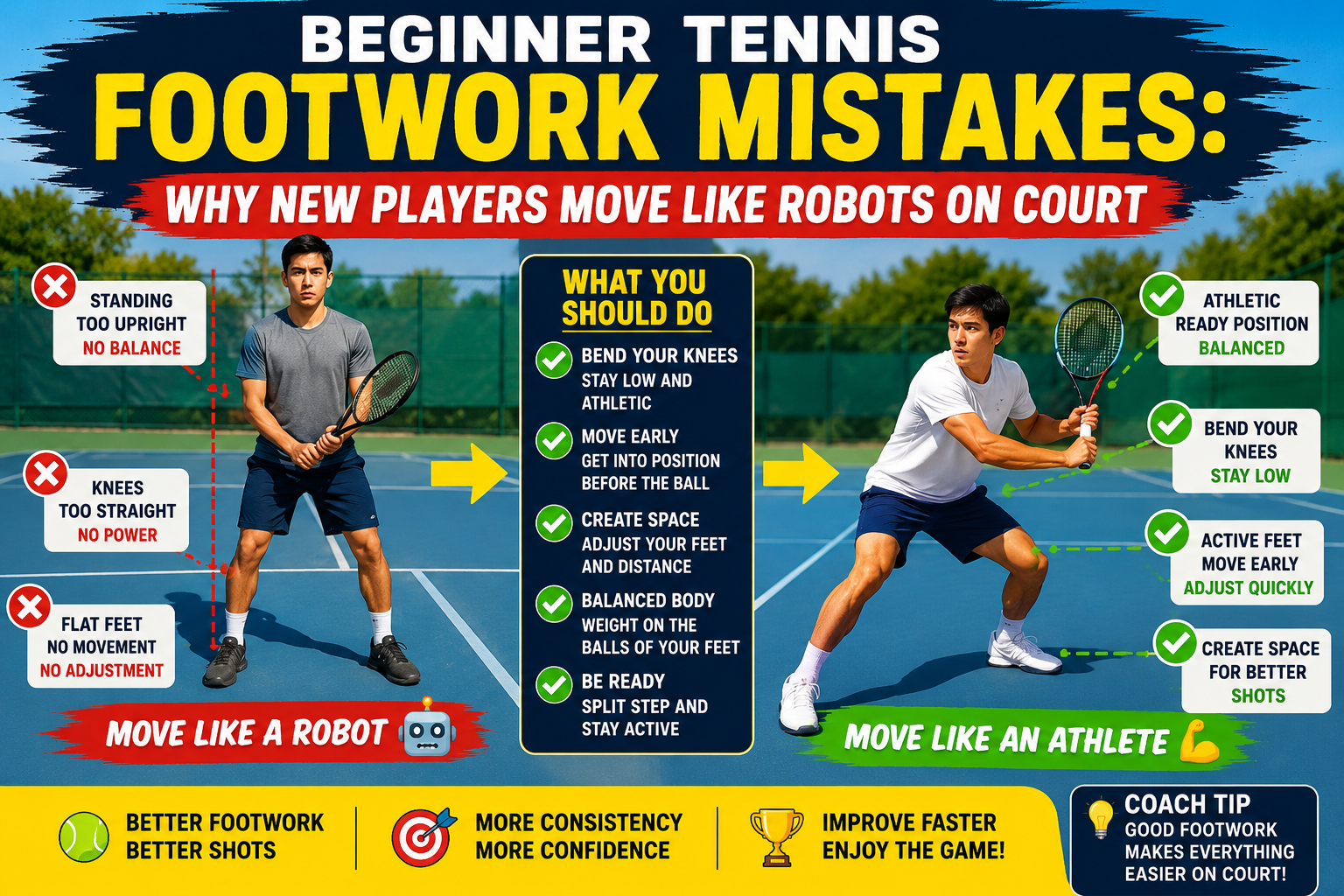
They stood frozen after every shot like robots waiting for instructions. Their knees stayed straight. Their shoulders were tight. Instead of moving naturally toward the ball, they reached awkwardly with their arms and hoped for the best.
One beginner missed three forehands in a row.
Another kept hitting the ball too late because his feet never adjusted.
A young player stood completely upright after serving, unable to recover for the next shot.
I watched quietly for a few minutes before walking closer to the fence.
“Stop standing tall like statues,” I said calmly.
The players laughed nervously.
One of them asked, “What do you mean?”
I pointed toward their legs.
“Your knees are too straight. Tennis is movement. If your legs are stiff, your shots will also become stiff.”
They listened carefully now.
I stepped onto the court and demonstrated slowly.
“Always bend your knees before the ball comes,” I explained. “Good players don’t wait flat-footed. They prepare early.”
I showed them how the body should stay balanced:
- Knees bent
- Chest relaxed
- Feet active
- Eyes forward
- Weight ready to move
“Your body position controls your timing,” I continued. “If you stand like robots, you cannot adjust.”
One beginner nodded immediately because he finally understood why every fast ball felt difficult.
Then I gave them the most important advice.
“Create space for adjustments.”
They looked confused at first.
So I demonstrated again.
Instead of standing too close to the ball, I moved my feet quickly, creating the perfect distance between my body and the contact point.
“When the ball comes,” I explained, “don’t trap yourself. Move your feet early so your body has room to swing naturally.”
I hit a relaxed forehand crosscourt.
The movement looked simple, but the difference was huge.
The beginners began practicing again.
This time:
- Their knees bent lower
- Their feet moved earlier
- Their balance improved
- Their contact became cleaner
One player who kept framing the ball suddenly hit three smooth forehands in a row.
Another beginner smiled after finally timing a backhand correctly.
The court slowly transformed.
The players no longer looked like robots standing in place. They started looking like athletes learning how to move with rhythm and purpose.
As the practice ended, one beginner walked over and said:
“I thought tennis was only about the swing.”
I smiled and shook my head.
“Tennis starts with the feet. The racket only finishes the shot.”