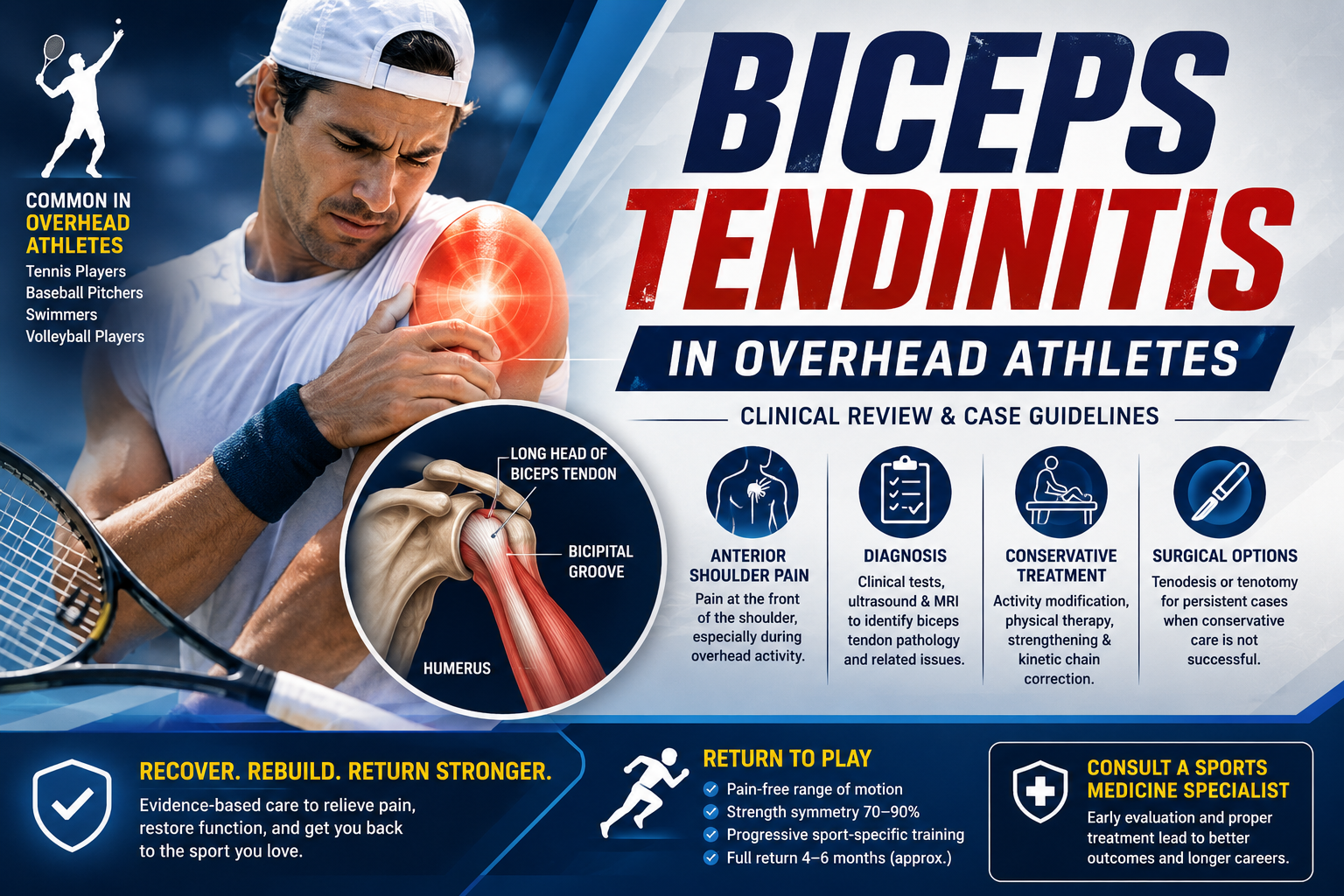
Clinical Review for Tennis Players, Baseball Pitchers, Swimmers and Other Overhead Athletes
Biceps tendinitis—more accurately called long-head biceps tendinopathy (LHBT) when degenerative tendon changes are present—is a common source of pain at the front of the shoulder.
For overhead athletes, including tennis players, baseball pitchers, swimmers and volleyball players, the condition deserves particular attention because the long head of the biceps tendon is exposed to repetitive loading during serving, throwing and other high-velocity overhead movements.
From a U.S. sports-medicine perspective, the important message is this:
Anterior shoulder pain is not automatically a biceps problem.
Long-head biceps pathology frequently exists together with rotator-cuff disease, labral pathology, shoulder instability or other sources of shoulder pain. Clinical examination therefore needs to evaluate the entire shoulder rather than focusing on the biceps tendon alone.
1. Understanding the Long Head of the Biceps Tendon
The long head of the biceps tendon originates at the superior aspect of the shoulder near the glenoid labrum and travels through the shoulder before entering the bicipital groove on the upper humerus.
This anatomy is important because the tendon crosses the shoulder joint before continuing into the upper arm.
During an overhead tennis serve, for example, the shoulder goes through rapid transitions involving:
External rotation → acceleration → internal rotation → deceleration → recovery
The biceps tendon participates in this complex shoulder system and can be exposed to substantial repetitive loading.
When training volume becomes excessive or the shoulder's mechanics are compromised, tendon irritation or degeneration may develop.
Research describes LHBT tendinopathy as potentially beginning with inflammatory changes and progressing toward degenerative changes involving tendon thickening, tissue disorganization and scarring.
2. Why Overhead Athletes Are Particularly Vulnerable
The shoulder is not an isolated joint.
A powerful tennis serve requires coordinated movement through the:
Legs → hips → trunk → scapula → shoulder → elbow → wrist → racket
This is the athlete's kinetic chain.
If one component of that chain is inefficient, another component may have to compensate.
Example: Tennis Serve
Imagine a player who has:
- poor thoracic mobility;
- weak scapular stabilizers;
- inadequate hip rotation;
- poor leg drive;
- or limited shoulder mobility.
The player may compensate by generating more force through the shoulder and arm.
Over thousands of repetitions, that additional load can contribute to shoulder problems.
The scapula is particularly important because it provides the foundation from which the shoulder operates.
Muscles such as the serratus anterior and trapezius help control scapular position and movement. Rehabilitation programs for LHBT tendinopathy therefore commonly include strengthening and movement retraining rather than simply treating the painful tendon.
3. Biceps Tendinopathy Is Often Not an Isolated Problem
This is one of the most important concepts for athletes.
A painful long-head biceps tendon may coexist with:
- rotator-cuff tendinopathy or tears;
- subacromial pain;
- superior labral pathology;
- shoulder instability;
- biceps tendon subluxation;
- or other intra-articular abnormalities.
The biceps tendon and superior labrum form part of a complex anatomical system, and pathology in one structure may affect the others.
Therefore, a player who has persistent anterior shoulder pain should not assume:
"My biceps hurts, so I only need to treat my biceps."
The underlying shoulder mechanics need to be evaluated.
4. Typical Symptoms
The classic symptom is pain at the front of the shoulder.
An athlete may describe:
- a deep ache in the anterior shoulder;
- pain when serving;
- discomfort when reaching overhead;
- pain during the acceleration or follow-through phase;
- pain with lifting;
- discomfort when rotating the shoulder;
- tenderness over the bicipital groove;
- or clicking/snapping sensations.
Some athletes notice pain particularly when the arm is elevated or rotated.
Night pain can also occur in biceps-related shoulder pathology.
A Warning Sign for Tennis Players
If a player begins experiencing:
Serve → anterior shoulder pain → continued serving → increasing pain
that should not simply be treated as normal training soreness.
Persistent or worsening pain deserves evaluation.
5. How U.S. Clinicians Evaluate the Condition
There is no single physical examination maneuver that can perfectly diagnose long-head biceps pathology.
Instead, clinicians combine:
- patient history;
- location and behavior of pain;
- physical examination;
- provocative testing;
- assessment of rotator-cuff function;
- evaluation of scapular mechanics;
- and imaging when appropriate.
Speed's Test
The athlete performs resisted shoulder flexion with the forearm supinated.
Pain reproduced in the anterior shoulder may support biceps involvement.
Yergason's Test
The clinician evaluates the biceps during resisted forearm supination and external rotation.
Pain or abnormal tendon movement around the bicipital groove can provide additional information.
O'Brien's Active Compression Test
This can be incorporated when labral or other intra-articular pathology is suspected.
However, these tests should not be interpreted individually as definitive diagnoses. Evidence indicates that tests such as Speed's, Yergason's and O'Brien's have limitations in specificity and are more useful when combined with the overall clinical examination.
6. Diagnostic Imaging
Ultrasound
Musculoskeletal ultrasound can be particularly useful because it allows clinicians to visualize the tendon dynamically.
It may demonstrate findings such as:
- tendon thickening;
- fluid around the tendon;
- structural abnormalities;
- or instability/subluxation.
One advantage is that the tendon can be observed while the shoulder moves.
However, ultrasound is operator-dependent.
MRI
MRI can help evaluate the broader shoulder environment, including:
- rotator cuff;
- labrum;
- biceps tendon;
- cartilage;
- and other intra-articular structures.
This becomes particularly valuable when an athlete has persistent symptoms or when another shoulder injury is suspected.
7. First-Line Treatment: Don't Rush to Surgery
For most athletes, treatment begins conservatively.
The initial objective is not simply to eliminate pain.
The objective is to determine:
Why did the tendon become overloaded in the first place?
A rehabilitation program may include:
Activity Modification
Temporarily reduce or stop activities that reproduce significant pain.
For a tennis player, this might mean reducing:
- serving;
- overhead drills;
- high-intensity hitting;
- and heavy shoulder lifting.
That does not necessarily mean complete inactivity.
The appropriate level of activity depends on the athlete's symptoms and clinical assessment.
Pain and Inflammation Management
Depending on the individual athlete, clinicians may consider:
- ice;
- short-term anti-inflammatory medication when medically appropriate;
- and other pain-management strategies.
NSAIDs are not appropriate for everyone, so athletes should discuss medication use with a physician or qualified healthcare professional.
Physical Therapy
A structured rehabilitation program may address:
- rotator-cuff strength;
- scapular control;
- thoracic mobility;
- shoulder range of motion;
- biceps loading;
- trunk control;
- and sport-specific movement.
Consensus-based physical therapy recommendations for LHBT tendinopathy support multimodal rehabilitation incorporating exercise, education and other individualized interventions.
8. The Importance of Progressive Tendon Loading
One common mistake is protecting a painful tendon indefinitely.
Tendons generally need progressive loading to regain capacity.
Rehabilitation may progress through stages such as:
Isometric loading → controlled strengthening → eccentric/concentric loading → sport-specific loading → high-speed overhead activity
The exact progression should be individualized.
For a tennis player, the final stage may involve:
- shadow serving;
- controlled serves;
- half-speed serves;
- progressive full-speed serving;
- return-to-play hitting;
- and eventually competitive match intensity.
The goal is to rebuild the tendon and the entire kinetic chain rather than simply waiting for pain to disappear.
9. When Might an Injection Be Considered?
In selected cases, a clinician may consider an image-guided corticosteroid injection around the biceps tendon sheath or another appropriate shoulder structure.
However, injections should not be viewed as a substitute for rehabilitation.
They may reduce pain and inflammation in selected patients, but the underlying mechanical problem still needs to be addressed.
A U.S. sports-medicine approach generally asks:
Why is this tendon being overloaded?
rather than simply:
How can we make the pain disappear?
10. When Is Surgery Considered?
Surgery may become an option when:
- symptoms persist despite appropriate conservative treatment;
- there is significant tendon damage;
- tendon instability is present;
- substantial partial tearing exists;
- or significant associated shoulder pathology requires surgical treatment.
The decision should be individualized.
There is no universal rule that every athlete with biceps tendinopathy should have surgery after exactly three or six months.
The patient's symptoms, tendon condition, associated injuries, athletic demands and response to rehabilitation all matter.
11. Biceps Tenodesis vs. Tenotomy
Two major surgical options are biceps tenodesis and biceps tenotomy.
Biceps Tenodesis
During tenodesis, the diseased long-head biceps tendon is released from its proximal attachment and fixed to the humerus.
The objective is to remove the painful tendon segment from its intra-articular position while maintaining the length-tension relationship of the biceps.
Tenodesis is frequently favored in active patients when preservation of the biceps contour and function is important.
A survey of members of the American Shoulder and Elbow Surgeons found that biceps tenodesis was overwhelmingly preferred over tenotomy for many surgical LHBT scenarios, although there was no consensus on one specific tenodesis technique.
Biceps Tenotomy
Tenotomy simply releases the diseased long-head tendon from its proximal attachment.
It is generally a simpler procedure, but it carries a greater risk of the characteristic "Popeye" deformity and may cause cramping in some patients.
A meta-analysis of randomized trials found higher rates of Popeye deformity and cramping with tenotomy, while several measures of shoulder function favored tenodesis. However, pain relief and some strength measures were similar between procedures.
For Competitive Athletes
For a high-level tennis player, the decision is more complicated than simply choosing the "best" operation.
The surgeon considers:
- age;
- sport;
- dominant arm;
- tendon quality;
- associated rotator-cuff or labral pathology;
- cosmetic concerns;
- strength requirements;
- and expected return-to-sport demands.
12. Return-to-Play: Don't Use the Calendar Alone
One of the biggest mistakes in sports rehabilitation is saying:
"It's been three months, so I'm ready."
Return to play should be based on function, not merely elapsed time.
Before returning to unrestricted overhead competition, an athlete should demonstrate appropriate:
Pain Control
Normal daily activities and progressive sport-specific movements should be tolerable.
Range of Motion
Shoulder motion should be sufficiently restored for the athlete's sport, with meaningful symmetry where appropriate.
Strength
The athlete should demonstrate adequate strength of:
- rotator cuff;
- biceps;
- scapular stabilizers;
- and the broader kinetic chain.
Movement Quality
The athlete should be able to perform overhead movements without major compensatory mechanics.
Sport-Specific Tolerance
A tennis player should be able to progressively tolerate serving and hitting before returning to competitive match play.
13. Return to Tennis After Biceps Surgery
After a biceps tenodesis, rehabilitation is deliberately progressive.
Early protection is important because the tendon needs time to heal at its new attachment.
Later stages progressively restore:
Mobility → strength → endurance → power → overhead speed → tennis-specific loading
A return to competitive tennis can therefore take several months, and the exact timeline varies substantially according to the surgical procedure, concomitant repairs, healing, rehabilitation progress and surgeon-specific protocol.
A particularly important point:
A calendar date should never override biological healing or functional readiness.
14. The Tennis Serve: The Final Test
For an overhead athlete, the serve is often the ultimate stress test.
A player may feel fine during:
- walking;
- daily activities;
- light groundstrokes;
- or gym exercises.
Then the first high-speed serve produces shoulder pain.
That is why return-to-play must progressively reproduce the demands of competition.
A tennis rehabilitation program should eventually challenge:
- shoulder external rotation;
- internal-rotation acceleration;
- deceleration;
- scapular control;
- trunk rotation;
- leg drive;
- and repeated high-speed serving.
Only after the athlete tolerates these demands should unrestricted competition be considered.
15. The Bigger Lesson: Treat the Athlete, Not Just the Tendon
From a U.S. high-performance sports-medicine perspective, the biggest lesson from biceps tendinopathy is simple:
The painful tendon may be the victim rather than the entire problem.
If an athlete repeatedly overloads the shoulder because of poor scapular control, limited thoracic mobility, inadequate lower-body contribution or excessive training volume, treating the tendon alone may not solve the problem.
The rehabilitation process therefore needs to address the complete system.
The High-Performance Chain
Lower body → hips → trunk → scapula → shoulder → elbow → wrist → racket
Every link contributes to efficient overhead performance.
If one link fails, another may absorb the excess load.
Final U.S. Sports-Medicine Perspective
Biceps tendinitis—or more broadly long-head biceps tendinopathy—is a legitimate performance problem for overhead athletes, but it should not automatically end an athlete's season or lead directly to surgery.
The modern approach is usually:
Accurate diagnosis → activity modification → progressive rehabilitation → kinetic-chain correction → gradual sport-specific loading → objective return-to-play assessment.
Surgery such as tenodesis or tenotomy is reserved for selected cases where symptoms, structural pathology or associated injuries justify operative treatment.
For tennis players, the most important goal is not simply getting back on court.
It is getting back with a shoulder that can tolerate the repetitive, high-speed demands of the modern tennis serve.
The objective is not just pain-free tennis.
The objective is durable, high-performance tennis.
Clinical note: This article is an educational sports-medicine review, not a diagnosis or individualized treatment plan. Persistent shoulder pain, weakness, instability, significant loss of motion, or an acute injury should be evaluated by a qualified sports-medicine physician or orthopedic clinician.
Sources
The clinical discussion above is informed by U.S. shoulder-surgery literature and peer-reviewed evidence concerning long-head biceps pathology, physical therapy, imaging, tenodesis and tenotomy.