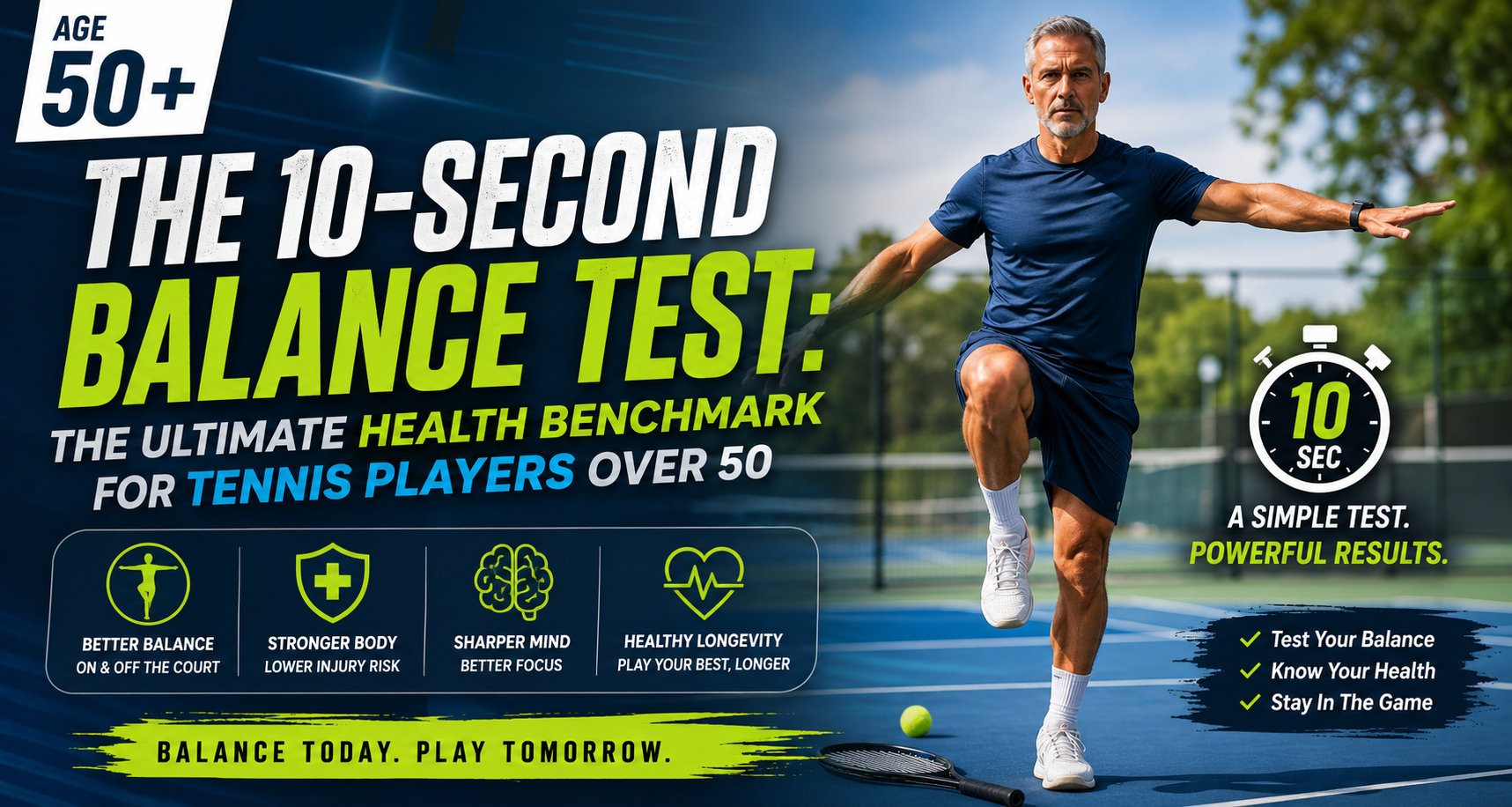
If you are a tennis player between the ages of 50 and 60, you likely spend a good amount of time worrying about your forehand technique, your serve velocity, or your court positioning. But there is one metric that matters more than your ace count, and it takes only ten seconds to measure. Can you stand on one leg with your eyes closed?
Research now points to this simple exercise as a strong predictor of long-term wellness, neurological health, and, most critically for your game, your ability to stay on the court and compete without injury. Most players focus on cardiovascular fitness or muscle mass, but balance depends on a complex coordination between your brain, your inner ear, and your nervous system. For a tennis player in their 50s, this is where matches are won and lost, and where independence is preserved.
Why Balance is the Secret Weapon for Your Tennis Game
Tennis at any age requires rapid changes of direction, explosive lunges, and the ability to recover quickly after a wide shot. But as we enter our 50s, the physical systems that support these movements begin to decline. Balance is not just about leg strength. It is a data processing task handled by several bodily systems at once:
- The vestibular system in the inner ear, which detects motion and orientation.
- Proprioceptive sensors in the joints and muscles that tell your brain where your limbs sit in space.
- The cerebellum, which coordinates motor movement and precision.
When you split-step to react to a serve or lunge for a drop shot, your brain is reading signals from all three of these sources simultaneously. If any of these systems slip, your ability to reach that ball drops off sharply, often before you even feel a symptom. That mistimed step or awkward pivot that leads to a rolled ankle? That is your balance system failing to keep up with your competitive instincts.
The Critical Window: Why 50 to 60 Matters
For players in this age bracket, the stakes are higher. Medical studies have found a clear link between balance duration and cognitive function, especially in people over fifty. Researchers discovered that a sharp drop in the ability to hold a one-legged stance can precede cognitive impairment and small vessel disease in the brain. Balance takes real work from the brain's neural networks, so struggling to stay upright often points to early neural decline.
For a tennis player, this translates directly to reaction time. If your brain is struggling to process spatial data, you will be late to the ball. Your split-step will be heavier. Your transition from defense to offense will be sluggish. People who cannot hold the position for ten seconds may face higher odds of memory problems or strokes later in life, but in the short term, it means losing matches you used to win.
The Eye-Closed Challenge: Removing the Safety Net
Here is the real test for a tennis player. Most of you can stand on one leg with your eyes open without much trouble. You have visual cues, the court lines, the net, the fence to orient yourself. But close your eyes during this test, and a basic movement turns into a real neurological exam.
Without a horizon line to look at, your brain cannot use sight to correct for swaying or wobbling. It has to rely entirely on internal feedback loops. This is exactly what happens on the court when you are tracking a high lob under the sun or pivoting to hit a backhand while looking over your shoulder. Your visual system is compromised, and your proprioceptive system must take over.
The sudden struggle when the lights go out shows exactly why keeping your nervous system active through physical and mental work matters. If you cannot hold this position for ten seconds with your eyes shut, your body alignment is off, and your nervous system is not firing as efficiently as it needs to for competitive tennis.
What Your Balance Says About Your Body Alignment
Poor balance rarely starts in the ankle. It starts in the kinetic chain. If your core is weak, your pelvis tilts forward, throwing off your center of gravity. If your hips are tight, your lower back compensates, altering your stance. Tennis is a sport of repetitive asymmetrical movement, meaning your dominant side is often stronger and tighter than your non-dominant side. This imbalance creates a cascade of misalignment that shows up clearly in a one-legged stance test.
Testing your balance regularly gives you a window into these hidden asymmetries. A significant difference between your left-leg and right-leg balance times is a red flag. It tells you that your body is compensating, and that compensation will eventually lead to overuse injuries, whether it is tennis elbow, knee pain, or lower back strain.
Protecting Your Future Mobility and Your Game
The good news is that balance is a skill you can improve or hold onto with practice and the right habits. Strengthening your core, trying yoga or tai chi, and doing daily balance drills all help keep the connection between your brain and body working efficiently. For the 50-to-60-year-old tennis player, this is not optional. It is the difference between playing into your 70s and being forced to watch from the sidelines.
Here is what you should do starting today:
- Test yourself weekly. Stand on one leg, close your eyes, and time how long you can hold it. Aim for ten seconds. Track your progress.
- Incorporate single-leg exercises into your warm-up, such as single-leg Romanian deadlifts or balance reaches, to challenge your proprioception.
- Add yoga or tai chi to your weekly routine. Both disciplines focus heavily on weight shifting and body awareness, which directly translate to better court coverage.
- Strengthen your glutes and core. Planks, bird-dogs, and lateral lunges create the stable base you need to maintain alignment during sudden stops and starts.
The Bottom Line
Checking this simple metric at home gives you a window into your neurological health and a reason to act early to protect your independence and your tennis game. The ability to stand steady on one leg with your eyes closed for ten seconds is not just a party trick. It is a hard data point that predicts your reaction time, your injury risk, and your longevity in the sport you love.
Building these habits now is an investment in staying sharp and steady for years down the road. So, the next time you step onto the court, before you hit a single forehand, drop down, lift one foot, close your eyes, and ask yourself: is my body ready for this match? If the answer is no, you know exactly where to start.