
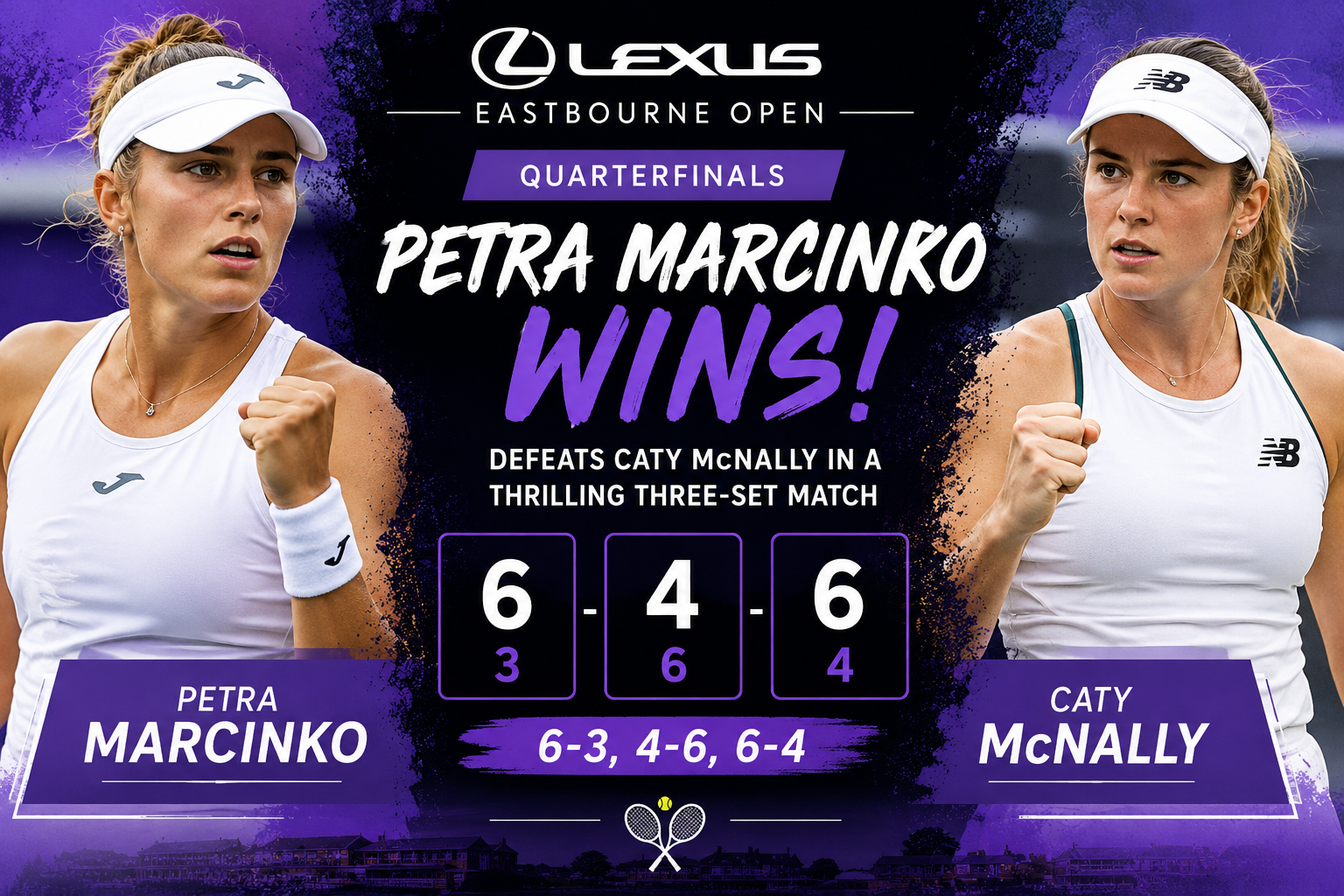
Quarterfinal Result
At the Lexus Eastbourne Open quarterfinal, Petra Marcinko defeated Caty McNally in a thrilling three-set battle:
Petra Marcinko def. Caty McNally 6-3, 4-6, 6-4 in 2 hours and 16 minutes, advancing to the semifinals against Madison Keys. Marcinko entered the tournament as a lucky loser and continued her remarkable run on grass.
ATP Men's Coach Match Diagnosis
As an ATP men's coach, I don't evaluate a match by simply asking who hit more winners. I analyze four areas:
- Tactical intelligence
- Pressure management
- Momentum adjustments
- Alpha mentality
This match was not decided by power.
It was decided by who made the better adjustments after momentum shifted.
Marcinko demonstrated a higher tactical IQ during the biggest moments of the match.
First Set Analysis (Marcinko wins 6-3)
The opening set belonged almost entirely to Petra Marcinko.
From the first few games she established several important advantages.
1. Early Court Position
Marcinko consistently positioned herself close to the baseline.
Instead of allowing McNally to dictate first strike tennis, Marcinko absorbed pace and redirected the ball deep through the middle.
This prevented McNally from attacking immediately.
2. Heavy Crosscourt Pressure
Against an aggressive player like McNally, many opponents attempt risky down-the-line winners.
Marcinko remained patient.
She repeatedly hit:
- deep crosscourt forehands
- heavy backhands
- high-margin topspin balls
This forced McNally into uncomfortable contact points.
3. Excellent Rally Discipline
One of the best coaching observations:
Marcinko refused to panic.
Instead of ending rallies in four shots, she often accepted:
- 8-ball rallies
- 10-ball rallies
- 14-ball rallies
Grass courts reward first-strike tennis.
But Marcinko understood:
"If McNally has to hit one extra ball every rally, eventually errors appear."
That proved correct.
McNally's Problems in Set One
McNally looked rushed.
Several patterns appeared repeatedly.
Forehand Overhitting
Instead of constructing points patiently, she tried finishing too early.
Result:
- missed forehands
- rushed approaches
- poor shot selection
Predictable Serve Patterns
Marcinko began reading:
- wide serves
- body serves
- second serve direction
Once the returner predicts the serve, pressure immediately shifts.
Emotional Frustration
McNally occasionally rushed between points.
Her decision making became faster...
but not better.
Good players play fast.
Great players think clearly before playing fast.
Marcinko's Alpha Pattern
An Alpha player asks:
"How can I make my opponent uncomfortable every point?"
Not:
"How can I hit a winner?"
Marcinko consistently attacked:
- movement
- balance
- recovery position
rather than simply attacking lines.
Second Set Analysis (McNally wins 6-4)
Champions respond.
McNally made excellent adjustments.
This was her best tennis of the afternoon.
Adjustment #1
Higher First Serve Percentage
She reduced unnecessary risk.
Instead of serving for outright aces,
she served for:
- better first ball
- easier forehand
- better positioning
That immediately increased hold percentage.
Adjustment #2
Earlier Forehand Contact
She stepped farther inside the baseline.
Grass rewards players who take time away.
McNally stopped waiting.
She attacked earlier.
Adjustment #3
More Net Pressure
McNally possesses excellent doubles instincts.
She finally trusted them.
Instead of staying behind the baseline,
she finished points at the net.
That shortened rallies.
Exactly what Marcinko wanted to avoid.
Momentum Shift
Momentum in tennis rarely changes because of one spectacular winner.
It changes because one player begins winning:
- serve plus one
- return plus one
- neutral rallies
McNally slowly controlled these categories.
That allowed her to level the match.
Marcinko's Challenge
Many young players lose confidence after dropping a set.
Marcinko didn't.
She stayed emotionally neutral.
That became the biggest reason she eventually won.
Third Set: Championship Tennis
The final set separated good competitors from elite competitors.
Neither player dominated.
Instead,
every service game became a mental examination.
Marcinko's Biggest Adjustment
Instead of increasing power,
she increased margin.
This is elite decision making.
Many players think:
Final set = hit harder.
Wrong.
Champions usually think:
Final set = make one fewer mistake.
Marcinko embraced that philosophy.
Shot Tolerance
One hidden statistic coaches love:
How many quality balls can a player hit consecutively?
Marcinko's shot tolerance remained high.
Even under pressure she continued producing:
- heavy topspin
- deep trajectory
- safe net clearance
Those are championship habits.
McNally's Third Set Issues
The biggest tactical issue became impatience.
Several important games ended with:
- ambitious forehands
- rushed returns
- low-percentage attacks
Against disciplined defenders,
those decisions become expensive.
Alpha Game Plan That Won the Match
If I summarize Marcinko's strategy into one sentence:
Win through pressure—not desperation.
She built pressure by:
1. Deep Middle Balls
Instead of aiming immediately for the sidelines,
she repeatedly attacked the middle.
Why?
Because middle depth removes angles.
Eventually the short ball appears naturally.
2. High Percentage Forehand
Notice how often she avoided low-margin winners.
Instead:
- heavy spin
- safe clearance
- consistent depth
Those shots slowly forced McNally backward.
3. Smart Direction Changes
Changing direction is risky.
Marcinko only changed direction when balanced.
Never while stretched.
This greatly reduced errors.
4. Patience Before Acceleration
ATP players follow a simple rule:
Build.
Build.
Build.
Attack.
Marcinko rarely attacked too early.
She earned attacking opportunities.
Serve Analysis
Marcinko's serve was not overwhelming.
But it accomplished three important goals.
Placement
She mixed:
- wide
- body
- T serves
keeping McNally guessing.
Height
Excellent net clearance.
Very few free errors.
Second Serve Courage
Young players often push second serves.
Marcinko accelerated through hers.
That prevented McNally from dominating returns.
Return Analysis
Her returning deserves praise.
Rather than chasing spectacular winners,
she focused on:
- neutralizing serve
- deep return
- immediate recovery
That instantly placed rallies on equal footing.
Movement Analysis
Grass movement is unique.
Players cannot over-slide.
Marcinko adjusted beautifully.
She maintained:
- compact first step
- balanced split step
- efficient recovery
Those details saved energy across more than two hours.
Mental Game Diagnosis
The biggest difference between the two players wasn't strokes.
It was emotional stability.
Marcinko showed:
- patience
- acceptance
- composure
McNally displayed:
- urgency
- aggression
- confidence
But occasionally,
too much urgency.
Alpha Mindset
An Alpha competitor never asks:
"Am I playing well?"
Instead they ask:
"What adjustment wins the next three points?"
Marcinko constantly solved problems.
That is championship thinking.
Coaching Adjustments for McNally
If I coached McNally before their next meeting:
Improve Transition Timing
Approach the net only after producing a weaker reply.
Not after neutral balls.
Reduce Forehand Risk
Use:
70%
instead of
100%
power.
Consistency creates more opportunities than reckless winners.
Vary Return Position
Occasionally return from:
- farther back
- inside baseline
Changing visual rhythm disrupts servers.
More Slice Variation
Grass rewards slice.
Mixing slice would force Marcinko lower.
That creates shorter replies.
Coaching Adjustments for Marcinko
Even after winning,
improvement never stops.
Stronger First Strike
Against elite players like Madison Keys,
neutral rallies become dangerous.
She must attack earlier.
First Serve Percentage
A slightly higher percentage would create more free points.
Finish Short Balls
Several attackable balls remained neutral.
Top-20 players punish those immediately.
Net Confidence
Marcinko should finish more points forward.
Modern grass rewards decisive transitions.
Physical Conditioning
This match highlighted outstanding endurance.
Marcinko maintained:
- explosive legs
- stable balance
- excellent recovery
Deep into the third set,
her movement barely declined.
That conditioning made the difference late in the match.
Tactical Grade
Petra Marcinko
Serve: 8/10
Return: 9/10
Movement: 9.5/10
Decision Making: 9.5/10
Mental Strength: 10/10
Overall Alpha Rating:
9.5/10
Caty McNally
Serve: 8.5/10
Forehand: 8.5/10
Net Game: 8.5/10
Decision Making: 7.5/10
Pressure Management: 7.5/10
Overall Rating:
8.4/10
Lessons Every Competitive Player Should Learn
This quarterfinal was an outstanding example that matches are rarely won through spectacular shot-making alone. Marcinko demonstrated that disciplined point construction, emotional control, and tactical flexibility can overcome an opponent with aggressive weapons. She resisted the temptation to chase low-percentage winners, trusted her rally tolerance, and made smarter adjustments as the match evolved. McNally's second-set response showed her ability to raise her level, but in the deciding set, Marcinko's patience and decision-making under pressure proved decisive.
For club players and professionals alike, the takeaway is clear: the "Alpha Game" is not about overpowering the opponent. It is about controlling tempo, making fewer unforced errors in critical moments, recognizing momentum shifts, and consistently choosing the highest-percentage play. Those habits allowed Petra Marcinko to turn a difficult quarterfinal into a hard-earned 6-3, 4-6, 6-4 victory and continue her impressive run from lucky loser to semifinalist at Eastbourne.