
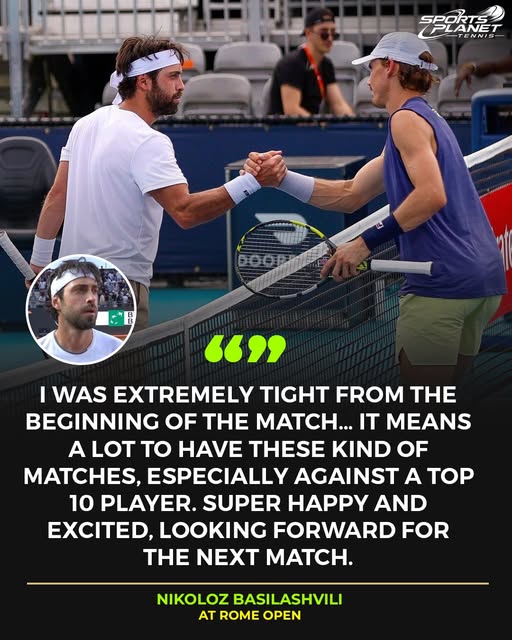
“I was extremely tight from the beginning of the match… It means a lot to have these kind of matches, especially against a Top 10 player. Super happy and excited, looking forward for the next match.”
Those words from Nikoloz Basilashvili after his emotional performance in Rome revealed something deeper than simple post-match relief.
They revealed a player still fighting internally between old explosive instincts and the modern discipline required to survive elite ATP tennis.
For years, Basilashvili has remained one of the most unpredictable power hitters in professional tennis. On his best days, he can hit through almost anyone in the world. His forehand can suddenly become nuclear. His flat backhand penetrates through the court with shocking pace. His fearless aggression can suffocate elite defenders quickly.
But modern tennis is no longer won only by raw shotmaking.
And that has become the central challenge of Basilashvili’s career.
The weapons remain dangerous.
The ball striking remains explosive.
But the emotional structure and point-management system still need evolution if he wants to consistently threaten the ATP elite again.
From the perspective of elite USA tennis coaching, Basilashvili’s Rome performance was both encouraging and revealing at the same time.
The fire still exists.
But the architecture around that fire must become stronger.
The Basilashvili Identity: Controlled Chaos
Very few ATP players strike the ball like Basilashvili.
His game has always been built around offensive violence:
- early ball striking,
- flat trajectory pace,
- baseline risk-taking,
- and fearless acceleration.
When his timing locks in, opponents feel overwhelmed immediately.
The ball comes:
- low,
- fast,
- deep,
- and relentlessly aggressive.
From a pure shotmaking perspective, Basilashvili belongs among the cleanest ball strikers of his generation.
But his style also creates one dangerous problem:
small emotional instability creates massive performance swings.
That is the reality of high-risk tennis.
Players who attack constantly operate on thinner margins psychologically. Confidence becomes directly connected to timing.
Once timing disappears slightly:
- errors increase rapidly,
- footwork tightens,
- shot selection becomes rushed,
- and emotional frustration grows.
This has followed Basilashvili throughout his career.
Why He Said He Felt “Tight”
The most important part of his Rome statement may have been the word:
“tight.”
Elite players rarely use that word casually.
In tennis language, “tightness” usually means:
- emotional tension,
- overthinking,
- physical hesitation,
- or fear of execution under pressure.
For aggressive players like Basilashvili, tension becomes especially dangerous because their entire system depends on free acceleration.
A relaxed Basilashvili swings explosively.
A tight Basilashvili decelerates unconsciously.
That tiny hesitation changes everything:
- forehands land shorter,
- backhands lose penetration,
- timing collapses,
- and confidence disappears.
USA high-performance coaches often explain this with one phrase:
“Power players cannot play scared.”
And in Rome, Basilashvili openly admitted the emotional pressure affected him early.
The positive sign?
He survived it mentally.
That matters enormously.
The Forehand: Still One of the Most Dangerous in Tennis
At peak rhythm, Basilashvili’s forehand remains world-class.
Technically, it is built for pure court penetration.
Several characteristics make it dangerous:
- flat contact,
- forward acceleration,
- aggressive body weight transfer,
- and early strike timing.
Unlike heavy topspin players who push opponents back gradually, Basilashvili attacks directly through the court.
His forehand travels like a bullet.
This creates massive pressure because opponents lose reaction time immediately.
From a biomechanical perspective, his forehand uses:
- explosive hip rotation,
- open-stance loading,
- and violent racket-head acceleration.
When synced correctly, the ball explodes off the strings with elite pace.
But here is the problem:
his margin for error is small.
Flat hitters depend heavily on timing precision.
If footwork becomes unstable emotionally, the forehand breaks down quickly.
What Needs Improvement on the Forehand
From the USA coaching perspective, Basilashvili’s forehand still needs three major improvements:
Better Height Variation
He often attacks too flat during neutral rallies.
Modern ATP tennis rewards controlled aggression, not permanent maximum pace.
Adding slightly more net clearance occasionally would improve consistency dramatically.
Smarter Point Construction
Sometimes Basilashvili tries ending points too early.
Against elite defenders, one explosive shot is rarely enough anymore.
Modern champions build pressure patiently before final acceleration.
This is where players like:
- Jannik Sinner
- Carlos Alcaraz
- Novak Djokovic
separate themselves tactically.
They know when to accelerate fully.
Emotional Relaxation During Misses
Basilashvili’s body language still changes too dramatically after errors.
Aggressive players must accept misses emotionally.
If frustration enters too early, timing collapses.
This remains one of his biggest mental-development areas.
His Backhand Is Cleaner Than People Realize
Many casual fans focus mostly on Basilashvili’s forehand power.
But his backhand may actually be the more technically stable side.
His two-handed backhand:
- stays compact,
- redirects pace beautifully,
- and penetrates extremely well down the line.
When relaxed, he drives through contact with elite timing.
The issue again becomes emotional rhythm.
Under pressure:
- preparation speeds up,
- balance disappears,
- and contact timing becomes rushed.
This creates inconsistency during long pressure exchanges.
Why His Footwork Controls Everything
Basilashvili’s game depends heavily on positioning quality.
Because he hits flat and early, he requires perfect spacing.
Flat hitters cannot improvise late contact easily.
Players using heavier topspin can recover from imperfect positioning more safely. Basilashvili’s flatter strike zone punishes poor footwork immediately.
This is why emotional tension affects him more visibly than some other players.
Tension tightens movement.
Tight movement destroys spacing.
Poor spacing destroys timing.
Everything becomes connected.
The Mental Battle of High-Risk Tennis
One of the hardest realities in professional tennis is sustaining aggressive confidence over long periods.
Attackers live emotionally close to danger.
Defensive players can survive imperfect timing longer.
Aggressive players cannot.
This creates huge mental fatigue.
Every point requires commitment.
Basilashvili’s career has often looked like emotional warfare between:
- fearless acceleration,
- and fear of mistakes.
That internal battle becomes exhausting mentally.
The Rome performance showed progress because he admitted feeling tight but continued fighting anyway.
That emotional honesty matters.
What USA Coaches Would Change Mentally
From elite American coaching systems, Basilashvili’s mental development would focus heavily on emotional neutrality.
Not emotional hype.
Not emotional collapse.
Neutrality.
Modern ATP champions manage emotions extremely efficiently.
After misses:
- calm reset,
- controlled breathing,
- tactical clarity,
- and immediate recovery.
Basilashvili still rides emotional momentum too strongly.
When confidence rises, he becomes terrifying.
When frustration enters, decision-making becomes unstable.
The next evolution of his career may depend entirely on emotional stabilization.
The Serve Still Has Untapped Potential
One underrated part of Basilashvili’s game is his serve.
At his best, the serve:
- sets up first-ball aggression,
- creates free points,
- and shortens pressure rallies.
But consistency fluctuates heavily under tension.
Again, this connects directly to relaxation.
Tight shoulders reduce racket speed.
Rushed rhythm destroys placement.
Mental anxiety changes toss consistency.
The technical motion itself is powerful enough.
The challenge is maintaining calm repetition during pressure moments.
Why His Ball Is So Heavy
Many opponents describe Basilashvili’s shots as deceptively heavy.
This comes from:
- flat acceleration,
- strong forward momentum,
- and deep penetration.
Unlike spin-heavy players who create height and bounce, Basilashvili drives through the court aggressively.
The ball arrives earlier than expected.
This rushes opponents constantly.
When he controls the baseline confidently, his game becomes suffocating.
That is why he remains dangerous against top players even during inconsistent seasons.
Pure shotmaking always carries upset potential.
The Modern ATP Problem
Unfortunately for Basilashvili, modern tennis has evolved tactically.
Today’s elite players defend better than previous generations.
Simply hitting hard is no longer enough consistently.
Players now combine:
- elite movement,
- counterpunching,
- transition defense,
- and mental patience.
This forces aggressive hitters to become more intelligent strategically.
The era of “all-out hitting every point” is disappearing slowly.
Modern champions attack with structure.
This is where Basilashvili still needs evolution.
The Importance of Rally Tolerance
One of the biggest improvements Basilashvili could make is rally tolerance.
This does not mean becoming defensive.
It means learning:
- when to build,
- when to reset,
- and when to attack fully.
Great modern attackers understand pacing.
Not every ball requires maximum acceleration.
Sometimes controlled pressure creates better opportunities later in rallies.
This is something elite USA academies now teach aggressively to young power hitters.
Why Rome Could Become Important for Him
Emotionally, Rome may become a critical moment in Basilashvili’s season.
Not because of rankings.
Not because of headlines.
But because he openly acknowledged pressure while still competing courageously.
That is growth.
For years, Basilashvili sometimes looked emotionally trapped during difficult matches.
Rome showed more awareness and resilience.
That could become the foundation for more stable tennis moving forward.
What Makes Him Dangerous Against Top 10 Players
Top players actually dislike facing unpredictable power hitters.
Why?
Because rhythm disappears.
Basilashvili can suddenly:
- flatten the ball,
- redirect pace early,
- and attack impossible angles.
This breaks normal rally patterns.
Even elite defenders become uncomfortable because timing gets disrupted.
That is why Basilashvili continues earning dangerous wins occasionally against top-ranked opponents.
His ceiling remains extremely high.
The problem has never been talent.
It has always been sustainability.
Lessons Younger Players Can Learn
Young aggressive players should study Basilashvili carefully because his career contains important lessons.
Power alone is not enough anymore.
Modern tennis requires:
- emotional control,
- tactical patience,
- movement discipline,
- and recovery management.
His game shows both:
- the beauty of fearless aggression,
- and the danger of emotional instability.
Young players must learn balance earlier.
The Hidden Positive From His Rome Comments
One subtle but important detail from Basilashvili’s statement was gratitude.
He said:
“It means a lot to have these kind of matches.”
That mentality matters.
Players who appreciate competition often recover mentally stronger after difficult periods.
It suggests he still loves the battle.
Still values the opportunity.
Still believes improvement is possible.
That emotional hunger remains important for veteran players trying to climb again.
Final Thoughts: The Fire Still Exists
Nikoloz Basilashvili remains one of the ATP Tour’s most fascinating power players.
The racket speed still exists.
The forehand can still explode.
The backhand can still penetrate elite defenses.
But modern tennis now demands more than raw aggression.
To evolve further, Basilashvili must improve:
- emotional neutrality,
- rally tolerance,
- point construction,
- and pressure management.
The Rome performance showed both the danger and vulnerability of his game style beautifully.
He can still threaten elite opponents.
He can still produce explosive shotmaking.
He can still create chaos against Top 10 players.
But the next step of his career may no longer depend on power.
It may depend on peace.
Because if Basilashvili ever combines his fearless ball striking with stable emotional structure consistently…
the ATP Tour could suddenly become very uncomfortable again.