
The Pattern That Refuses to Be Ignored
In elite sport, history rarely repeats itself by accident. It echoes through patterns—through mentality, through habits, through the quiet, relentless work that nobody sees. And now, once again, that pattern has surfaced in the form of a fearless 18-year-old: Mirra Andreeva.
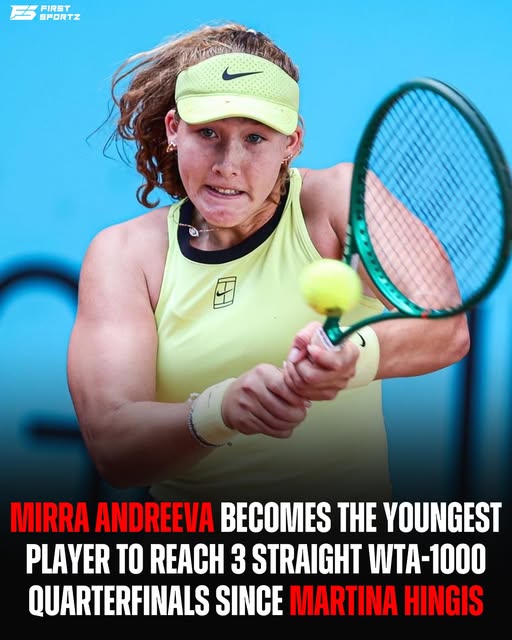
At just 18, Andreeva has become the youngest player since Martina Hingis to reach three consecutive WTA-1000 quarterfinals. That is not a coincidence. That is not luck. That is not “just a good run.”
That is alignment between dream, belief, and execution.
And as a coach who has spent decades working with high-performance athletes in the United States, I can tell you—this is exactly what destiny looks like when it is backed by structure.
History Repeats: Why Hingis and Andreeva Are Connected
When we mention Martina Hingis, we’re talking about one of the most intelligent players the sport has ever seen. She didn’t overpower opponents—she dismantled them.
Mirra Andreeva is showing the same DNA.
Not identical strokes. Not identical physiques. But identical decision-making maturity at an early age.
Here’s the real connection:
- Both read the game two shots ahead
- Both absorb pace instead of forcing it
- Both thrive under structured patterns rather than chaos
- Both show emotional control beyond their years
That last point matters more than anything.
Young players don’t lose because of technique. They lose because of instability—mental, emotional, tactical.
Andreeva? She’s stable.
That’s why history is repeating.
Dreaming Is Not Enough — Execution Is Everything
Let’s address the core message:
Dream dreams and take action with full dedication.
That’s not motivational fluff. That’s the blueprint.
Every player on tour had a dream. Thousands had talent. Only a handful turn it into something real.
What separates Mirra Andreeva?
1. Clarity of Identity
She knows exactly how she wants to play:
- Controlled aggression
- High-percentage patterns
- Tactical patience
She doesn’t chase highlights. She builds points.
2. Repetition Under Pressure
At WTA-1000 level, you are not tested on your best shot—you are tested on your most repeatable shot.
Andreeva’s crosscourt consistency is elite for her age.
3. Discipline Over Emotion
She doesn’t panic when rallies extend.
That alone puts her ahead of 90% of young players.
Tactical Breakdown: Why Her Game Works Now
Let’s break this down from a coaching perspective.
Baseline Structure
Andreeva plays with a neutral-to-aggressive baseline position. She is not overly defensive, but she does not rush forward unnecessarily.
This allows her to:
- Stay balanced
- Control rally tempo
- Redirect pace efficiently
Backhand Stability
Her two-handed backhand is her anchor.
- Compact takeback
- Clean contact point
- Minimal error leakage
This is where rallies stabilize for her.
Forehand Evolution
This is still developing—but here’s the key:
She doesn’t overhit it.
Instead:
- Uses shape when needed
- Flattens out only when the opening is clear
That’s decision-making maturity.
Transition Game
This is where she’s improving rapidly.
She chooses the right moments to move forward—not just “attack for the sake of attacking.”
The Psychological Edge: Built, Not Given
Talent gets you noticed.
Mental structure keeps you there.
Mirra Andreeva shows three elite psychological traits:
1. Non-Reactivity
She doesn’t overreact to mistakes.
That means:
- No emotional swings
- No rushed points
- No collapse after errors
2. Point-to-Point Reset Ability
She plays each point as a new event.
This is something even top 20 players struggle with.
3. Competitive Curiosity
She’s not just playing—she’s learning mid-match.
That’s rare.
That’s dangerous—for opponents.
Destiny vs Accident: Let’s Be Clear
People will say:
- “She’s on a hot streak”
- “She’s just in form”
- “Let’s see if she can sustain it”
That’s surface-level thinking.
From a coaching lens, this is what we see:
- Technical foundation
- Tactical clarity
- Emotional discipline
- Match pattern consistency
When those four align, results are inevitable.
That’s not luck.
That’s inevitability.
The Modern WTA Landscape: Why This Matters Now
The current WTA game is built on:
- Power baseline exchanges
- First-strike tennis
- Physical endurance
What Mirra Andreeva brings is different:
She slows the game down mentally while keeping it fast physically.
That’s rare.
And that’s disruptive.
She forces opponents to:
- Play one more ball
- Think one more step
- Question their patterns
And when players start thinking too much—they lose.
The Hingis Comparison — Where It Holds, Where It Doesn’t
Let’s stay honest.
Where it holds:
- Tactical intelligence
- Court awareness
- Pattern construction
Where it differs:
- Today’s game is more physical
- Points are longer
- Pace is higher
So Andreeva’s challenge is bigger.
Which makes this achievement even more impressive.
What Comes Next: The Real Test
Three consecutive WTA-1000 quarterfinals is a signal.
But the next phase defines careers.
Phase 1: Consistency Across Surfaces
Can she replicate this on:
- Clay
- Grass
- Faster hard courts
Phase 2: Handling Expectations
Now she’s no longer “the surprise.”
She’s a target.
Phase 3: Physical Durability
The tour is brutal.
Managing:
- Recovery
- Scheduling
- Load
will determine longevity.
Lessons for Players: This Is the Real Takeaway
If you’re a player reading this, understand:
This is not about copying Andreeva’s strokes.
This is about adopting her principles.
What You Should Take From This
- Build patterns, not highlights
- Train consistency under fatigue
- Learn to reset emotionally
- Develop decision-making, not just power
Because at the highest level:
The smartest player often beats the strongest one.
The Reality of Dreams
Let’s ground this.
“Dream big” is incomplete advice.
Dreams without structure are illusions.
Mirra Andreeva’s journey shows us:
- Dreams + Discipline = Direction
- Direction + Repetition = Results
- Results + Stability = Legacy
Why This Is Not the Future — It’s the Present
Mirra Andreeva is not “coming soon.”
She’s already here.
Beating established players
Handling pressure moments
Competing deep into elite tournaments
That’s not potential.
That’s presence.
Final Word From a Coach
I’ve seen hundreds of young talents come and go.
The difference is never just talent.
It’s always:
- Who commits fully
- Who stays disciplined when it’s boring
- Who trusts the process when results are slow
Andreeva checks those boxes.
That’s why history is repeating.
Not because the sport is nostalgic.
But because greatness follows patterns—and she is following them precisely.
Closing Thought
This is what people misunderstand about destiny:
It’s not something you wait for.
It’s something you build—daily, quietly, relentlessly.
And when preparation meets opportunity, people call it history.
But those who understand the process?
They call it inevitable.