
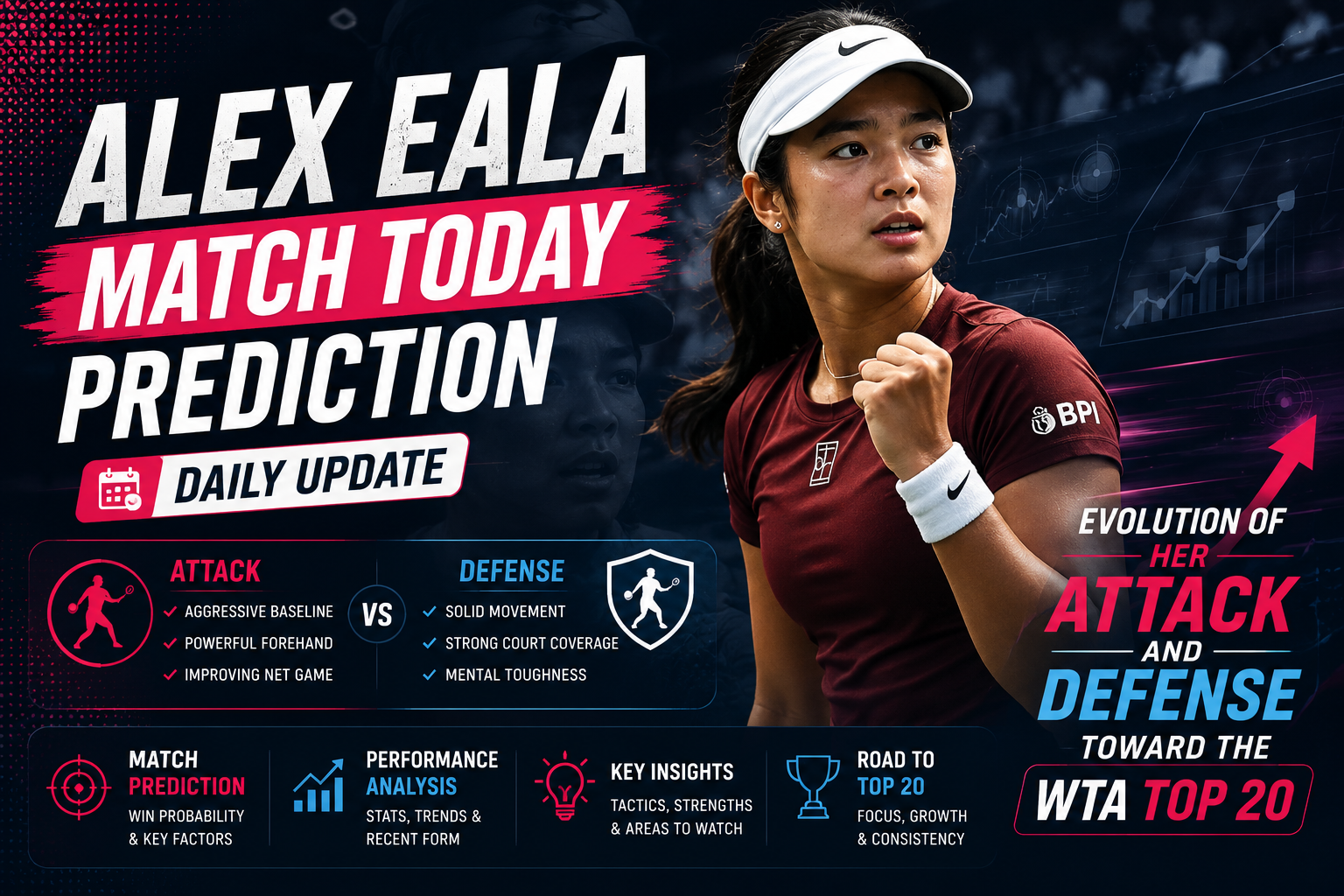
The rise of Alex Eala continues to attract attention across the international tennis world. Every tournament now feels increasingly important because fans, analysts, and coaches are watching her development closely. What once appeared to be a talented junior project is now becoming a serious professional movement toward elite women’s tennis.
Today’s match is more than another result on the schedule. It represents another step in the evolution of her game, another test of her adaptability, and another opportunity to prove she belongs among the future Top 20 players on the WTA Tour.
From the perspective of a UK-based tennis coach and former player, Alex Eala’s progression is especially fascinating because her game is mutating in ways that mirror the evolution of modern women’s tennis itself.
The modern WTA game no longer rewards one-dimensional players. Pure defense is no longer enough. Pure power alone is also becoming insufficient. The players climbing fastest are those who can balance attack and defense seamlessly while adapting tactically during matches.
Alex Eala appears to be learning that balance at exactly the right time in her career.
Match Today: What Makes Alex Eala Dangerous
Whenever Eala enters the court now, opponents face a player who is becoming increasingly difficult to predict.
Earlier in her professional transition, her game relied heavily on consistency, left-handed angles, and patience from the baseline. Those qualities remain strengths today, but several new layers have emerged.
Her current evolution includes:
- earlier ball striking
- improved aggression
- smarter defensive recovery
- stronger physical movement
- more tactical variation
These changes are important because elite WTA tennis is now built around adaptation.
Players who cannot evolve become exposed quickly.
Eala’s development suggests she understands this modern reality.
Prediction for Today’s Match
From a tactical perspective, today’s match likely depends on three critical factors:
1. First-Strike Tennis
Modern women’s tennis increasingly revolves around first-strike aggression:
- serve plus first ball
- return aggression
- early court positioning
If Alex Eala successfully establishes early offensive control, she becomes extremely dangerous.
Her left-handed patterns naturally create uncomfortable angles that disrupt opponent timing.
When she attacks early:
- opponents are pushed wide
- rallies shorten
- court openings appear faster
This is where her recent evolution becomes visible.
2. Defensive Transition
The biggest improvement in Eala’s game has arguably been her transition from defense into attack.
Previously, she often defended well but waited too long before changing momentum.
Now, she is becoming more proactive.
She increasingly:
- absorbs pace
- redirects angles
- counterattacks earlier
- changes depth intelligently
This transition ability is essential for future Top 20 players.
3. Emotional Stability
Daily professional tennis is mentally brutal.
The best players survive momentum swings without panic.
UK coaching philosophy often emphasizes emotional discipline because matches can change quickly under pressure.
Eala has shown increasing maturity in:
- body language
- point recovery
- frustration management
- tactical composure
That mental evolution could become decisive in today’s match.
The Mutation of Alex Eala’s Playing Style
One of the most interesting aspects of Eala’s journey is the mutation of her playing identity.
Modern tennis constantly evolves.
The styles that dominated 10 years ago are no longer enough against today’s athletic and explosive competition.
The new WTA environment rewards players who can:
- attack aggressively
- defend dynamically
- recover instantly
- adapt tactically mid-match
Alex Eala’s game is slowly mutating toward this hybrid style.
Earlier Aggression
In junior tennis, patience often wins matches.
Professional tennis is different.
Top-level players punish passive positioning immediately.
Eala now attacks:
- shorter balls faster
- second serves more aggressively
- open court opportunities earlier
This offensive adaptation is critical.
Improved Defensive Intelligence
Elite defense is not simply running.
Modern defense involves:
- anticipation
- balance
- recovery positioning
- tactical depth control
Eala’s defensive movement has become much more sophisticated.
She now defends with purpose rather than merely surviving rallies.
The Evolution of Women’s Tennis
To understand Alex Eala’s progress, it is important to understand how much women’s tennis itself has changed.
The modern game is faster and more physical than ever before.
Players like:
- Iga Swiatek
- Aryna Sabalenka
- Coco Gauff
- Elena Rybakina
have transformed the sport into an athletic battlefield.
The elite level now requires:
- explosive movement
- tactical adaptation
- physical endurance
- mental resilience
- offensive courage
Alex Eala’s progression suggests she is adapting to this environment rather than resisting it.
That is an extremely encouraging sign.
Attack vs Defense: The Balance of Elite Players
The most dangerous players in modern tennis are not pure attackers or pure defenders.
They combine both.
This is where Eala’s future potential becomes exciting.
Offensive Development
Her forehand aggression continues improving.
She now steps forward more confidently and looks increasingly comfortable taking control of rallies.
Top 20 players must consistently create pressure rather than waiting for mistakes.
Eala’s willingness to attack is growing visibly.
Defensive Recovery
At the same time, her movement remains one of her strongest assets.
She covers the court intelligently and recovers balance quickly after difficult exchanges.
This balance between:
- attack
- defense
- transition
is the foundation of modern elite tennis.
The Importance of the Left-Handed Advantage
Left-handed players naturally create unique tactical problems.
Alex Eala’s lefty patterns remain one of her biggest advantages.
Her crosscourt forehand can pull opponents outside the doubles alley, opening space for aggressive finishing shots.
Historically, left-handed players have disrupted elite competition because opponents face fewer lefties regularly.
Examples include:
- Rafael Nadal
- Petra Kvitova
- Angelique Kerber
Eala’s challenge is continuing to strengthen the offensive quality of those patterns.
If she does, her left-handed game could become extremely dangerous against higher-ranked players.
Why Her Ranking Progress Is Accelerating
Many fans underestimate how quickly rankings can change in tennis.
Momentum matters enormously.
Once players begin consistently competing at higher levels, confidence often accelerates rapidly.
Several factors suggest Eala’s ranking progression could continue climbing aggressively:
- improved physical conditioning
- growing tactical maturity
- better shot tolerance
- increased tour experience
- stronger offensive confidence
The Top 20 no longer feels unrealistic.
Instead, it feels increasingly like a long-term target within reach.
UK Coaching Perspective on Her Development
From a UK coaching perspective, one of the most impressive aspects of Alex Eala’s progression is her willingness to adapt.
Many young players resist changing their natural style.
That becomes dangerous because the modern game evolves constantly.
Eala appears highly coachable.
Her game continues developing in:
- positioning
- shot selection
- transition timing
- point construction
This flexibility often separates future elite players from talented prospects who plateau.
The Physical Side of Modern Tennis
Top-level women’s tennis today demands extraordinary physical resilience.
Players compete across:
- hard courts
- clay
- grass
with constant travel and short recovery windows.
Eala’s physical development is still ongoing.
As her strength improves further, several areas could become even more dangerous:
- serve power
- forehand penetration
- movement explosiveness
- defensive stability
The next few years of physical maturity could dramatically raise her level.
Match Prediction: Tactical Outlook
For today’s match, several patterns are likely to decide the outcome.
If Eala Wins:
- she controls rally tempo early
- her first serve percentage stays high
- she attacks second serves aggressively
- she transitions from defense to offense quickly
If She Struggles:
- passive positioning may allow opponents to dominate baseline exchanges
- short second serves could become vulnerable
- emotional frustration may affect rhythm
However, her recent development suggests she is increasingly capable of handling these situations.
The Evolution of Confidence
Confidence in tennis is not only psychological.
It is tactical confidence.
Elite players trust:
- their movement
- their shot selection
- their physical conditioning
- their decision-making
Alex Eala appears increasingly comfortable playing aggressive tennis under pressure.
That confidence is one of the strongest indicators of future ranking growth.
Can Alex Eala Reach the Top 20?
From a UK coach’s perspective, yes.
Her current evolution strongly suggests Top 20 potential.
Why?
Because she possesses several qualities shared by elite players:
- adaptability
- movement intelligence
- left-handed variation
- improving offense
- emotional composure
However, reaching that level still requires continued development in critical areas.
Key Areas for Improvement
Serve Evolution
The modern WTA Tour rewards free points heavily.
Improving:
- first-serve speed
- placement
- second-serve aggression
could significantly boost her hold percentage.
Forehand Weaponization
Top 20 players usually possess one elite offensive weapon.
Eala’s forehand is gradually evolving toward that level.
Consistency Against Power Players
The biggest challenge in modern women’s tennis is handling relentless pace.
Her ability to redirect power consistently will determine how high she climbs.
The Cultural Impact of Alex Eala
Alex Eala’s rise means far more than rankings.
She represents hope for tennis growth throughout the Philippines and Southeast Asia.
Her success could inspire:
- junior participation
- investment in tennis facilities
- coaching development
- international exposure
Young athletes need visible examples.
Eala is becoming that figure.
Future Prediction
Short-Term Outlook
- more consistent WTA main-draw appearances
- improved results against seeded players
- continued ranking climb
Mid-Term Outlook
- entry into Top 30–20 range
- deeper Grand Slam performances
- increased confidence at major events
Long-Term Outlook
If her evolution continues:
- Top 10 contention becomes realistic
- elite tournament runs become possible
- leadership role in Asian tennis grows significantly
Final Thoughts
Alex Eala’s progress is no longer simply about potential.
It is about transformation.
Her game is mutating in the correct direction for modern women’s tennis:
- more aggressive
- more athletic
- more adaptable
- more complete
Today’s match is another important chapter in that evolution.
Whether she wins or loses, the larger story remains the same: Alex Eala is steadily building the tools required to compete with the world’s best players.
From a UK coaching perspective, the most exciting part is not her current ranking.
It is the visible evolution of her identity as a player.
She is learning when to attack.
She is learning when to defend.
She is learning how to transition between both worlds.
And in modern tennis, that balance is exactly what creates future elite players.