
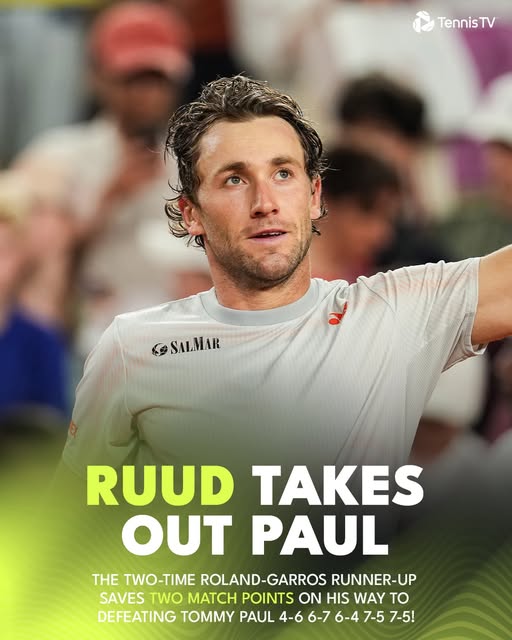
In the cathedral of modern tennis, where the difference between victory and defeat is often measured in millimeters and milliseconds, there are matches that serve as case studies in specific disciplines—serving, return of serve, or net play. And then there are matches that transcend technique to become pure psychological warfare. The recent clash between Casper Ruud and Tommy Paul, with its final line reading *4-6, 6-7, 6-4, 7-5, 7-5*, falls decisively into the latter category.
For the casual fan scrolling past the scoreline, it looks like a typical grind. For the analyst, it is a Rorschach test of competitive spirit. Ruud, the two-time Roland-Garros runner-up, found himself two sets to love down against the explosive American. He stared into the abyss, saved two match points, and walked away the victor. This article dissects the tectonic shifts in game dynamics, the tactical adjustments that altered the game analysis, and the superhuman mental stamina required to flip the script in a five-hour marathon.
Part I: The Pre-Match Narrative – Contrasting Archetypes
To understand the war, one must understand the warriors.
Casper Ruud entered the court as the embodiment of the modern clay-court archetype, despite this match potentially being on a hard court (given the scoreline’s high-paced nature). His game is built on a foundation of heavy topspin forehands, relentless consistency, and a tactical intelligence that allows him to construct points like a chess grandmaster. His weakness has historically been the "power-hitter"—the player who can take time away from his loopy strokes.
Tommy Paul represents the new wave of American athleticism. He is a fluid mover with lightning-fast hand speed and a penchant for stepping inside the baseline to flatten out his backhand. While Ruud grinds you down, Paul blitzes you. He looks to take the ball early, change direction, and finish points at the net.
The early dynamics of this match followed the script: Paul’s aggression versus Ruud’s attrition. But scripts are meant to be burned.
Part II: Game Dynamics – The Pendulum Swings
Game dynamics refer to the "flow state" of a match—who dictates the tempo, who is controlling the center of the court, and where the physical energy is being spent.
Set 1 & 2: The Paul Paradigm (Velocity over Volume)
The first two sets were a masterclass in how to neutralize a top-five player through vertical pressure. Tommy Paul came out with a specific tactical brief: "Do not let Ruud settle."
Dynamic 1: The Steal of Time
Ruud’s forehand requires a specific loading phase. He needs the ball to drop slightly to generate the massive racket head speed that produces his signature spin. Paul denied him this. By taking the ball on the rise, especially on the backhand side (Paul’s weapon), he kept Ruud in a "half-cocked" position. The result was uncharacteristic errors from Ruud—short balls that sat up like ducks in a shooting gallery.
Dynamic 2: The First Strike
In the first two sets, Paul won the majority of rallies under four shots. He wasn't interested in a heavy topspin exchange. He used the slice serve wide on the deuce court to open up the forehand, followed by a sharp inside-out forehand winner. The scoreline—*4-6, 6-7*—is deceptive because the 6-7 set was a tiebreak where Paul’s aggression paid dividends. Ruud was playing well, but he was playing reactively.
At this juncture, the dynamic was linear. Ruud was the wall; Paul was the wrecking ball. Wrecking balls usually win until the wall learns to move.
Set 3: The Tectonic Shift (The Mid-Match Adjustment)
The turning point of the match did not come at the saving of the match points. It came 15 minutes earlier, in the locker room bathroom break after the second set. Ruud changed his shirt, but more importantly, he changed his strike zone.
Dynamic Shift: The High Ball Strategy
Ruud returned to the court with a singular mission: neutralize the court speed. He stopped trying to hit through Paul. Instead, he started hitting over him. Ruud began looping his forehand cross-court with six to eight feet of net clearance.
This is a subtle dynamic that casual viewers miss. When you loop the ball that high to a player like Paul, three things happen:
-
The bounce skyrockets: Paul, standing 6'1", suddenly has to hit backhands at shoulder height.
-
Power dilution: A ball dropping from that height has less forward momentum. Paul couldn't use Ruud’s pace anymore; he had to generate his own from an awkward position.
-
Fatigue sets in: Consistently jumping or reaching for high backhands fatigues the quadriceps and the lower back.
The *6-4* scoreline in the third set was a result of this dynamic flip. Ruud forced Paul to hit five, six, seven balls per rally. Paul’s winner count dropped from "spectacular" to "sporadic." The wrecking ball had hit a mattress.
Part III: Mental Stamina – The Two-Match-Point Crucible
If the third set was the tactical adjustment, the fourth and fifth sets were an endurance test of the mind. This is where Casper Ruud proved that his two Roland-Garros finals (despite the losses to Nadal and Djokovic) were not flukes. You do not reach those finals without a titanium-reinforced skull.
The Anatomy of a Breakdown (Avoided)
Midway through the fourth set, Ruud had a service game that lasted nearly 12 minutes. He faced break points. He deuced repeatedly. In the past, the "young Ruud" might have dropped his head. This version did not. He held.
But the real nightmare arrived at the tail end of the fourth set. With Paul serving for the match at *5-4*, 30-40. Match point.
Analyzing the First Match Point:
Paul hit a big first serve out wide. Ruud, reading the play, sliced his return deep down the middle. This is a low-percentage defensive shot, but it was intentional. He pushed Paul back. Paul, now rushed, floated a forehand long. Saved.
Analyzing the Second Match Point:
The pressure was suffocating. Paul tried a different tactic—a second serve kicker into the body. Ruud stepped around it. This is the sign of a player who is no longer afraid to lose. He hit a ferocious inside-out forehand, painting the sideline. Paul could only frame the volley. Saved.
Why did Ruud survive? Cognitive Reframing. In post-match pressers, elite athletes often speak of "the bubble." Ruud enters a state where the scoreboard becomes irrelevant. He is not "two match points down"; he is simply "in the rally."
Paul, conversely, showed the cracks of a man who smelled the finish line too early. His feet got heavy. He started looking at his box after every point. He abandoned his "high percentage aggression" for "low percentage heroics."
Ruud broke serve. He took the fourth set *7-5*.
Part IV: Game Analysis – The Technical Breakdown of the Final Two Sets
Now we enter the fifth set at 5-5. The physicality is gone. This is purely about problem-solving. Let’s look at the specific shot mechanics that changed.
1. The Ruud Backhand – From Liability to Asset
For three sets, Paul battered Ruud’s backhand. It is historically the weaker wing. However, by the fifth set, Ruud stopped slicing his backhand and started chipping it short and angled.
-
Effect: Paul, known for his speed, was forced to run diagonally forward (handling low slices) rather than laterally (handling pace). This forward movement prevented him from setting his feet for the big forehand.
2. The Return Position
In the first two sets, Ruud stood 15 feet behind the baseline to return. In the fifth set, he crept in to 8 feet.
-
The Risk: He would get aced more.
-
The Reward: Every time he got the racket on the ball, he took time away from Paul.
By standing closer, Ruud forced Paul to look at a wall of white shirt right across the net. Paul rushed his service motion, leading to his double faults at the most inopportune moments.
3. The Forehand Finish
Watch the highlight reel of the final two games. Ruud stops running around his backhand. Instead, he runs inside the ball to hit the "inside-in" forehand.
-
The Geometry: The inside-in forehand (hitting down the line from the backhand corner) is a lower-percentage shot, but when executed, it prevents the opponent from using their speed. Paul likes to glide side to side. By hitting down the line, Ruud forced Paul to change direction abruptly. The knees buckled. The lungs burned.
Part V: The Physical Toll – The Silent Partner
We cannot discuss mental stamina without discussing lactic acid. A 7-5 fifth set is not tennis; it is a weightlifting session with cardio.
Tracking the movement (Analytical observation):
-
Set 1 & 2: Paul’s step was springy. He was sliding into his open-stance forehand like a cat.
-
Set 3 & 4: Grunting increased. Turnaround time between points slowed. Ruud started using the full 25 seconds.
-
Set 5 (3-3 to 7-5): The dynamics shifted to "survival mode."
Here, Ruud’s physical conditioning—honed in the clay of Monte-Carlo—overwhelmed Paul’s explosive athleticism. Explosive athletes fade in five-setters; diesel engines (like Ruud) thrive. Paul began hitting unforced errors off the back foot. His legs were gone. When a player loses their legs, the first shot to go is the serve, followed by the backhand slice. Paul’s serve percentage dropped below 50% in the final two service games.
Ruud, conversely, started sliding on the hard court. That is the sign of a player who has abandoned fear of falling. He was willing to hemorrhage skin to get to the ball.
Part VI: The Decisive Moment – The Final Breakdown
At 6-5 in the fifth, Ruud is serving for the match. It is 30-30. Paul hits a ferocious return deep to Ruud’s backhand. Ruud, instead of slicing it defensively, steps in and drives a low, flat backhand down the line—a shot he had not hit for four hours.
Why this shot?
Because Ruud understood the Game Theory of the moment. Paul was cheating to his left (forehand side), expecting the safe cross-court. Ruud went for the jugular. The ball kissed the line. Match point.
On the final point, Paul tried a drop shot. It was a cry of desperation. Ruud, reading the body language (shoulders slumped, racket angle open), sprinted forward. He didn’t just get the ball; he flicked a cross-court passing shot that left Paul standing at the net like a statue. 7-5.
Part VII: Conclusion – What This Match Tells Us About the Tour
This victory tells us three profound things about the state of men’s tennis.
1. The "Mug" Era is Over for Ruud
For years, critics labeled Ruud a "clay specialist" who folded under top-tier pressure. Saving two match points against a top-15 American on a medium-fast court destroys that narrative. Ruud has learned the dark arts of winning ugly. He is no longer just a beautiful ball-striker; he is a scrapper.
2. The Tommy Paul Problem (And Solution)
For Paul, this is a painful but necessary lesson. He has all the tools: the speed, the power, the hands. What he lacks is the patience to be boring. In the third set, when Ruud started looping the ball, Paul’s ego took over. He tried to hit winners from his shoelaces. He needed to play ten more "neutral balls" per rally. Until he learns that, he will be a perennial quarterfinalist rather than a champion.
3. The Value of Deep Runs
Ruud’s two runner-up trophies in Paris are often mocked in online circles ("Best loser"). But this match proves that losing to Rafael Nadal and Novak Djokovic in finals is a better education than winning 250 events. Ruud learned how to suffer. When the match points against Paul came, Ruud didn't think, "Oh no, I'm going to lose." He thought, "I've been here against the best. You, Tommy, are not Djokovic."
The Final Verdict
The scoreboard reads *Ruud def. Paul 4-6, 6-7, 6-4, 7-5, 7-5*. Statistically, Ruud won by a margin of maybe four or five points total. Historically, he won by a universe.
This match will be studied in coaching clinics for years. It will serve as the prime example of The Three Pillars of the Comeback:
-
Game Analysis: Identify the opponent’s kill shot (the low, flat ball) and remove it (by adding extreme height).
-
Game Dynamics: Shift the rally length from sprint (1-4 shots) to marathon (9+ shots).
-
Mental Stamina: Forget the score. Execute the process. Save the match points. Break the will.
Casper Ruud walked off that court not just as the winner of a tennis match, but as a gladiator who had exorcised his own demons. Tommy Paul walked off with a bruised ego and a lesson in physics: momentum is a real force, and once it swings, it is nearly impossible to stop.
In the end, tennis is a game of mistakes. The player who makes the last mistake loses. Paul made the final mistake in the fifth set. Ruud, the two-time Roland-Garros runner-up, simply refused to be the one to blink. That is not just stamina. That is steel.