
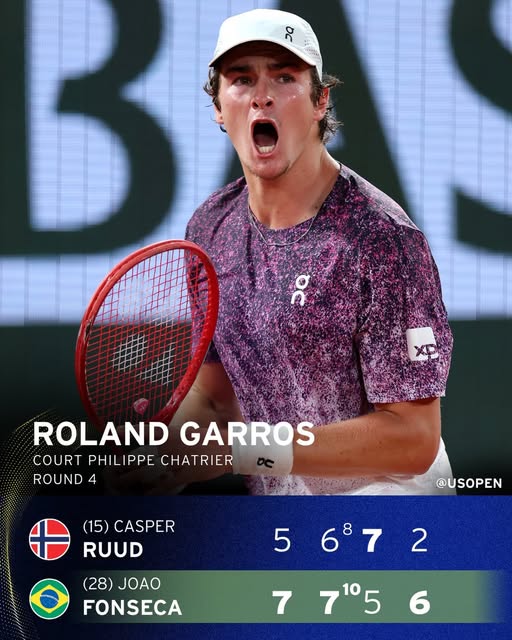
The tennis world may have witnessed a defining moment in Paris.
On one of the sport's most prestigious stages, João Fonseca delivered another statement performance, defeating Casper Ruud to reach the first Grand Slam quarterfinal of his young career. For many fans, the result may look like another upset. For ATP analysts, however, it feels more like confirmation.
The Brazilian teenager is no longer simply a promising prospect.
He is becoming a legitimate threat to the world's best players.
Every generation produces a handful of talents who appear capable of changing the future of the sport. Carlos Alcaraz was one. Jannik Sinner was another. Today, João Fonseca is rapidly entering that conversation.
The victory over Casper Ruud demonstrated far more than powerful shot-making. It revealed a player whose confidence is growing at an extraordinary rate, whose tactical understanding continues to evolve, and whose physical tools are beginning to match his ambitions.
From an ATP expert perspective in the United States, one conclusion is becoming increasingly difficult to ignore:
João Fonseca looks like a future Grand Slam champion.
The Significance of a First Grand Slam Quarterfinal
Every elite player remembers their first major breakthrough.
For some players it is reaching the third round.
For others it is reaching the second week.
For future champions, it is often the first Grand Slam quarterfinal.
This stage represents an important psychological barrier.
The player begins to understand that he belongs among the sport's elite.
No longer is he merely participating.
He is competing to win.
That distinction matters enormously.
Many talented players spend years trying to convince themselves they belong on the biggest courts.
Fonseca is beginning to show signs that he already believes it.
Confidence at the professional level is one of the most powerful weapons in tennis.
Once a player develops genuine belief, performance often accelerates rapidly.
Defeating Casper Ruud Is Not a Small Achievement
Some casual fans underestimate how difficult it is to beat Casper Ruud on clay.
That would be a mistake.
Ruud has built a reputation as one of the strongest clay-court competitors of his generation.
His strengths include:
- Heavy topspin forehand
- Excellent movement
- Tactical discipline
- Physical endurance
- Patience during long rallies
These qualities make him extremely dangerous at Roland Garros.
To defeat Ruud, a player must sustain aggression while remaining disciplined.
Fonseca managed to do exactly that.
The Brazilian did not simply overpower Ruud.
He outplayed him strategically.
That is what makes the performance particularly impressive.
The Confidence Level Is Rising Massively
The most important development in Fonseca's game may not be technical.
It may be psychological.
Every major victory adds confidence.
Every big stage appearance increases belief.
Every successful challenge against an established star creates momentum.
Momentum in tennis can be transformative.
A player who enters tournaments expecting success often performs differently.
Movement becomes freer.
Shot selection becomes clearer.
Decision-making becomes faster.
Pressure situations become less intimidating.
Fonseca increasingly appears to be playing with that type of confidence.
The difference is visible.
His body language is stronger.
His court presence is growing.
His competitive energy is becoming more consistent.
These are signs commonly observed in future champions.
ATP Expert View: Confidence Changes Everything
American ATP analysts often discuss a concept called "competitive identity."
This refers to how a player sees himself.
There is a major difference between thinking:
"I hope I can compete."
and
"I expect to win."
The second mindset creates a completely different athlete.
Players such as Novak Djokovic, Rafael Nadal, and Roger Federer developed an expectation of success.
They walked onto the court believing they could beat anyone.
Fonseca is beginning to display similar traits.
He is not intimidated by rankings.
He is not overwhelmed by famous opponents.
He is focused on competing.
That is a critical characteristic for future Grand Slam winners.
Smart Ball Striking Is Becoming a Signature Strength
Many young players rely purely on power.
Fonseca is showing increasing intelligence in his shot selection.
This is an important distinction.
Power without strategy is often inconsistent.
Smart aggression creates sustained success.
Against Ruud, several patterns stood out:
Directional Changes
Fonseca frequently changed directions at the right moments.
Rather than hitting hard for the sake of hitting hard, he used pace to create opportunities.
Court Positioning
He looked increasingly comfortable taking the ball early.
This allowed him to reduce Ruud's reaction time.
Depth Control
Many of his groundstrokes landed deep near the baseline.
Deep shots are among the most effective weapons in professional tennis.
They force opponents into defensive positions.
Point Construction
Perhaps most importantly, Fonseca appeared to understand how to build points.
This maturity is unusual for a young player.
Speed and Agility Are Becoming Elite Weapons
Modern tennis is faster than ever.
Power alone is no longer enough.
Elite movement determines who survives at the highest level.
Fonseca's athleticism continues to improve.
Several movement qualities stand out:
Explosive First Step
His ability to react quickly helps him reach difficult balls.
Recovery Speed
After striking a shot, he recovers efficiently.
Defensive Transition
He moves from defense to offense exceptionally well.
Court Coverage
His range allows him to extend rallies and frustrate opponents.
These attributes are critical for success in Grand Slam events.
Seven-match tournaments demand extraordinary physical capabilities.
Fonseca appears capable of handling those demands.
The Momentum Factor
Momentum is one of the least understood elements in professional tennis.
Many people view momentum as emotion.
In reality, it is often a combination of factors:
- Confidence
- Match fitness
- Tactical clarity
- Positive results
- Belief
Fonseca currently appears to be experiencing all five.
When momentum builds, players often discover a higher performance level.
Suddenly they begin winning matches that previously felt difficult.
The sport becomes simpler.
Execution becomes cleaner.
Pressure becomes manageable.
This is often how future stars emerge.
Why Grand Slam Success Changes Players
A deep Grand Slam run teaches lessons that cannot be learned elsewhere.
Players discover:
- How their bodies respond under pressure
- How they recover between matches
- How they handle media attention
- How they perform on the biggest courts
These experiences accelerate development.
Every additional round creates valuable information.
The quarterfinal stage introduces new challenges.
Future champions embrace those challenges.
Tactical Adjustments Separate Good Players from Great Players
One of the most encouraging developments in Fonseca's rise is his willingness to adjust.
Professional tennis is a game of constant adaptation.
Opponents study weaknesses.
Coaches analyze patterns.
Players must evolve continuously.
Against elite opponents, Plan A rarely works forever.
Champions develop Plan B and Plan C.
Fonseca appears increasingly comfortable making adjustments during matches.
That flexibility will become essential as he faces stronger competition.
Learning from Alcaraz and Sinner
The rise of Carlos Alcaraz and Jannik Sinner offers a useful comparison.
Both players improved rapidly because they constantly evolved.
They refined:
- Serve placement
- Shot selection
- Return positioning
- Physical conditioning
- Match management
Fonseca appears to be following a similar path.
His current game is impressive.
His future game may be significantly stronger.
That should excite Brazilian fans.
The Importance of Managing Energy
Grand Slam tournaments are physical marathons.
Winning one requires careful energy management.
Many young players waste energy unnecessarily.
Future champions learn efficiency.
They understand:
- When to attack
- When to defend
- When to shorten points
- When to conserve energy
Fonseca's court intelligence is improving in this area.
He appears increasingly aware of momentum shifts and physical demands.
That awareness becomes invaluable during major tournaments.
The Serve Is Continuing to Develop
One area with significant upside remains the serve.
The serve often determines whether a player becomes good or great.
A stronger serve creates:
- More free points
- Easier service games
- Reduced physical stress
- Greater confidence under pressure
Fonseca already possesses strong fundamentals.
As he matures physically, his serve could become a major weapon.
That possibility should concern future opponents.
Mental Strength Is Emerging
Every Grand Slam champion possesses exceptional mental resilience.
Pressure is unavoidable.
The ability to manage it separates contenders from champions.
Fonseca's emotional control continues to improve.
Several encouraging signs are visible:
- Positive body language
- Quick recovery after mistakes
- Focus during important points
- Confidence in big moments
These characteristics are often associated with future elite players.
The mental side of tennis cannot be overstated.
Championships are frequently decided between the ears.
Why the Tennis World Is Paying Attention
The excitement surrounding Fonseca is not based solely on talent.
It is based on trajectory.
His improvement curve is remarkably steep.
Each month appears to bring progress.
Each tournament reveals new strengths.
Each challenge creates growth.
This pattern is familiar.
It resembles the early stages of many great careers.
ATP USA Expert Analysis: A Future Grand Slam Champion?
Predicting Grand Slam winners is always difficult.
The ATP Tour remains incredibly competitive.
However, certain players demonstrate qualities that suggest extraordinary potential.
Fonseca possesses many of those qualities:
Elite Athleticism
A foundation for long-term success.
Explosive Shot-Making
Capable of hurting opponents from anywhere on the court.
Growing Tactical Intelligence
Improving rapidly with experience.
Competitive Courage
Unafraid of major stages.
Strong Mentality
Able to handle pressure effectively.
Together, these traits form the profile of a future champion.
The Brazilian Dream
Brazil has waited many years for another player capable of challenging for the sport's biggest titles.
The country has always produced passionate tennis fans.
Now they have a young star who appears capable of carrying those hopes.
Expectations will continue to rise.
Media attention will increase.
Pressure will grow.
How Fonseca manages these factors will shape his future.
So far, he appears ready.
Looking Ahead
The next phase of Fonseca's journey will be fascinating.
The quarterfinal breakthrough is important.
But future champions rarely stop there.
They keep pushing.
They keep improving.
They continue chasing larger goals.
The signs suggest Fonseca has that mentality.
His confidence is growing.
His game is evolving.
His understanding of elite tennis is deepening.
Most importantly, he appears to be learning how to win.
Final Thoughts
João Fonseca's first Grand Slam quarterfinal represents far more than a single tournament achievement. It is a signal that one of tennis' brightest young talents is beginning to transform potential into reality.
His victory over Casper Ruud showcased confidence, tactical maturity, intelligent ball striking, elite athleticism, and a growing ability to manage momentum. These are not merely characteristics of a promising prospect. They are characteristics commonly found in future champions.
From an ATP expert perspective in the United States, Fonseca's development is accelerating at an impressive pace. While the journey toward a Grand Slam title remains challenging, the foundations are clearly being built.
If he continues refining his game, strengthening his physical conditioning, and maintaining the fearless mindset that has fueled his rise, it would not be surprising to see João Fonseca lifting a major trophy in the coming years.
The tennis world is watching closely.
And after reaching his first Grand Slam quarterfinal, João Fonseca is giving everyone a compelling reason to believe that a future Grand Slam champion may already have arrived.