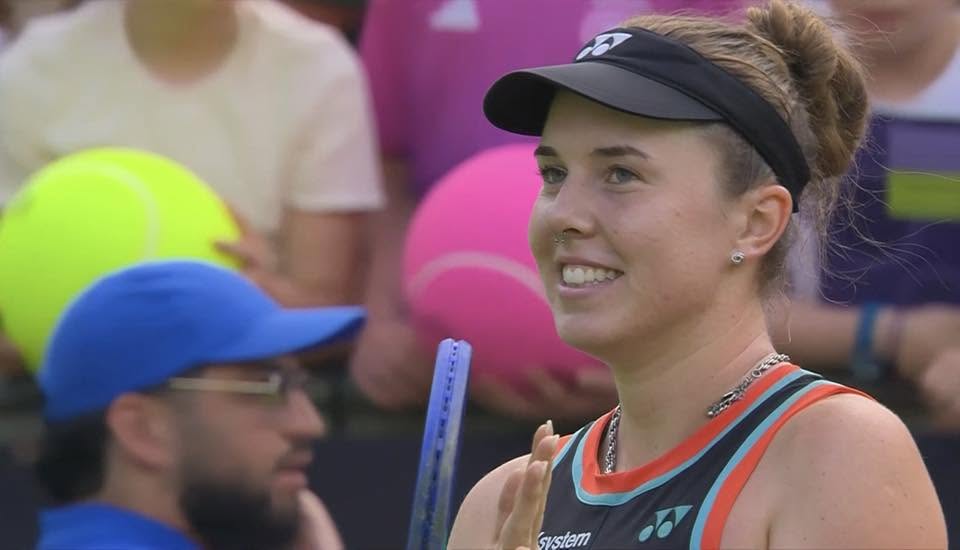
his Was Not the Same Linda Eala Beat in 2020
Tennis fans often look at head-to-head records and assume they tell the entire story.
But the three matches between Linda Nosková and Alexandra Eala reveal something much deeper.
Head-to-Head History
2020 French Open Juniors (Quarterfinals)
- Eala defeated Nosková
2026 Indian Wells Round of 16
- Nosková defeated Eala 6-2, 6-0
2026 Berlin Open Semifinals
- Nosková defeated Eala 6-2, 6-4
Many people focus on the scores.
The bigger story is the transformation.
The Linda Nosková that lost to Eala in Paris as a junior is not the Linda Nosková that demolished Eala at Indian Wells and controlled her in Berlin.
What happened?
The answer is simple:
Nosková's game mutated into a higher level.
She evolved from a talented junior into a modern power tennis machine.
Meanwhile, Eala's strengths remained based on creativity, intelligence, court construction, and tactical variety.
When these two developmental paths collided in 2026, Nosková's evolution proved overwhelming.
Understanding Game Mutation in Professional Tennis
A tennis player's growth is rarely linear.
Young players improve through stages.
Stage 1: Talent
At junior level:
- Technique wins
- Consistency wins
- Court intelligence wins
This was where Eala excelled.
Her tennis IQ often exceeded opponents.
She understood patterns.
She understood geometry.
She understood momentum.
Stage 2: Professional Strength
At professional level:
- Ball speed increases
- Physicality increases
- Serve quality increases
Players begin to hit harder.
Rallies become faster.
Time disappears.
Stage 3: Elite Mutation
This is where Nosková has entered.
Elite mutation means:
- Power increases dramatically
- Decision-making speeds up
- Court positioning improves
- Physical strength becomes a weapon
- Offensive opportunities are recognized instantly
This is the level where matches are controlled rather than played.
Nosková is increasingly operating in this zone.
The Indian Wells Destruction Was the First Warning
The 6-2, 6-0 victory at Indian Wells was shocking.
The scoreline revealed more than a bad day.
It revealed a matchup problem.
A 6-0 set at professional level usually means one player completely understands how to expose another.
Nosková discovered something important.
She realized:
- Eala prefers rhythm.
- Eala prefers constructing points.
- Eala prefers using angles.
- Eala prefers tactical exchanges.
Nosková removed all of that.
She transformed tennis into pure pressure.
The result was devastating.
Berlin Confirmed the Blueprint
Indian Wells could have been considered an isolated event.
Berlin removed all doubt.
The semifinal lasted only 69 minutes.
That is extremely short for a WTA semifinal.
Why?
Because Nosková never allowed Eala to settle.
Every game felt rushed.
Every rally felt compressed.
Every decision had to be made instantly.
This was not accidental.
It was tactical suffocation.
The Biggest Difference: Ball Weight
Many fans discuss power.
Few understand ball weight.
Ball weight is different from speed.
A ball can travel fast.
A heavy ball travels fast while also pushing the opponent backward.
Nosková's forehand has become one of the heaviest shots among younger WTA players.
When Eala contacted the ball, she was often:
- Moving backward
- Hitting from lower positions
- Defending instead of attacking
This changed everything.
Eala's creativity disappears when she is defending.
Nosková understood this perfectly.
How Nosková Took Away Time
The greatest weapon in modern tennis is not power.
It is time.
Elite players steal time.
Nosková repeatedly:
- Took balls early
- Returned aggressively
- Moved forward
- Flattened groundstrokes
Every action reduced Eala's reaction window.
Instead of having two seconds to decide, Eala had one.
Instead of one second, she had half a second.
This constant reduction creates pressure.
Pressure creates errors.
The Center of the Court Belonged to Nosková
The player controlling the center usually controls the match.
Throughout Berlin:
Nosková occupied the center.
Eala defended the corners.
This difference is enormous.
The center provides:
- Better angles
- More offensive options
- Shorter recovery distances
Nosková repeatedly forced Eala outside the doubles alley.
Once that happened, the next shot usually ended the rally.
The Evolution of Nosková's Serve
One major difference between junior Nosková and professional Nosková is the serve.
The serve is now:
- More powerful
- More accurate
- More varied
As a junior, rallies began on relatively equal terms.
Now Nosková often begins points with immediate advantage.
When a player starts every service game ahead, confidence grows rapidly.
Eala struggled to establish pressure on Nosková's service games.
Without return pressure, momentum becomes difficult to create.
Why Eala's Left-Handed Advantage Was Neutralized
Against many players, Eala's left-handed game is a nightmare.
The serve drags opponents wide.
The forehand creates unusual angles.
The patterns are uncomfortable.
Nosková looked completely prepared.
She anticipated:
- Wide serves
- Crosscourt forehands
- Lefty patterns
Nothing surprised her.
This preparation removed one of Eala's biggest weapons.
The Physical Mutation
The junior Nosková of 2020 was talented.
The professional Nosková of 2026 is physically imposing.
She now possesses:
- Greater leg strength
- Greater core strength
- Greater shoulder strength
- Better endurance
These improvements allow her to maintain pace throughout matches.
Power without endurance is useless.
Nosková now has both.
The Return Game Became a Weapon
One of the most overlooked aspects of the matchup is returning.
Many players simply put the return back into play.
Nosková attacks.
Her returns immediately seize control.
Against Eala's second serve, Nosková often stepped forward aggressively.
This produced:
- Short rallies
- Immediate pressure
- Defensive first shots
The server suddenly becomes the defender.
That is a nightmare scenario.
Why Grass Favored Nosková
Berlin was played on grass.
Grass rewards first-strike tennis.
It rewards:
- Big serves
- Flat hitters
- Early ball striking
- Aggressive positioning
These conditions naturally favor Nosková.
Eala's strengths involve:
- Constructing points
- Creating angles
- Changing rhythm
- Building rallies
Grass gives less time for those strengths to emerge.
The surface amplified Nosková's advantages.
The Fear Factor
Elite players create psychological pressure.
When opponents know a ball is coming hard, they start preparing early.
This anticipation causes mistakes.
By Berlin, Eala had already experienced the Indian Wells defeat.
She knew Nosková could overwhelm her.
That memory matters.
Athletes rarely admit it publicly.
But previous losses remain in the subconscious.
Every missed shot reinforces them.
Every winner recalls them.
Psychological pressure compounds technical pressure.
The Forehand Was the Difference-Maker
If there was one shot that defined the rivalry in 2026, it was Nosková's forehand.
The forehand accomplished three objectives:
1. Push Eala Back
Every heavy forehand moved Eala behind the baseline.
2. Open the Court
Once Eala moved backward, angles appeared.
3. Finish Points
The next forehand frequently ended rallies.
This sequence repeated throughout both victories.
Why Eala Could Not Establish Rhythm
Eala's game thrives on rhythm.
She is excellent at:
- Pattern recognition
- Tactical construction
- Shot variation
Nosková prevented rhythm entirely.
Instead of ten-ball rallies, points ended in four.
Instead of six-ball exchanges, points ended in three.
The shorter the rally became, the more Nosková benefited.
The Modern WTA Trend
The match also reflected a larger trend in women's tennis.
The modern WTA increasingly rewards:
- Power
- Aggression
- First-strike tennis
Players like Nosková represent this evolution.
They seek immediate control.
They do not wait for mistakes.
They create them.
Eala represents a more strategic and creative style.
The challenge is ensuring that creativity can survive against overwhelming pace.
What Eala Must Learn
Every defeat contains information.
Berlin offered valuable lessons.
Improve First-Serve Effectiveness
More free points are needed.
Take Balls Earlier
Giving Nosková time is dangerous.
Develop More Offensive Patterns
Defense alone cannot survive against elite power.
Improve Transition Game
Moving forward can disrupt heavy baseline hitters.
Add More Variety
Slices and changes of pace can break rhythm.
These adjustments are achievable.
Why This Loss May Help Eala More Than a Win
Strange as it sounds, difficult defeats often accelerate growth.
Great champions learn through exposure.
They learn by seeing the next level.
Nosková showed Eala what elite power tennis looks like.
That experience is invaluable.
Every future training session now has greater clarity.
The weaknesses have been revealed.
The solutions can now be developed.
Has Nosková Become Eala's Worst Matchup?
Possibly.
At least for now.
The reasons are obvious:
- Superior power
- Superior serve
- Superior first-strike tennis
- Ability to neutralize lefty patterns
Some players simply possess natural stylistic advantages.
Nosková currently appears to be one of those opponents.
However, tennis history is filled with players who eventually solved difficult matchups.
The Next Evolution for Eala
The most exciting part of this rivalry may still be ahead.
Eala is not a finished product.
Far from it.
Her next mutation may involve:
- More aggressive court positioning
- Greater physical strength
- More serve power
- More offensive confidence
If these developments occur, future meetings could become dramatically different.
Final Analysis: Why Nosková Hammered Eala
Linda Nosková did not simply beat Alexandra Eala.
She imposed a higher level of tennis.
The junior rivalry ended years ago.
The professional rivalry began in 2026.
And in that professional rivalry, Nosková introduced a game that had evolved significantly beyond its 2020 version.
Her serve became bigger.
Her forehand became heavier.
Her return became more aggressive.
Her movement became more explosive.
Her decision-making became faster.
Most importantly, she learned how to remove time from Eala.
The 6-2, 6-0 victory at Indian Wells exposed the matchup.
The 6-2, 6-4 victory in Berlin confirmed it.
Nosková found the tactical blueprint: attack early, dominate the center, pressure the backhand, punish second serves, and never allow Eala to build rhythm.
That blueprint carried her into the Berlin final.
For Eala, the challenge now is clear. The next chapter of this rivalry will depend on whether she can create her own mutation—one powerful enough to answer the relentless pace, power, and pressure that Linda Nosková now brings to the court.