
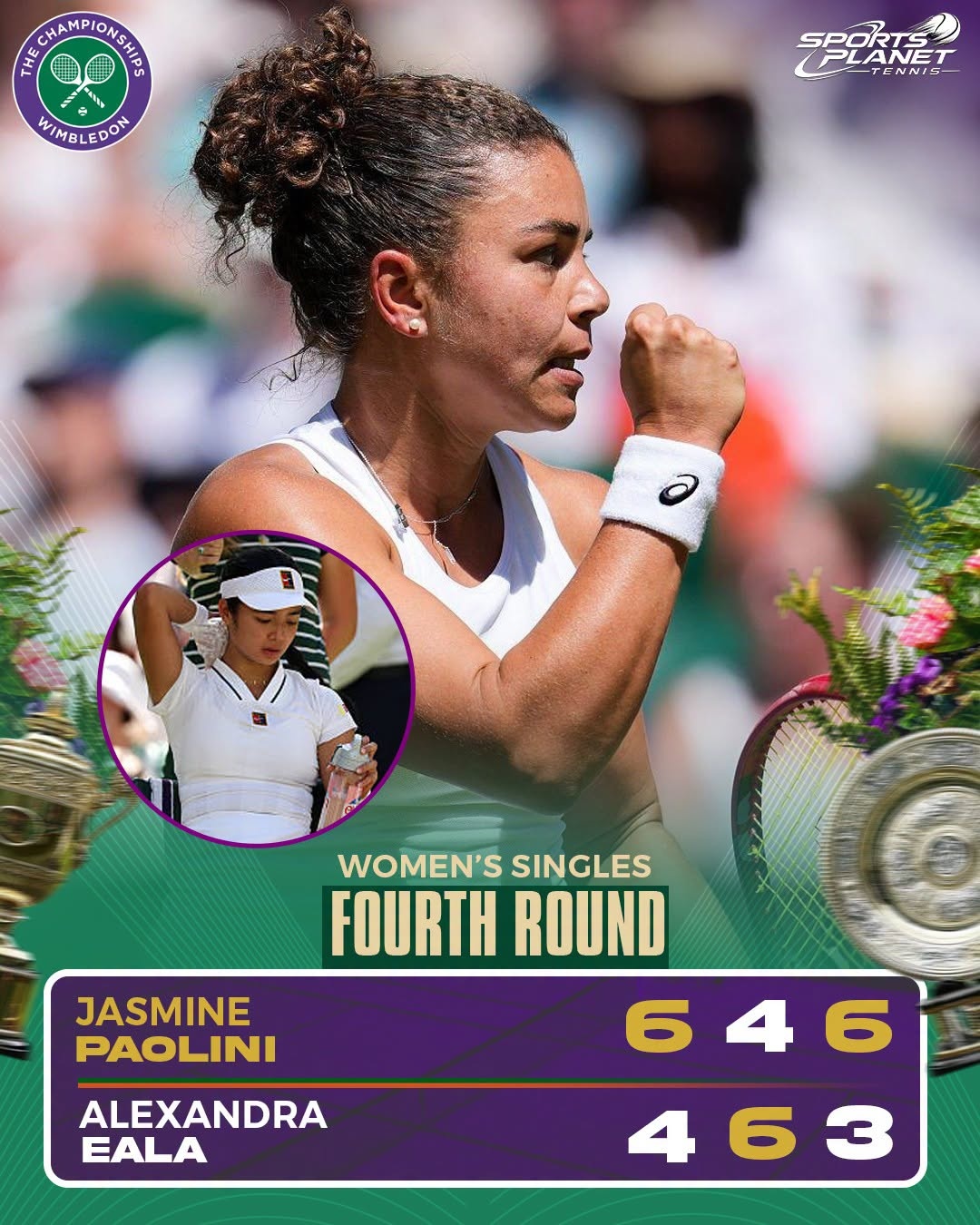
The atmosphere on Centre Court felt different long before the final point. Every rally carried the weight of a Grand Slam quarterfinal berth. Every exchange demanded explosive movement, tactical precision, and emotional control. As the match entered its decisive moments, the intensity rose with every heartbeat.
This was not simply a contest of forehands and backhands. It became a battle between composure and pressure, between youthful fearlessness and veteran experience.
For more than two hours, Alexandra Eala challenged one of the most accomplished grass-court players on tour, pushing Jasmine Paolini to the limit before Paolini prevailed 6-4, 4-6, 6-3.
The Match Turned Into Pure Survival
The opening set resembled a tactical chess match.
Paolini refused to give Eala easy winners. Every aggressive forehand from Eala was met with extraordinary anticipation and counterpunching. Rather than attempting outright winners from impossible positions, Paolini patiently redirected the ball, stretching rallies until she found the perfect opening.
Eala responded with fearless attacking tennis.
Her left-handed forehand repeatedly opened the court, creating sharp crosscourt angles that forced Paolini to defend outside the doubles alley. Whenever Eala stepped inside the baseline, the pace of the match accelerated dramatically.
The crowd sensed something special.
Each winner ignited louder applause.
Each extended rally increased the emotional tension.
Every point felt larger than the previous one.
Momentum Shifted Completely
After surrendering the opening set, Eala refused to disappear.
Instead, she raised her aggression.
Her footwork became more explosive.
She attacked second serves earlier.
She flattened her forehand.
She shortened points before Paolini could establish long defensive exchanges.
The second set belonged to Eala because she dictated the tempo instead of reacting to it.
Every clean strike forced Paolini farther behind the baseline.
Every successful return placed immediate pressure on the Italian veteran.
Momentum had completely shifted.
Centre Court suddenly believed an upset was possible.
The Final Set Became a Psychological Battle
The deciding set demanded something different.
No longer was it simply about physical ability.
It became about emotional control.
As the pressure mounted, both athletes experienced the body's natural stress response.
Heart rates climbed.
Breathing accelerated.
Adrenaline surged through the muscles.
This reaction is normal in elite tennis.
However, the difference between champions and challengers often lies in how effectively they perform despite that stress.
The Hidden Battle: Heart Rate Under Pressure
During ordinary rallies, professional players often perform with remarkable fluidity because their movements are highly automated through years of training.
During the deciding games, however, the body's chemistry changes.
Adrenaline increases.
The sympathetic nervous system becomes dominant.
Heart rate rises significantly.
The brain begins processing every point as increasingly important.
If that response becomes too intense, players may experience:
- Slightly tighter forearm muscles.
- Faster but less controlled swings.
- Milliseconds of delayed preparation.
- Narrower attentional focus.
- Reduced precision under pressure.
These changes are often almost invisible to spectators.
Yet at Wimbledon, matches are frequently decided by differences measured in centimeters and milliseconds.
Milliseconds Decide Championships
A tennis ball may travel more than 120 km/h after a groundstroke.
The player has only fractions of a second to:
- Read the opponent's shot.
- Judge the bounce.
- Move into position.
- Prepare the racket.
- Execute perfect contact.
If preparation is delayed by only a fraction of a second, the consequences can include:
- Contact slightly behind the body.
- A forehand drifting long.
- A backhand clipping the net.
- Reduced topspin.
- Less effective recovery movement.
Elite tennis rewards extraordinary precision.
Small timing differences often determine entire tournaments.
Paolini's Championship Experience Emerged
This was where Jasmine Paolini demonstrated why experience matters.
She recognized that Eala's pace remained dangerous.
Instead of trying to overpower her opponent, Paolini changed the geometry of the court.
She used:
- Higher topspin.
- Deeper crosscourt angles.
- Heavy defensive retrievals.
- Precise changes of direction.
- Exceptional court positioning.
Rather than rushing for spectacular winners, she patiently forced Eala into increasingly difficult decisions.
Every additional shot increased physical fatigue.
Every extended rally tested concentration.
Eventually, tiny opportunities appeared.
Paolini seized nearly every one.
The Power Shots Never Stopped
Even late in the third set, Eala continued swinging aggressively.
Her forehand remained one of the most dangerous weapons on court.
Her willingness to attack impressed everyone watching.
However, Paolini repeatedly absorbed that pace before redirecting it with remarkable consistency.
That defensive excellence slowly transformed into offense.
The Italian's greatest weapon was not overwhelming power.
It was controlled pressure.
Why Paolini Won
Several technical adjustments separated the two players late in the match.
Paolini:
- Increased first-serve accuracy.
- Reduced unforced errors.
- Extended rallies strategically.
- Returned second serves aggressively.
- Chose higher-percentage attacking opportunities.
- Managed emotions exceptionally well during pressure points.
Those adjustments proved decisive in the closing games.
Alexandra Eala Leaves Wimbledon Stronger
Although defeated, Eala demonstrated why she is regarded as one of the brightest young talents in women's tennis.
She proved she belongs on the biggest stage.
She matched one of the world's elite grass-court competitors for long stretches.
She showed courage under pressure.
She displayed explosive shot-making.
Most importantly, she gained invaluable experience competing deep into a Grand Slam against an opponent who has learned how to navigate the sport's biggest moments.
Jasmine Paolini Is Back
After injuries, setbacks, and difficult months away from her highest level, Jasmine Paolini reminded the tennis world why she became one of the sport's elite competitors.
Her victory was not built solely on powerful strokes.
It was built on resilience.
On tactical intelligence.
On emotional discipline.
On trusting years of experience when every heartbeat grew louder.
Champions are rarely defined only by how hard they hit the ball.
They are defined by how calmly they think when the pressure is greatest.
Against Alexandra Eala, Jasmine Paolini proved exactly that.
She is back where she belongs—in the Grand Slam quarterfinals.