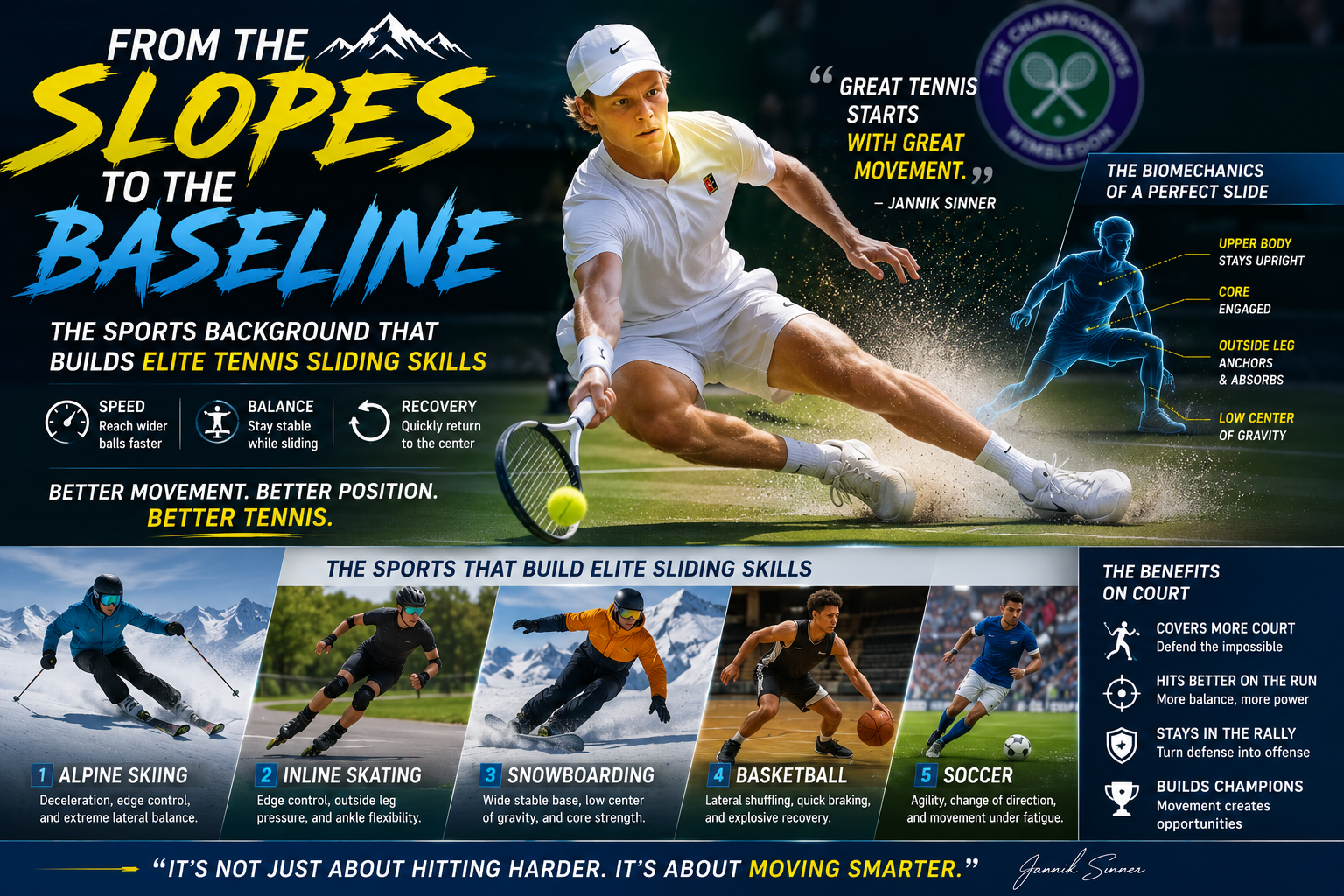
"Elite footwork isn't born overnight—it is built through years of mastering balance, body control, and movement."
Modern tennis has evolved into one of the most physically demanding sports in the world. Today's champions are expected to sprint, stop, slide, recover, and strike powerful groundstrokes in a matter of seconds. While explosive strokes often dominate highlight reels, coaches know that the true foundation of championship tennis begins with movement.
Among today's elite players, few demonstrate this better than Jannik Sinner. His ability to slide effortlessly on clay, hard courts, and grass has become one of the defining features of his game. Although his years as a young alpine ski racer likely contributed to qualities such as balance, edge control, and confidence managing momentum, his movement is also the result of years of specialized tennis coaching, physical conditioning, and technical refinement.
Many sports develop athletic qualities that transfer well to tennis, but some provide a particularly strong foundation for the balance, coordination, and lower-body control required for advanced sliding skills.
Why Sliding Matters in Modern Tennis
Sliding is no longer reserved only for clay courts.
Today's elite professionals increasingly slide on hard courts and even grass when conditions allow.
A controlled slide can help a player:
- Reach wider balls.
- Slow down efficiently after sprinting.
- Maintain balance during difficult shots.
- Recover more quickly toward the center of the court.
- Transition from defense into offense.
Executing this movement safely requires exceptional timing, strength, flexibility, and technique.
Alpine Skiing: The Closest Athletic Match
Among all sports, alpine skiing shares many movement principles with modern tennis footwork.
Both demand precise balance while controlling momentum at high speed.
Learning to Use Friction
Ski racers constantly regulate speed by working with friction rather than fighting against it.
Instead of making sudden stops, they redirect momentum through carefully controlled edge angles.
Advanced tennis players apply a similar concept during controlled slides.
Rather than planting the foot abruptly, they allow the shoe to glide across the surface under control before pushing into the next movement.
This smooth deceleration reduces wasted motion and helps maintain balance.
Exceptional Lateral Balance
Ski racing also develops remarkable side-to-side stability.
Athletes learn to keep their upper body calm while their lower body absorbs large lateral forces.
That same body position appears in elite tennis.
Watch Sinner during a full-speed slide.
His legs may be stretched wide apart, but his head remains remarkably steady.
His shoulders stay level.
His eyes remain locked on the ball.
This upper-body stability helps preserve stroke accuracy even during extreme movement.
Inline Skating: Building Edge Control
Many performance coaches recommend inline skating as one of the best complementary sports for tennis players.
Although the movement is different from tennis, several athletic qualities transfer well.
Weight Transfer
Skating teaches athletes to shift body weight smoothly onto one leg while maintaining balance.
This resembles the outside-leg loading used before many wide defensive or offensive shots in tennis.
Efficient weight transfer allows players to recover faster and generate more force during directional changes.
Stronger Ankles
Skating also develops ankle mobility and lower-leg strength.
These qualities help athletes better tolerate the demands of rapid direction changes and controlled deceleration on the tennis court.
Strong ankles alone do not make sliding safe, but they are an important part of overall movement quality.
Snowboarding: Stability Under Pressure
Snowboarding develops a different, yet equally valuable, set of athletic skills.
Because both feet remain fixed to one board, riders constantly manage balance through their hips, knees, and core.
This reinforces several movement patterns that also benefit tennis players.
A Wide Athletic Base
Snowboarders naturally adopt a low center of gravity with bent knees and active core muscles.
That same athletic posture appears repeatedly in elite tennis.
A stable base allows players to absorb incoming pace while remaining balanced enough to attack the next shot.
Basketball: Mastering Lateral Quickness
Although basketball players rarely slide across the floor intentionally, they excel at rapid side-to-side movement.
Defensive positioning requires:
- Bent knees.
- Wide stance.
- Explosive lateral shuffles.
- Fast recovery.
These qualities closely resemble the movement patterns tennis players use between shots.
Basketball also teaches athletes to react instantly to unpredictable changes in direction, an essential skill during long rallies.
Soccer: Efficient Movement Under Fatigue
Soccer develops another important athletic quality.
Players repeatedly accelerate, decelerate, and change direction throughout a match.
These constant transitions improve:
- Agility.
- Lower-body endurance.
- Coordination.
- Reaction speed.
- Dynamic balance.
Although soccer does not involve tennis-style sliding, it builds many of the physical foundations needed for elite court coverage.
Why Tennis Training Still Comes First
Cross-training can enhance athletic qualities, but mastering tennis sliding ultimately depends on tennis-specific practice.
Elite players spend thousands of hours refining:
- Foot placement.
- Court positioning.
- Balance during strokes.
- Timing of the slide.
- Recovery after contact.
- Surface-specific movement.
Sliding on clay differs from sliding on hard courts or grass, and each surface requires its own adjustments.
Without expert coaching and gradual progression, attempting advanced slides on hard courts can increase the risk of ankle, knee, or hip injuries.
The Physical Blueprint of Elite Movers
Professional players who slide effectively generally possess a combination of:
- Exceptional hip mobility.
- Strong gluteal and core muscles.
- Flexible ankles.
- Excellent single-leg balance.
- Explosive leg power.
- Superior coordination.
These qualities allow them to stay balanced while producing powerful groundstrokes under extreme movement demands.
Why Jannik Sinner Stands Out
Jannik Sinner represents the modern evolution of tennis movement.
His early experience in alpine skiing likely gave him an outstanding athletic foundation, but his success comes from blending those qualities with years of dedicated tennis development.
His movement is defined by:
- Smooth deceleration.
- Efficient recovery.
- Stable upper-body posture.
- Excellent balance during wide defensive positions.
- The ability to transition from defense to offense in a single movement.
Rather than sliding only to reach difficult balls, he frequently uses controlled slides to create balanced hitting positions that allow him to strike aggressively.
That combination of movement efficiency and shot production is one reason he has become one of the most complete players in modern tennis.
Lessons for Every Tennis Player
Most recreational players focus on hitting harder serves or more powerful forehands.
Elite coaches often begin somewhere else.
They teach players how to move.
A player who reaches the ball in perfect balance can generate more power, recover faster, and make better tactical decisions than someone with bigger strokes but poorer footwork.
Whether your athletic background comes from skiing, skating, basketball, soccer, or another sport, the underlying lesson remains the same: great movement creates great tennis.
In the modern game, footwork is no longer just a supporting skill—it is a competitive advantage. Players like Jannik Sinner demonstrate that championships are built not only through powerful strokes, but through intelligent movement, precise balance, and the ability to arrive in the right place at exactly the right time.