
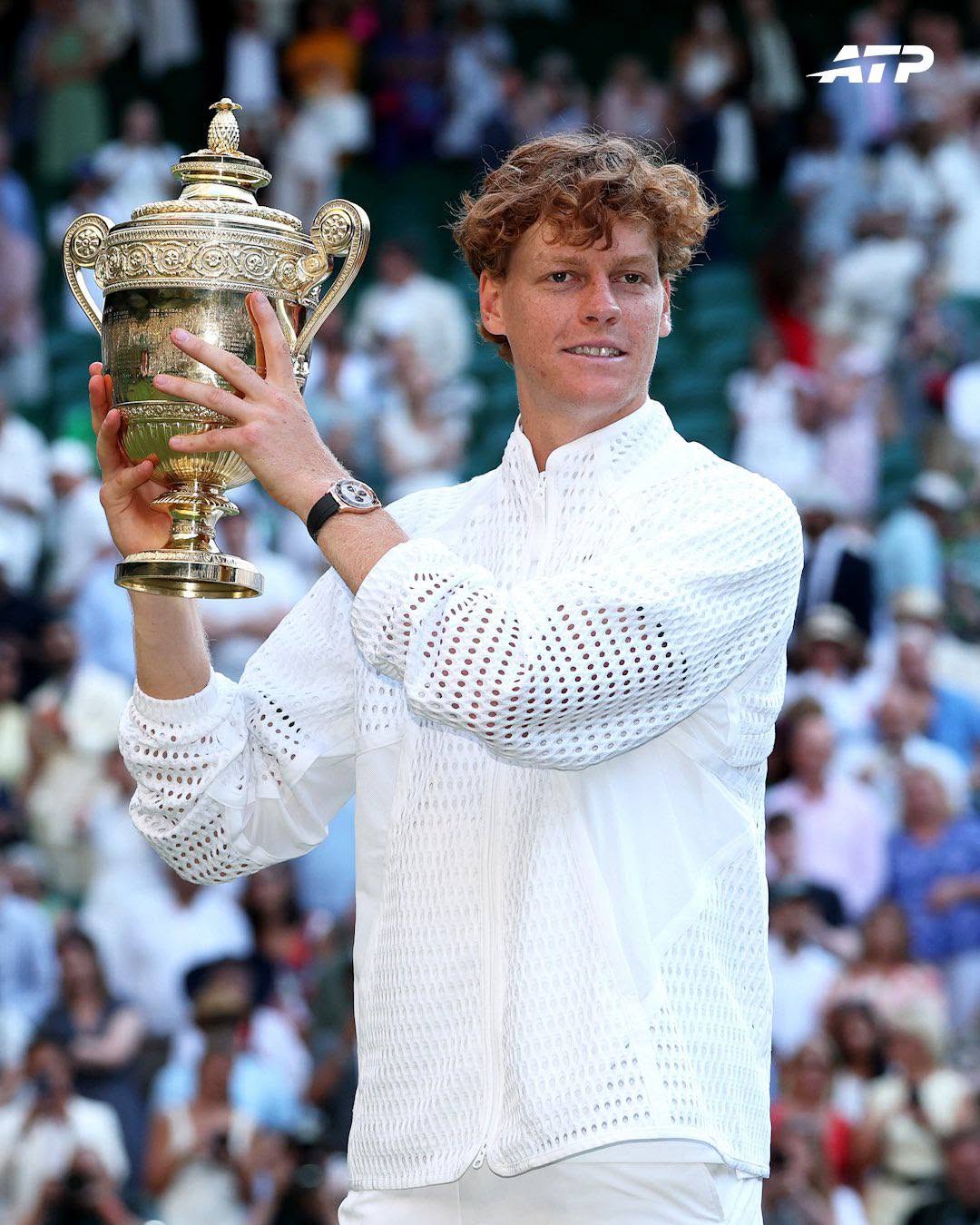
Great champions don't simply hit better shots—they systematically eliminate every possible path to defeat."
When Jannik Sinner walked onto Centre Court to defend his Wimbledon crown, he wasn't relying on emotion, momentum, or spectacular shot-making alone. He arrived with something even more dangerous—a game built on precision, repeatability, and relentless tactical evolution.
Modern tennis has entered an era where matches are increasingly won through analytics, biomechanics, and decision-making under pressure. No player embodies that philosophy more completely than Jannik Sinner.
His consecutive Wimbledon championships are not merely the result of exceptional talent. They are the product of a championship system that continually removes uncertainty from his own game while steadily increasing it for his opponents.
Against the world's best players, Sinner doesn't simply outplay them.
He slowly removes every option they have left.
The Championship Blueprint
Many champions throughout history possessed one overwhelming weapon.
Pete Sampras overwhelmed opponents with his serve.
Roger Federer dazzled with effortless creativity.
Rafael Nadal suffocated rivals with relentless topspin.
Novak Djokovic became nearly impossible to break down defensively.
Jannik Sinner represents something different.
He combines elements from every modern champion into a complete baseline system built around pressure, efficiency, and precision.
His game resembles an elite chess player thinking five moves ahead while striking every ball at over 120 km/h.
Every rally has structure.
Every shot has purpose.
Every adjustment is calculated.
Layer One: The Geometry of Controlled Violence
The greatest strength of Sinner's tennis is not how hard he hits.
It is where he hits.
Many players possess one dominant wing.
Some rely heavily on their forehand.
Others protect a weaker backhand.
Opponents build game plans around exploiting those imbalances.
Sinner removes that possibility entirely.
Symmetrical Firepower
His forehand and backhand generate nearly identical pace, depth, and penetration.
This changes the geometry of every rally.
Instead of waiting for the "right" forehand opportunity, Sinner attacks immediately from either side.
There is no predictable pattern.
No safe direction.
No obvious weakness.
His opponents cannot simply pin him into one corner because every corner becomes an attacking position.
The court suddenly feels much smaller.
Stripping Away Time
Elite tennis is not only about power.
It is about time.
Sinner's flat, penetrating groundstrokes rob opponents of valuable milliseconds.
Before they finish recovering from one shot, the next ball is already forcing another difficult decision.
That constant pressure creates errors long before fatigue arrives.
Many players believe they still have options.
By the time they realize those options have disappeared, the point is already lost.
Layer Two: The Master of Mid-Match Evolution
One of Sinner's defining characteristics is that he rarely plays the fifth set the same way he played the first.
His improvements happen almost invisibly.
Instead of dramatic tactical overhauls, he makes dozens of tiny corrections.
Those corrections accumulate into dominance.
The Clutch Serve Program
Earlier in his career, Sinner's serve was considered solid but not exceptional.
Today it has become one of the most reliable weapons in men's tennis.
When pressure reaches its highest level, his serving often improves rather than declines.
Facing break point...
Serving at 30–30...
Closing a championship...
His mechanics remain remarkably stable.
Small adjustments to ball toss height, shoulder rotation, and contact point allow him to maintain accuracy even under difficult conditions like swirling Wimbledon winds.
Rather than chasing outright aces, Sinner often prioritizes placement and first-strike control, ensuring he begins the rally from an advantageous position.
Champions win pressure points.
Sinner engineers them.
Calculated Unpredictability
One criticism of Sinner early in his career was that his game could become too linear.
He listened.
He evolved.
His rivalry with Carlos Alcaraz accelerated that transformation.
Instead of relying solely on relentless baseline aggression, Sinner added new dimensions to his game:
- Low, skidding slice backhands.
- Surprise drop shots.
- Offensive lobs.
- Timely serve-and-volley plays.
- Confident net approaches.
- Short-angle forehands that pull opponents off the court.
These variations are not used randomly.
They appear precisely when opponents begin adjusting to his rhythm.
Just when they believe they understand the pattern...
The pattern changes.
That tactical unpredictability forces opponents to think instead of react.
Thinking slows movement.
Slower movement creates shorter balls.
Shorter balls become winners.
Layer Three: The Champion's Emotional Firewall
Perhaps Sinner's greatest weapon cannot be measured by statistics.
It is his emotional stability.
Tennis is a sport of momentum swings.
Players lose leads.
Miss easy volleys.
Double fault on break point.
Lose heartbreaking tiebreaks.
Many spend the next several games replaying those mistakes.
Sinner appears to delete them instantly.
The Instant Reset
Lose a set?
Reset.
Miss an easy forehand?
Reset.
Double fault?
Reset.
Instead of chasing spectacular recovery shots or abandoning his game plan, Sinner simply returns to his fundamentals.
Deep returns.
Heavy baseline pressure.
High first-serve percentage.
Patient point construction.
That discipline prevents emotional mistakes from becoming tactical mistakes.
Pressure Never Changes His Identity
Many players become either overly aggressive or excessively cautious under pressure.
Sinner does neither.
His philosophy remains remarkably consistent.
He trusts the process.
He trusts repetition.
He trusts disciplined execution.
That unwavering belief makes him extraordinarily difficult to break mentally.
Opponents often feel they must produce perfect tennis for hours simply to stay level.
Few can sustain that standard.
The Wimbledon Masterclass
His championship performance perfectly demonstrated every layer of his evolution.
After losing a fiercely contested opening-set tiebreak to Alexander Zverev, there was no visible frustration.
No rushed decisions.
No panic.
Instead, Sinner made subtle adjustments:
- Increased first-serve precision.
- Attacked second serves earlier.
- Redirected rallies more aggressively with his backhand.
- Used greater variation to disrupt Zverev's rhythm.
- Managed windy conditions with exceptional footwork.
The match gradually tilted in his favor.
Not because he suddenly played spectacular tennis.
Because he steadily removed every tactical solution available to his opponent.
That is championship tennis at its highest level.
Why Opponents Feel Trapped
The psychological pressure of facing Sinner is immense.
His opponents know that:
- Neutral rallies become offensive opportunities.
- Defensive positions rarely produce free points.
- Long exchanges favor his consistency.
- Pressure moments often bring out his best serving.
- Emotional swings rarely affect his decision-making.
As the match progresses, they begin forcing riskier shots.
Those risks create unforced errors.
The scoreboard begins to move.
The pressure multiplies.
This is how Sinner quietly wins matches.
Not through chaos.
Through inevitability.
A Champion Built for the Modern Era
Tennis has entered an age where physical strength alone is no longer enough.
Today's champions must combine biomechanics, tactical intelligence, adaptability, and emotional resilience.
Jannik Sinner embodies that evolution.
His game is a blend of power, precision, patience, and constant refinement—a system that keeps learning without abandoning its core principles.
Every adjustment is measured.
Every decision is intentional.
Every point contributes to a larger strategy.
That is why defending Wimbledon is not just another title for Sinner—it is proof that his championship model can withstand the greatest pressure in the sport.
The hallmark of a true champion is not perfection. It is the ability to evolve while remaining true to one's identity. Jannik Sinner has mastered that balance, and in doing so, he has established himself as one of the defining players of his generation.