
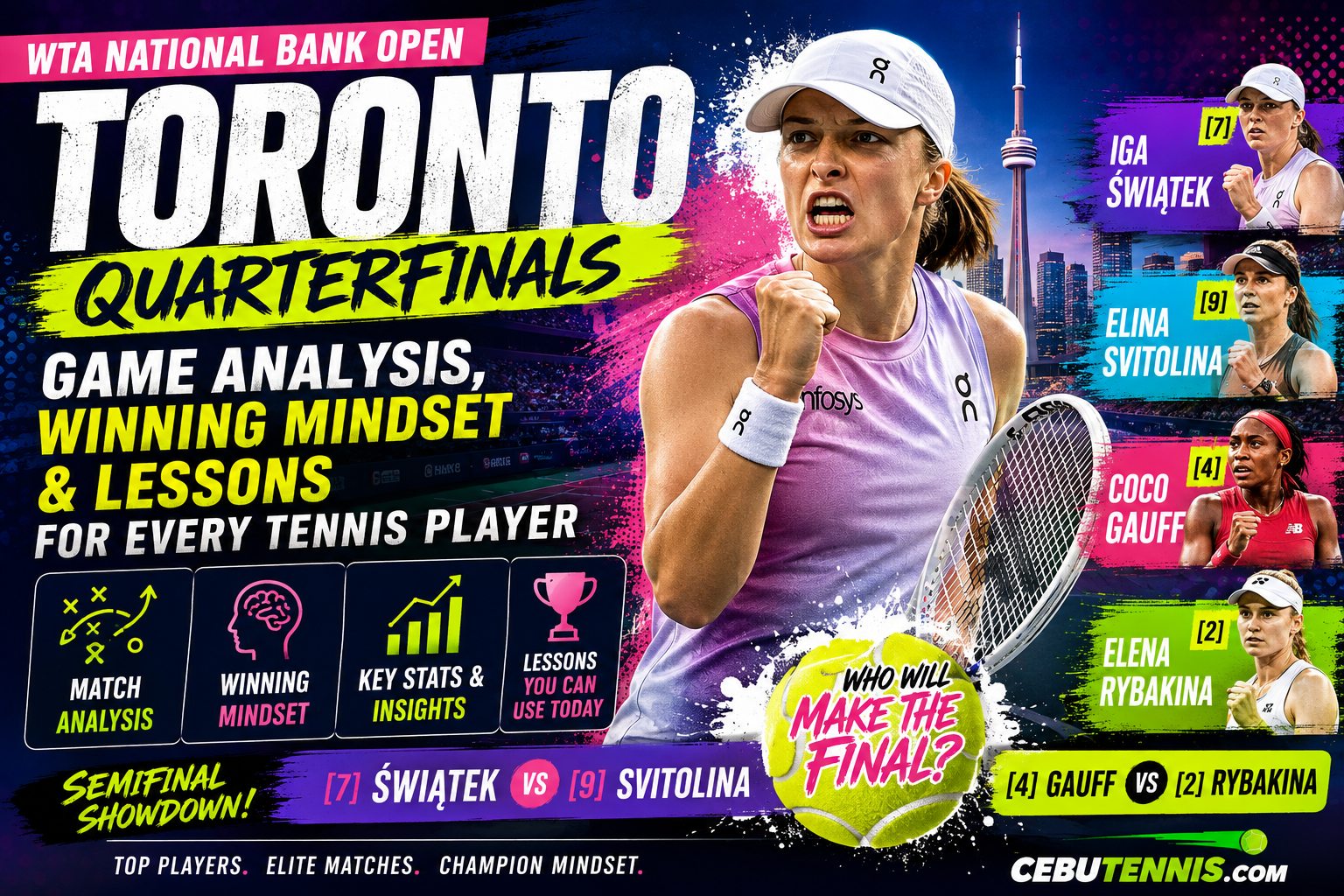
National Bank Open Toronto Quarterfinal — Tactical Breakdown
[7] Iga Świątek def. [15] Diana Shnaider, 6-2, 6-1
From a tactical perspective, Iga Świątek's 6-2, 6-1 victory over Diana Shnaider was much more than a straight-set win. It was a demonstration of how an elite player can identify an opponent's preferred patterns, take away their best weapons, and repeatedly force them to play uncomfortable tennis.
Świątek completed the match in only 64 minutes, won 11 of 16 points against Shnaider's second serve, and dropped only three points behind her first serve. Shnaider, meanwhile, committed 22 unforced errors in just 15 games, while Świątek made only eight.
For American coaches and competitive players, this match provides an excellent case study because the decisive factor wasn't simply power.
It was court positioning + ball height + return pressure + disciplined point construction.
The central question is:
How do you make a dangerous opponent play the kind of tennis they don't want to play?
Świątek answered that question extremely well.
1. The First Tactical Objective: Attack the Strike Zone
One of the most important concepts in modern tennis is contact height.
Players have preferred zones where they can accelerate the ball comfortably.
When an opponent receives the ball at their ideal height, they can use their normal swing, generate pace and maintain offensive control.
Świątek's heavy topspin changes that equation.
Her forehand can produce a high, heavy bounce that forces the opponent to make a decision:
- take the ball early;
- move backward;
- attack from an uncomfortable height;
- or attempt to flatten the ball and risk an error.
Against Shnaider, this was particularly important because Shnaider owns a powerful left-handed game and can create significant pace when she gets comfortable.
Świątek did not simply try to hit harder.
She made the ball harder to attack.
The official tournament report noted that Shnaider struggled to keep the ball in the court and never found her rhythm.
Coaching principle
Heavy spin is not only defensive. It is a form of offensive pressure.
A 75-mph forehand isn't necessarily more dangerous than a 70-mph forehand if the slower ball jumps six inches higher and pushes the opponent outside their preferred contact zone.
That is an important lesson for club players.
Don't ask:
"How hard can I hit?"
Ask:
"Where is my opponent most uncomfortable making contact?"
2. Świątek's Forehand Was a Weapon of Disruption
The forehand wasn't simply used to produce winners.
It was used to disrupt Shnaider's rhythm.
That distinction is important.
At the professional level, a point often begins with a tactical objective.
For Świątek, the objective was frequently:
heavy ball → uncomfortable contact → shorter reply → attack
This is a classic first-strike sequence.
She didn't need to hit a winner immediately.
She only needed to create a weaker ball.
Once Shnaider's ball became shorter or less controlled, Świątek could step forward and take command.
The winning pattern
Heavy forehand
↓
Push opponent away from ideal contact
↓
Receive shorter reply
↓
Move forward
↓
Attack open court
This is how elite tennis creates seemingly easy winners.
The winner is often the final step.
The real work happened two shots earlier.
3. Second-Serve Punishment: Where the Match Became Uneven
This was arguably the biggest statistical advantage.
Świątek won 11 of 16 points when returning Shnaider's second serve—69%.
That number tells us something important.
Shnaider was not being given a comfortable start to her service points.
Świątek positioned herself aggressively enough to make the second serve feel like an opportunity rather than a neutral ball.
Why this matters
A second serve is normally designed to:
- reduce double faults;
- increase margin;
- start the rally safely.
But against an elite returner, that safety disappears.
The returner can move forward, take the ball earlier and immediately create scoreboard pressure.
Świątek essentially converted Shnaider's second serve into a defensive starting position.
4. The Return Position Changed the Geometry of the Point
This is where recreational players can learn a major lesson.
A return isn't simply:
serve → return
It is:
serve → return position → contact point → next shot → court geometry
If the returner moves forward, the server has less time.
If the return is deep, the server has less opportunity to attack.
If the return is directed into a difficult location, the server may begin the rally from a defensive position.
Świątek's aggressive return positioning compressed the amount of time Shnaider had to construct points.
That creates what coaches often call time pressure.
5. The Serve Was About Placement, Not Just Speed
Another interesting tactical element is Świątek's use of spin and placement rather than simply trying to overpower the returner.
A kick serve can be extremely effective because it changes the returner's contact height.
A wide serve can also manipulate court geometry by pulling the receiver outside the singles court.
Against a left-handed opponent, the server has to think carefully about which direction opens the court.
The goal is not simply:
"Serve wide."
The goal is:
"Serve to a location that creates the easiest second shot for me."
That distinction separates tactical serving from random serving.
6. The 1-2 Punch
One of the most useful patterns to take from Świątek's performance is the serve-plus-one concept.
The first shot creates the opening.
The second shot attacks it.
For example:
Wide serve
→ opponent pulled outside the court
→ return lands shorter
→ forehand into open court
This is the classic 1-2 combination.
It doesn't require a 120-mph serve.
It requires relationship between the serve and the next shot.
That's something players at every level can practice.
7. Breaking the Opponent's Rhythm
Shnaider entered the match with the ability to produce aggressive tennis.
The problem was that Świątek didn't allow her to establish a comfortable rhythm.
The official National Bank Open report described Shnaider as looking nervous and struggling to keep the ball inside the court. She committed 22 unforced errors across 15 games.
This is where an elite opponent can become psychologically difficult to play.
When you repeatedly miss by a few inches, you start changing your swing.
Then you start thinking about the swing.
Then you become even less committed.
That can create a negative cycle:
pressure → hesitation → shorter swing → poor contact → error → more pressure
Świątek's consistency helped create that cycle.
8. Disciplined Error Control
Świątek committed only eight unforced errors, compared with Shnaider's 22.
That is a massive difference over a 15-game match.
But we shouldn't interpret this as simply "Świątek played safe."
She wasn't playing passive tennis.
She was playing high-margin aggressive tennis.
That's very different.
Passive tennis
Hit safely.
Wait for the opponent to miss.
Don't take risks.
High-margin aggression
Use heavy spin.
Attack space.
Move forward when the ball is short.
Return aggressively.
Use large targets.
Keep the opponent under pressure.
That's the blueprint Świątek executed.
9. The Hidden Weapon: Extra Balls
One of the most underrated weapons in tennis is forcing your opponent to hit one more ball.
You don't necessarily have to hit a winner.
If you can force your opponent to hit:
one more forehand
and then:
one more backhand
and then:
one more defensive shot
the probability of an error rises.
This becomes particularly dangerous when the opponent is trying to create offense from a defensive position.
Świątek's combination of movement, depth and spin forced Shnaider to repeatedly solve difficult balls.
Eventually, the errors came.
10. What Was Shnaider's Main Problem?
The scoreline tells us the obvious answer:
She couldn't establish sustained offensive control.
But the deeper problem was tactical.
Shnaider needed enough comfortable balls to use her aggressive game.
Świątek reduced those opportunities.
The result was that Shnaider increasingly had to manufacture offense.
There is a major difference between:
attacking a short ball
and
trying to attack a difficult ball from an uncomfortable position.
The second situation produces more errors.
11. How Could Shnaider Have Adjusted?
This is where the match becomes particularly valuable from a coaching perspective.
When an opponent is dominating you with heavy topspin and consistency, the answer isn't always to hit harder.
Shnaider needed to change the shape of the rally.
Adjustment #1: Take the Ball Earlier
Instead of allowing the ball to rise into the shoulder area, Shnaider could attempt to take certain balls earlier.
The objective:
remove time from Świątek.
If you allow a heavy topspin ball to rise, it becomes more difficult to attack.
Taking it earlier can neutralize some of the spin.
The risk is obvious:
You must have excellent timing.
But when you're losing 6-2, 6-1, you need to consider controlled tactical risk.
12. Adjustment #2: Change the Rally Height
If Świątek is comfortable hitting heavy topspin, don't give her exactly the same ball every time.
Use:
- flatter drives;
- lower trajectories;
- changes of direction;
- occasional slices;
- shorter angles;
- changes in pace.
The purpose isn't to become unpredictable for entertainment.
The purpose is to break the opponent's preferred rhythm.
13. Adjustment #3: Attack the Shorter Ball Earlier
If Shnaider received a shorter ball, she needed to recognize it immediately.
The decision should be:
GO.
Not:
Maybe I should hit another neutral ball.
Against an elite player, hesitation allows the opponent to recover.
A short ball is a tactical invitation.
Step inside.
Take the ball early.
Attack the open court.
Then recover immediately.
14. Adjustment #4: Make Świątek Serve More First-Serve Returns
One of the biggest goals for Shnaider should have been improving the quality of the first serve.
Why?
Because Świątek was winning 69% of the second-serve return points.
That is an enormous problem.
If your opponent is destroying your second serve, you have two options:
- improve your first-serve percentage;
- improve the quality and location of your second serve.
A second serve cannot simply become slower because you're afraid of a double fault.
It must remain strategically useful.
15. Adjustment #5: Use the Body Serve
Against an aggressive returner who moves forward, the body serve can be extremely useful.
Why?
Because the returner doesn't have as much time to swing freely.
A wide serve gives the returner a direction.
A body serve creates congestion.
The returner's feet and shoulders must reorganize quickly.
For a player like Shnaider, mixing:
wide → body → T
could prevent the returner from becoming too comfortable.
16. Adjustment #6: Attack the Returner's Position
This is a professional-level tactical concept.
If Świątek stands very far behind the baseline to return, don't automatically serve wide every time.
Sometimes the best serve is directly at the body or down the T.
Why?
Because you want to make her move forward or sideways before she can establish her preferred return.
The server should constantly ask:
Where is my opponent standing?
Not:
What serve do I normally hit?
17. If You Are Losing: Change One Thing at a Time
One of the biggest mistakes recreational players make when losing is changing everything.
Suddenly they:
- hit harder;
- serve faster;
- change grip;
- attack every ball;
- come to the net;
- go for lines.
That isn't adjustment.
That's panic.
A professional adjustment is usually much simpler.
First adjustment:
Change return position.
Second adjustment:
Change serve location.
Third adjustment:
Change rally height.
Fourth adjustment:
Change court position.
One variable at a time.
Then observe the result.
18. The Momentum Trap
Suppose Shnaider had changed her strategy and won two consecutive games.
The next mistake would be thinking:
"Now I'm back."
No.
You're simply 2-0 in the current sequence.
This is where the winner's mindset becomes important.
Świątek continued playing the same fundamental game because she didn't allow the scoreboard to dictate her emotional state.
The National Bank Open report noted that she broke in the opening game, broke twice in the first set and then broke three consecutive times in the second set.
That shows how sustained pressure can prevent an opponent from building momentum.
19. The Champion's Adjustment: Don't Fix What Isn't Broken
This is one of the most important lessons from the match.
If your opponent hasn't solved your tactical pattern, don't change it simply because you're bored.
Players sometimes become too clever.
They think:
"I've used the forehand pattern five times. Maybe I should try something different."
Why?
If it is working, keep using it.
The opponent has the responsibility to solve the problem.
This is one of the fundamental differences between tactical discipline and tactical creativity.
Creativity is valuable.
Unnecessary creativity is dangerous.
20. The Psychological Advantage of Repetition
If Świątek hits the same heavy forehand pattern repeatedly and Shnaider knows it's coming but still can't handle it, the psychological pressure increases.
The opponent starts thinking:
"I know what's coming, but I can't stop it."
That is an extremely powerful competitive position.
You aren't simply winning points.
You're creating doubt.
And doubt changes shot selection.
21. The Winner's Mindset: Stay With the Process
The mental lesson from this match is perhaps more important than the technical lesson.
A winning player doesn't constantly ask:
"Am I going to win?"
The better question is:
"What does this point require?"
If the opponent is struggling against your second-serve return:
Attack it.
If the opponent is struggling with your topspin:
Keep using it.
If the opponent finally adjusts:
Then adjust with them.
That is competitive problem-solving.
22. The Three-Level Tactical Model
For players who want to improve their own match intelligence, use this simple model.
Level 1 — What is working?
Identify your strongest pattern.
For example:
forehand crosscourt → opponent short → forehand down the line
Keep it.
Level 2 — What is hurting you?
Identify the opponent's best pattern.
For example:
wide serve → short return → forehand attack
Find a solution.
Level 3 — What changed?
The opponent eventually adjusts.
Now you must adjust again.
This creates a continuous tactical conversation.
You make a move.
Your opponent responds.
You respond to their response.
That is high-level tennis.
23. What an American Competitive Player Can Take From This Match
For a U.S. junior, college player, adult league competitor or serious recreational player, the lesson is simple:
Don't enter the match with only a collection of strokes.
Enter with patterns.
Before the match, know:
My best serve pattern
Serve → first forehand
My best return pattern
Return deep → establish forehand
My defensive pattern
High crosscourt → recover
My attacking pattern
Heavy ball → short ball → attack
My pressure pattern
Deep return → body serve → open court
This gives you a tactical structure.
24. The Mid-Match Adjustment Checklist
When you're down a set, don't panic.
Ask yourself five questions:
1. Where am I winning points?
Keep doing it.
2. Where am I losing points?
Find the pattern.
3. Which shot is hurting me most?
Neutralize it.
4. Where is my opponent standing?
Change the geometry.
5. What is the simplest adjustment I can make?
Make that adjustment first.
This is much more effective than simply trying to "play better."
25. The Big Lesson From Świątek's 6-2, 6-1 Victory
Świątek didn't win because she hit every ball perfectly.
She won because she consistently created a match that was uncomfortable for Shnaider.
The numbers tell the story:
64 minutes
11/16 second-serve return points won
8 unforced errors for Świątek
22 unforced errors for Shnaider
No break points faced by Świątek
The official tournament report also noted that Shnaider never found her rhythm while Świątek never lost more than two points in any service game.
That is tactical domination.
Final Coaching Verdict
From a U.S. tennis coaching perspective, the most impressive aspect of Świątek's performance was not one spectacular shot.
It was her ability to make the entire match operate on her terms.
She used:
Heavy topspin
→ to control contact height.
Aggressive returning
→ to attack second serves.
Serve placement
→ to manipulate court geometry.
Depth and consistency
→ to force additional balls.
Movement
→ to recover and extend rallies.
Low error production
→ to maintain pressure.
And most importantly:
discipline
→ to keep repeating the patterns that were working.
For Shnaider, the lesson is equally valuable.
When an opponent is dominating your preferred style, don't simply try to hit harder.
Change the geometry.
Change the height.
Change the timing.
Change the serve location.
Change your return position.
Change the rhythm.
But change with a plan.
That's what separates a frustrated player from a problem-solving competitor.
The Winning Formula
Identify the weakness.
Attack it repeatedly.
Force the opponent to adjust.
Recognize their adjustment.
Counter-adjust.
Stay emotionally neutral.
Play the next point.
That's championship tennis.
And that's the biggest lesson from Iga Świątek's 6-2, 6-1 dismantling of Diana Shnaider in Toronto.