
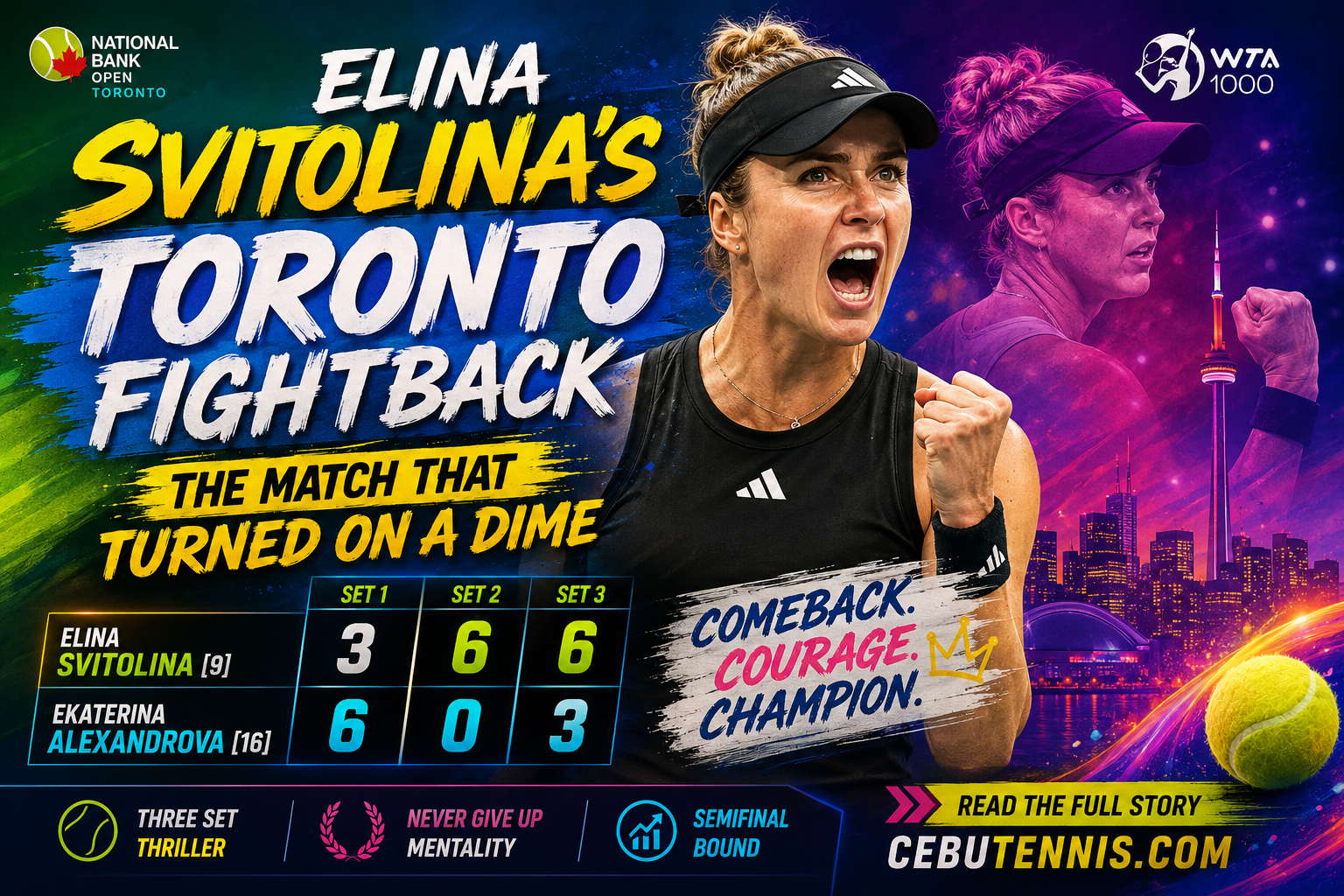
[9] Elina Svitolina def. [16] Ekaterina Alexandrova, 3-6, 6-0, 6-3
There are tennis matches that are won with power.
There are matches won with precision.
And then there are matches won because one player refuses to let the story end when it appears to be slipping away.
On Tuesday in Toronto, Elina Svitolina wrote exactly that kind of story.
The No. 9 seed walked onto court against No. 16 Ekaterina Alexandrova knowing she was facing one of the most dangerous players left in the Canadian Open draw. Alexandrova had just eliminated world No. 1 Aryna Sabalenka in a dramatic three-set battle, 7-6(3), 4-6, 6-4. She arrived with confidence, momentum and the unmistakable feeling that she belonged in the biggest moments.
For one set, she looked completely in control.
Then Svitolina changed the match.
The Ukrainian veteran turned a 6-3 opening-set deficit into a breathtaking 6-0 second set before taking command of the decider, eventually winning 3-6, 6-0, 6-3 and booking a place in the Toronto semifinals.
It wasn't simply a comeback.
It was a demonstration of competitive intelligence.
The Beginning: Alexandrova Strikes First
The opening set belonged to Alexandrova.
The Russian arrived in Toronto having already delivered one of the tournament's biggest shocks. Her victory over Sabalenka had demonstrated exactly what makes her dangerous: aggressive tennis, fearless shot-making and the ability to keep attacking when the pressure becomes enormous.
Against Svitolina, she continued that approach.
The first set ended 6-3.
For Svitolina, the scoreboard presented a familiar problem: she was behind, and the opponent across the net was playing with enough aggression to prevent her from simply waiting for mistakes.
But Svitolina has built much of her career around something more difficult to measure than raw power.
Adjustment.
Patience.
The ability to make an opponent play one more ball.
And sometimes, the ability to completely change the emotional temperature of a match.
Then Came the Most Important Set of the Match
The second set was almost unrecognizable.
Svitolina did not merely recover.
She dominated.
6-0.
Alexandrova, who had looked so dangerous in the opening set, suddenly found herself unable to establish the same rhythm.
Svitolina's court coverage became increasingly important. She repeatedly extended exchanges, absorbed pace and forced Alexandrova to hit additional shots under pressure.
The match had changed from:
“Can Alexandrova overpower Svitolina?”
to:
“Can Alexandrova find a way through Svitolina?”
That distinction changed everything.
Svitolina's comeback was not based on one spectacular shot.
It was built point by point.
She made Alexandrova work.
She made her uncomfortable.
And she kept the pressure on.
By the end of the second set, the match was completely level in sets—but psychologically, the momentum had swung dramatically toward Svitolina.
The Third Set: Where Experience Became a Weapon
A deciding set is where the body starts negotiating with the mind.
Legs become heavier.
The margin for error becomes smaller.
A player who has been aggressive for two hours may suddenly begin questioning whether to attack one more ball.
This is where Svitolina's experience became invaluable.
She began the deciding set with the belief that the match could be controlled through movement, defense and pressure rather than desperation.
According to reports from the match, Svitolina broke Alexandrova's serve six times during the contest, a reflection of how effectively she eventually disrupted Alexandrova's service games.
The rallies became increasingly physical.
Alexandrova still had the weapons.
Svitolina simply kept making those weapons work harder.
The Moment Alexandrova Tried to Fight Back
The third set was not a straight march to victory.
Alexandrova had already demonstrated earlier in Toronto that she could survive enormous pressure. Her victory over Sabalenka had required nearly two and a half hours of tennis and multiple momentum swings.
So when Svitolina began moving toward the finish line, Alexandrova did what elite competitors do.
She fought.
There was a late wobble from Svitolina as she attempted to close the match, but she recovered sufficiently to finish the job, winning the deciding set 6-3.
And with that, the comeback was complete.
3-6.
6-0.
6-3.
A match that once belonged to Alexandrova had become Svitolina's.
This Was More Than a Scoreline
The numbers tell the basic story.
Alexandrova won the first set.
Svitolina won the second without dropping a game.
Svitolina then won the deciding set.
But the deeper story is about adaptation.
Svitolina has repeatedly shown in 2026 that she can survive matches that appear to be moving away from her.
Earlier this year at Indian Wells, she defeated Iga Swiatek 6-2, 4-6, 6-4 in a two-hour, nine-minute quarterfinal, earning one of her biggest wins of the season.
In Rome, she produced another extraordinary comeback against Elena Rybakina, recovering from a set down and saving 16 of 20 break points on her way to a 2-6, 6-4, 6-4 victory.
And at Roland-Garros, even though she ultimately lost to Marta Kostyuk in the quarterfinals, she had already survived a brutal first-round battle against Anna Bondar after trailing early.
The Toronto match fits that larger pattern.
Svitolina does not need the match to be perfect.
She needs it to remain alive.
The Physical Battle
Watching Svitolina compete is a reminder that modern tennis isn't simply about hitting the hardest ball.
It is about repeatedly getting into position to hit the next one.
Her movement became one of the defining features of the match.
Fans watching the encounter reacted strongly to her speed and defensive coverage, with tennis-community discussion repeatedly highlighting how quickly she was moving around the court and how difficult she was making the court feel for Alexandrova.
That creates a special kind of pressure.
A player can hit an excellent shot and still lose the point.
They can hit another excellent shot—and still find Svitolina's racket waiting.
Eventually, the opponent begins trying to hit a perfect shot.
And that is when errors can arrive.
The Mental Turning Point
The most fascinating part of a comeback is rarely the final point.
It is the moment when the losing player stops thinking about the scoreboard.
Imagine the opening of the second set.
Svitolina had lost the first set 6-3.
She could have started chasing.
She could have tried to hit harder.
She could have become impatient.
Instead, she found another route.
She made the match physical.
She extended rallies.
She trusted her movement.
And suddenly Alexandrova had a different problem.
The opponent she had controlled in the first set was no longer giving her the same opportunities.
That is what makes elite comeback tennis so fascinating.
The comeback begins before the scoreboard changes.
It begins inside the player's decision-making.
Alexandrova Deserves Credit
It would be easy to turn this into a simple celebration of Svitolina.
But Alexandrova's tournament deserves recognition too.
Only days earlier, she had taken down Sabalenka, the world No. 1 and reigning U.S. Open champion, in a three-set battle.
That victory demonstrated the level of tennis she was capable of producing.
Against Svitolina, she started with the same aggressive mentality.
She won the first set.
She had the Ukrainian under pressure.
And even after being completely shut out in the second, she continued fighting in the third.
The final score doesn't erase how dangerous Alexandrova was.
It simply shows how effectively Svitolina solved the problem.
The Prize: Another Chapter Against Iga Swiatek
Svitolina's reward is enormous.
A semifinal against Iga Swiatek.
And this isn't an ordinary matchup.
Their 2026 season has already produced major chapters.
Svitolina defeated Swiatek at Indian Wells in March, winning 6-2, 4-6, 6-4.
Later, Svitolina also defeated Swiatek on the way to her Rome title, part of a remarkable clay-court run that included victories over several elite opponents.
Now they meet again in Toronto.
Swiatek enters the semifinal after dismantling Diana Shnaider 6-2, 6-1 in the quarterfinals, a performance Reuters described as dominant and controlled.
Svitolina arrives from the opposite direction.
She arrives having been tested.
Dragged into a three-set fight.
Forced to solve problems.
Forced to recover.
And ultimately forced to prove that her tournament is far from finished.
The Bigger Story: Svitolina Is Still Dangerous
There is something compelling about Svitolina's 2026 season.
She is not winning because every match is easy.
Quite the opposite.
She keeps finding herself in matches that demand something extra.
Against Rybakina in Rome, she survived 16 break points.
Against Swiatek at Indian Wells, she won another three-set battle.
Against Bondar at Roland-Garros, she survived a dramatic opening-round escape.
Against Alexandrova in Toronto, she lost the first set and then produced a 6-0 response.
These are not isolated moments.
They are characteristics.
Svitolina's greatest weapon may not be a single forehand, serve or backhand.
It may be her refusal to accept the first version of the match.
The Final Image
Picture the scoreboard.
Alexandrova — 6.
Svitolina — 3.
One set gone.
Then the numbers change.
6-0.
Suddenly, everything is alive.
Then the final set begins.
The rallies stretch.
The court seems smaller.
The pressure increases.
Alexandrova fights.
Svitolina runs.
One more ball.
One more recovery.
One more point.
And finally:
6-3.
Svitolina turns around.
The comeback is complete.
She didn't win because the match was easy.
She won because she made the match difficult for her opponent.
That is the essence of competitive tennis.
You don't always get to choose how the match begins.
You don't always control your opponent's first punch.
But you can decide whether the story is finished.
In Toronto, Elina Svitolina decided it wasn't.
And now, waiting on the other side of the net, is Iga Swiatek.
Another chapter.
Another test.
And for Svitolina, another opportunity to prove that when the match gets uncomfortable, she may be at her most dangerous.