
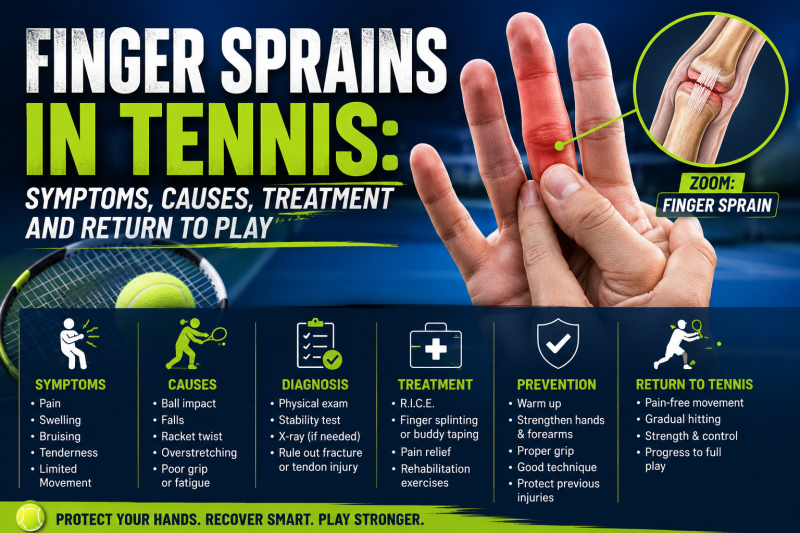
Finger sprains are a common tennis injury that can occur when a finger is bent, twisted, jammed, or forced beyond its normal range of motion. Although a finger sprain may seem minor, continuing to play too soon can prolong recovery and sometimes lead to stiffness or instability.
Quick Overview
A finger sprain is an injury to one or more ligaments that support the finger joints.
In tennis, finger sprains can happen when:
- A tennis ball strikes the finger unexpectedly.
- The racket twists or is forced out of the hand.
- A player falls and lands on the hand.
- The finger is suddenly bent backward or sideways.
- Repeated gripping aggravates an already irritated finger.
The severity can range from a mild ligament stretch to a complete ligament tear.
Symptoms of a Finger Sprain
Typical symptoms include:
- Finger pain, especially when bending or straightening it
- Swelling around the injured joint
- Tenderness when touching the area
- Bruising
- Reduced range of motion
- Difficulty gripping a tennis racket
- Weakness when squeezing or holding objects
- Feeling that the joint is unstable in more serious injuries
When should you be concerned?
Seek medical evaluation if the finger:
- Looks crooked or deformed
- Cannot be straightened or bent normally
- Has severe swelling or pain
- Becomes numb or unusually pale/blue
- Cannot grip objects
- Produces significant pain after a direct impact
A finger that looks "sprained" can sometimes actually have a fracture or tendon injury, so appearance alone is not enough to determine the diagnosis.
Common Causes of Finger Sprains in Tennis
1. Ball impact
A fast tennis ball can strike the fingertips and force a joint backward or sideways.
2. Falling on the hand
During a difficult point, players may fall while chasing a ball. Landing on an extended hand can injure the finger ligaments.
3. Racket-related injury
A sudden mishit or collision can cause the racket to twist violently in the hand.
4. Poor grip or fatigue
When a player becomes tired, grip control can decrease. This may make it easier for the racket to move unexpectedly during contact.
5. Previous finger injury
A previously injured finger may have reduced strength, flexibility or stability, increasing the possibility of another injury.
Diagnosis
A healthcare professional usually begins with a physical examination.
They may check:
- Where the pain is located
- Swelling and bruising
- Finger movement
- Joint stability
- Grip strength
- Circulation and sensation
An X-ray may be recommended when a fracture or joint injury is suspected.
More serious ligament, tendon or soft-tissue injuries may require additional imaging or specialist assessment.
Important
Do not assume that every painful finger is simply a sprain.
A fracture, dislocation, tendon injury or other hand injury can produce similar symptoms.
Treatment for a Finger Sprain
Treatment depends on the severity of the injury.
First 24–48 Hours
For a mild injury, initial care may include:
Protect
Stop tennis and avoid activities that increase pain.
Ice
A cold pack can help reduce pain and swelling. Use a cloth barrier between the ice pack and skin.
Elevation
Keeping the hand elevated can help control swelling.
Support
Depending on the injury, a healthcare professional may recommend taping or splinting the finger.
Avoid aggressively bending, stretching or "testing" the injured finger repeatedly during the early stage.
Buddy Taping
For certain stable finger sprains, buddy taping—supporting the injured finger against an adjacent finger—may be used.
However, it is not appropriate for every finger injury.
If there is significant deformity, suspected fracture, severe pain or instability, the injury should be assessed before relying on taping.
Rehabilitation
Once acute pain and swelling have improved, rehabilitation may focus on gradually restoring:
- Range of motion
- Finger strength
- Grip strength
- Coordination
- Tennis-specific function
The goal is not simply to make the finger feel better.
The finger needs to be capable of handling the repeated gripping and impact demands of tennis.
Prevention of Finger Sprains in Tennis
You cannot prevent every finger injury, but several habits can reduce risk.
Warm up before playing
Prepare the hands, wrists and fingers before intense practice or competition.
Maintain racket control
Use a comfortable grip size and avoid gripping the racket excessively tightly.
Strengthen the hand and forearm
Progressive strengthening can improve grip capacity and overall hand function.
Improve footwork
Good movement reduces the need for desperate reaches and awkward positions that can result in falls.
Pay attention to fatigue
When technique deteriorates because of fatigue, injury risk can increase. Take appropriate breaks during long training sessions.
Protect previous injuries
Players returning from a previous finger injury may need temporary taping or other support recommended by a healthcare professional.
Returning to Tennis After a Finger Sprain
Returning too early is one of the most common mistakes athletes make.
A player should generally be able to perform tennis-related movements without significant pain, swelling or loss of function before returning to full competition.
A gradual progression can look like this:
Stage 1 — Daily activities
The finger can move comfortably during normal activities.
Stage 2 — Light racket work
Begin with easy hitting and short sessions.
Stage 3 — Groundstrokes
Gradually increase hitting intensity while monitoring pain and swelling.
Stage 4 — Serving and higher-intensity tennis
Introduce serving, overheads and harder shots progressively.
Stage 5 — Practice sets
Return to more realistic match conditions.
Stage 6 — Competition
Return to competitive tennis when the finger has recovered sufficient movement, strength and stability.
If pain or swelling increases after training, reduce the workload and allow additional recovery.
How Long Does a Finger Sprain Take to Heal?
Recovery varies considerably depending on the ligament involved and the severity of the injury.
A mild sprain may improve over several weeks, while a more significant ligament injury can require substantially longer rehabilitation.
A complete ligament tear, fracture, dislocation or associated tendon injury may require specialist treatment and a longer return-to-play period.
The calendar alone should not determine when a tennis player returns.
Function matters.
Finger Sprain: When to See a Doctor
A tennis player should consider medical evaluation if there is:
- Severe or worsening pain
- Significant swelling
- Obvious deformity
- Inability to move the finger normally
- Persistent pain after an injury
- Numbness or loss of sensation
- Significant weakness
- A suspected fracture or dislocation
- No meaningful improvement with appropriate rest
For competitive players, early assessment can be particularly valuable because the goal is not only to relieve pain but also to restore full hand function safely.
Final Takeaway for Tennis Players
A finger sprain may look like a small injury, but the hands are critical to tennis.
Your fingers help control the racket, generate racket-head speed and maintain stability during groundstrokes, serves and returns.
Don't play through significant finger pain simply because you have an important match.
Protect the injury, get an appropriate diagnosis when necessary, rehabilitate progressively and return to tennis when your finger can safely handle the demands of the game.
A few days of caution can be better than turning a minor injury into a long-term tennis problem.
This information is for general education and does not replace an examination by a doctor, sports-medicine professional or qualified physiotherapist.