Pinoy tennis

The Winning Mindset: How Positive Thoughts on the Tennis Court Bring Your Dreams to Reality

"The most important shot in tennis is the next one." — Bjorn Borg

Introduction: Where Dreams Meet the Court

Every champion who has ever lifted a trophy began with a dream. Before the Grand Slam titles, before the roaring crowds, before the iconic moments etched into history — there was a thought. A positive, unshakable thought that whispered, "I can do this."

Can Cat Purrs Help Tennis Players Recover Bone and Tissue?

A tennis health blog exploring cat purr frequencies, bone healing, and recovery after injury.

Quick Overview

Could the gentle vibration of a cat's purr help a tennis player recover from a bone injury, tendon strain, or muscle damage?

Cat purrs commonly fall within approximately 20–150 Hz, a frequency range that overlaps with some forms of vibration therapy studied in medicine.

WTA Results Today (August 6, 2026): Toronto National Bank Open – Complete Match Analysis

The National Bank Open (WTA 1000) in Toronto delivered another day filled with dramatic comebacks, dominant performances, and statement victories from some of the world's biggest stars. Several seeded players survived difficult challenges, while unseeded competitors proved once again that the depth of women's tennis has never been stronger.

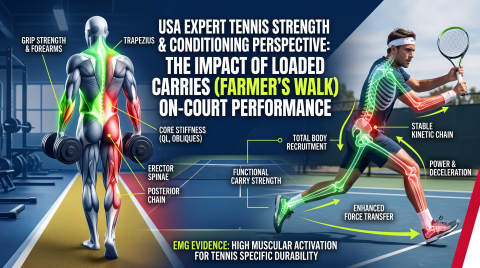
USA Expert Tennis Strength & Conditioning Perspective: The Impact of Loaded Carries (Farmer's Walk) on On-Court Performance

From a U.S. Strength and Conditioning (CSCS) and High-Performance Tennis Coaching standpoint, integrating loaded carries—specifically the Farmer's Walk— into a player's training protocol is one of the most effective, high-yield add-on routines available.

As highlighted by Dr. Stuart McGill’s electromyography (EMG) and biomechanical research, loaded carries create simultaneous high-level activation across the entire kinetic chain while requiring the body to continuously stabilize itself under dynamic movement.

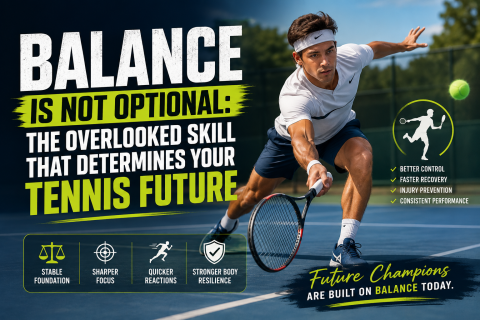
Balance Is Not Optional: The Overlooked Skill That Determines Your Tennis Future

You spend hours perfecting your forehand. You drill your serve until it feels automatic. You work on your footwork patterns until they become second nature. But there is one fundamental skill that even elite coaches say is the single biggest cause of errors in tennis, and most players never train it.

Balance.

The 10-Second Balance Test: The Ultimate Health Benchmark for Tennis Players Over 50

If you are a tennis player between the ages of 50 and 60, you likely spend a good amount of time worrying about your forehand technique, your serve velocity, or your court positioning. But there is one metric that matters more than your ace count, and it takes only ten seconds to measure. Can you stand on one leg with your eyes closed?

Alex Eala's Defensive Evolution: How Elite Movement and Mental Toughness Are Transforming Her Into a World-Class Contender

The rise of Alexandra "Alex" Eala has been driven by far more than explosive shot-making. While her aggressive baseline game first captured the attention of tennis fans, her continued success against the world's best players has revealed a far more complete athlete.

From the perspective of high-performance coaching in the United States, Eala has undergone one of the most significant evolutions a young professional can make: transforming from a primarily offensive player into a resilient, tactically mature competitor capable of winning matches in multiple ways.

Why Alexandra Eala Lost the Deciding Set: The Science of Pressure, Heart Rate, and Split-Second Timing in Elite Tennis

What happened to Alexandra Eala is common in elite tennis. When a match reaches its most important moments, the body and brain enter a high-stress state that changes heart rate, breathing, muscle control, and decision-making.

1. The heart rate rises dramatically

During routine rallies, a professional player's heart rate may be around 120–150 beats per minute (bpm).