
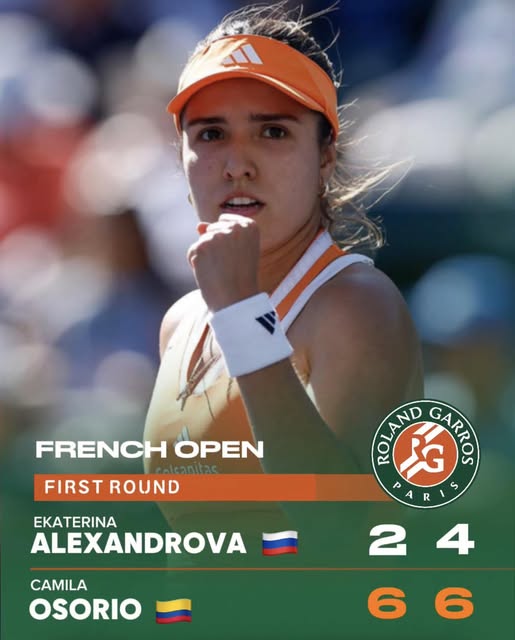
One of the biggest surprises of the opening round at French Open came from Colombia’s relentless fighter Camila Osorio. The reigning Philippine Open champion and current World No. 86 produced a stunning tactical performance to defeat Russia’s World No. 14 Ekaterina Alexandrova in straight sets, 6-2, 6-4, advancing confidently into the second round at Roland Garros.
This was not a lucky upset.
This was not a random hot streak.
This was a carefully constructed clay-court performance built on movement, intelligence, emotional resilience, and tactical discipline.
Many ATP and WTA analysts watching the match immediately recognized something important:
Camila Osorio completely disrupted Alexandrova’s rhythm from the very first games.
Now Osorio moves into a dangerous second-round showdown against Kazakhstan’s experienced World No. 76 Yulia Putintseva, another player known for toughness and defensive intensity.
But before looking ahead, this victory deserves deep analysis because it showcased exactly why clay-court tennis remains one of the purest tests in professional sports.
Why This Upset Was So Significant
On paper, the rankings heavily favored Ekaterina Alexandrova.
The Russian entered the tournament ranked inside the Top 15 with superior power, stronger serving numbers, and more experience against elite opposition.
Normally, aggressive first-strike players like Alexandrova can overwhelm lower-ranked opponents quickly.
But Roland Garros changes the equation.
Clay slows down the ball.
Rallies become longer.
Movement becomes essential.
Patience becomes mandatory.
And that is exactly where Camila Osorio thrived.
The Colombian transformed the match into a physical and tactical battle instead of a pure power contest.
That was the key.
Camila Osorio’s Clay-Court Identity
Some players are naturally designed for clay courts.
Camila Osorio belongs in that category.
Even before the match started, ATP experts understood that Osorio’s:
- Movement
- Defensive instincts
- Rally tolerance
- Shot variation
could become dangerous for Alexandrova if the Russian failed to finish points efficiently.
Clay tennis rewards players who understand:
- Space management
- Point construction
- Momentum control
- Emotional endurance
Osorio demonstrated all four at a very high level.
First Set Breakdown: Osorio Establishes Control Early
The opening set ended 6-2, but the scoreline reflected complete tactical superiority.
Early Momentum Shift
Alexandrova attempted to impose her usual aggressive baseline game immediately.
Her strategy was clear:
- Attack early
- Shorten rallies
- Dominate with pace
- Pressure Osorio’s weaker defensive positions
But Osorio responded brilliantly.
Instead of engaging in reckless power exchanges, she used:
- Deep heavy topspin
- High defensive margins
- Smart directional control
- Exceptional movement
This forced Alexandrova to hit extra shots repeatedly.
On clay courts, that becomes mentally exhausting.
ATP coaches constantly emphasize one truth:
“Clay rewards the player willing to suffer longer.”
Osorio embraced that challenge completely.
The Hidden Tactical Weapon: Height Variation
One of the most underrated parts of Osorio’s performance was her trajectory variation.
Many casual fans only focus on winners and aces.
But high-level clay-court tennis often revolves around ball height and spin.
Camila Osorio repeatedly changed:
- Net clearance
- Bounce height
- Rally tempo
This prevented Alexandrova from finding consistent strike zones.
Some balls kicked high above shoulder level.
Others stayed lower and flatter.
That variation disrupted timing continuously.
Elite clay-court players understand that rhythm is dangerous.
If an opponent becomes comfortable, they become explosive.
Osorio never allowed Alexandrova to feel comfortable.
Alexandrova’s Biggest Problem
Ekaterina Alexandrova’s aggressive game can be extremely dangerous when she controls court position.
But against Osorio, she faced several problems.
1. Poor Patience in Long Rallies
The Russian began forcing shots too early.
This usually happens when aggressive players become frustrated by defensive resistance.
Instead of building points patiently, Alexandrova attempted:
- Risky down-the-line strikes
- Low-percentage winners
- Early rally acceleration
Osorio anticipated this perfectly.
2. Difficulty Finishing Points
Clay courts reduce the effectiveness of raw power.
Alexandrova hit strong shots, but Osorio’s speed and anticipation extended rallies beyond the Russian’s comfort zone.
The longer the rally became:
- The more Alexandrova pressed
- The more errors accumulated
- The more confidence dropped
3. Emotional Frustration
This became visible midway through the first set.
Alexandrova’s body language changed dramatically:
- Faster pacing
- Frustrated reactions
- Rushed between-point decisions
Meanwhile Osorio remained composed and emotionally disciplined.
That emotional contrast became decisive.
ATP Expert Analysis: Why Osorio’s Movement Was Elite
Clay-court tennis begins with footwork.
Camila Osorio’s movement during this match was outstanding.
Sliding Efficiency
Her sliding mechanics were smooth and controlled.
Instead of scrambling defensively in panic, she:
- Balanced her body early
- Recovered quickly
- Transitioned efficiently into neutral positions
This preserved energy and allowed her to maintain consistency.
Recovery Positioning
After every shot, Osorio recovered intelligently toward ideal court positioning.
That prevented Alexandrova from finding easy open-court finishes.
Many lower-ranked players lose points not because of poor strokes — but because of poor recovery positioning.
Osorio avoided that mistake throughout the match.
Anticipation
Perhaps most impressive was her anticipation.
She read Alexandrova’s patterns exceptionally well.
Several times she moved early toward expected targets before contact even occurred.
That anticipation made Alexandrova feel as if winners were impossible.
Psychologically, that becomes devastating.
The Importance of Rally Tolerance
Modern tennis fans often underestimate rally tolerance.
But on clay courts, rally tolerance separates contenders from pretenders.
Camila Osorio displayed elite-level patience.
She understood:
- Not every ball must become a winner
- Defensive neutrality has value
- Physical pressure creates mental pressure
This forced Alexandrova into increasingly risky decisions.
ATP veterans often call this:
“Winning without overhitting.”
That is exactly what Osorio achieved.
Second Set Analysis: Pressure Management
The second set became more competitive.
Alexandrova attempted to increase aggression and shorten points even earlier.
For a brief period, the Russian generated momentum.
But Osorio adjusted beautifully.
That adjustment ability revealed her growing maturity as a professional player.
Tactical Adjustments That Changed the Match
Adjustment 1: More Aggressive Return Position
During the second set, Osorio stepped slightly closer on second-serve returns.
This immediately increased pressure.
Alexandrova’s second serve became vulnerable:
- Reduced confidence
- More rushed delivery
- Lower placement quality
That small positional adjustment shifted momentum back toward Osorio.
Adjustment 2: Targeting Movement Patterns
Osorio began attacking Alexandrova’s movement more strategically.
Instead of pure defense, she mixed:
- Crosscourt angles
- Sudden directional changes
- Deep middle pressure
This forced Alexandrova into awkward recovery positions.
Adjustment 3: Controlled Offensive Transition
Perhaps most impressive was Osorio’s selective aggression.
She did not attack recklessly.
Instead, she waited patiently for:
- Short balls
- Open court space
- Defensive weakness
Then she accelerated intelligently.
That balance between patience and aggression defines elite clay-court tennis.
Camila Osorio’s Mental Strength
Grand Slam tennis is often decided mentally before physically.
Camila Osorio showed exceptional emotional control throughout the match.
What Stood Out Mentally
Calm Under Pressure
Even when Alexandrova attempted momentum surges, Osorio never panicked.
Point-by-Point Focus
She stayed mentally present instead of emotionally reacting to scoreboard pressure.
Positive Body Language
Her energy remained composed and competitive.
This matters enormously in long clay-court battles.
Opponents notice emotional weakness quickly.
Osorio showed none.
Why This Win Matters for Colombian Tennis
Colombian tennis has produced talented players over the years, but deep Grand Slam consistency remains challenging.
Victories like this are important because they:
- Increase confidence
- Raise international visibility
- Inspire younger players
- Build ranking momentum
Camila Osorio continues proving she belongs on major stages.
Her Philippine Open title already demonstrated her competitiveness internationally.
Now this Roland Garros victory sends an even stronger message.
Lessons Beginner Tennis Players Can Learn From Camila Osorio
This match contained valuable lessons for developing players.
1. Movement Creates Opportunities
Many beginners focus only on stroke power.
But Osorio showed that:
- Footwork
- Recovery
- Balance
- Positioning
often matter more than raw hitting ability.
Without movement, powerful strokes collapse under pressure.
2. Patience Wins Matches
Alexandrova tried ending rallies quickly.
Osorio trusted rally construction.
Beginners often lose because they force low-percentage shots too early.
Clay tennis teaches patience.
3. Emotional Control Is a Skill
Osorio remained calm.
Alexandrova became frustrated.
That emotional difference changed the entire match dynamic.
Players must train mental discipline just like forehands and serves.
4. Smart Tennis Beats Reckless Tennis
Osorio played with:
- Margin
- Tactical structure
- Point awareness
She did not chase highlight shots constantly.
That maturity wins matches consistently.
The Challenge Ahead: Yulia Putintseva
Now Osorio faces another dangerous competitor in Yulia Putintseva.
This matchup becomes fascinating because both players thrive on:
- Defense
- Movement
- Emotional intensity
- Tactical disruption
Unlike Alexandrova, Putintseva is extremely comfortable in long rallies.
That changes the dynamics entirely.
ATP Expert Preview: Osorio vs Putintseva
This second-round match could become one of the most physically demanding battles of the tournament.
What Makes Putintseva Dangerous
Putintseva excels at:
- Extending rallies
- Changing rhythm
- Mental warfare
- Defensive counterpunching
She rarely gives opponents easy points.
Keys for Camila Osorio to Win
1. Avoid Emotional Traps
Putintseva often creates frustration through relentless defense and tactical disruption.
Osorio must stay emotionally composed.
2. Improve First-Strike Opportunities
Against Alexandrova, defense worked beautifully.
Against Putintseva, Osorio may need:
- Earlier offense
- Better court positioning
- Faster transitions
3. Maintain Physical Intensity
This match could become extremely long physically.
Movement quality late in rallies will matter enormously.
4. Attack Short Balls Decisively
Putintseva thrives when opponents hesitate.
Osorio must finish opportunities confidently.
Clay Courts Expose Mental Weakness
One major takeaway from this upset is how clay courts expose emotional instability.
Hard courts allow players to escape rallies with power.
Clay forces players to think.
Alexandrova struggled with:
- Patience
- Adaptation
- Momentum management
Osorio excelled in all three.
That became the difference.
Why ATP Coaches Respect Players Like Camila Osorio
ATP and WTA coaches love players who:
- Solve problems tactically
- Stay composed emotionally
- Compete relentlessly
- Adjust intelligently
Camila Osorio displayed all these traits.
This was not random tennis.
This was structured, intelligent clay-court competition.
The Evolution of Camila Osorio
One encouraging sign is her growing maturity.
Earlier in her career, Osorio sometimes relied too heavily on pure defense.
Now she appears more balanced:
- Better offensive timing
- Improved point construction
- Smarter transition play
- More composed mentality
Those improvements are significant.
Momentum at Grand Slams Changes Careers
Grand Slam tournaments often create life-changing momentum.
One upset victory can:
- Increase confidence dramatically
- Improve rankings
- Change public perception
- Create belief internally
Camila Osorio now enters the second round with growing confidence and dangerous momentum.
Opponents notice performances like this.
The Philippine Open Champion Continues to Shine
Winning the Philippine Open already established Osorio as a fan favorite among many Asian tennis supporters.
Now she carries that momentum onto one of tennis’ biggest stages.
Her fighting spirit, movement, and tactical intelligence make her one of the most entertaining competitors to watch on clay.
Final Thoughts: A Complete Clay-Court Performance
Camila Osorio did far more than defeat Ekaterina Alexandrova at French Open.
She delivered a complete tactical lesson in modern clay-court tennis.
Her victory showcased:
- Intelligent point construction
- Elite movement
- Emotional discipline
- Tactical flexibility
- Strong in-match adjustments
Most importantly, she proved that rankings alone do not decide Grand Slam matches.
Tennis remains a sport of adaptation, resilience, and strategic intelligence.
Now the focus shifts toward her second-round clash against Yulia Putintseva.
If Camila Osorio maintains this level of movement, patience, and tactical clarity, she could become one of the most dangerous floaters remaining in the women’s draw.
Congratulations to the Philippine Open Queen — and good luck in the next battle at Roland Garros.