Yesterday evening, I played pickleball for the second time. What surprised me most was how quickly I could adjust to the game.
Although pickleball has different rules, equipment, court dimensions, and playing strategies, many of the movements and tactical decisions felt familiar to me as a tennis player.
I did not need to start from zero. I could read the ball, recognize my opponent's positioning, adjust my footwork, and change my shot selection as the rally developed.
This experience raised an interesting question:
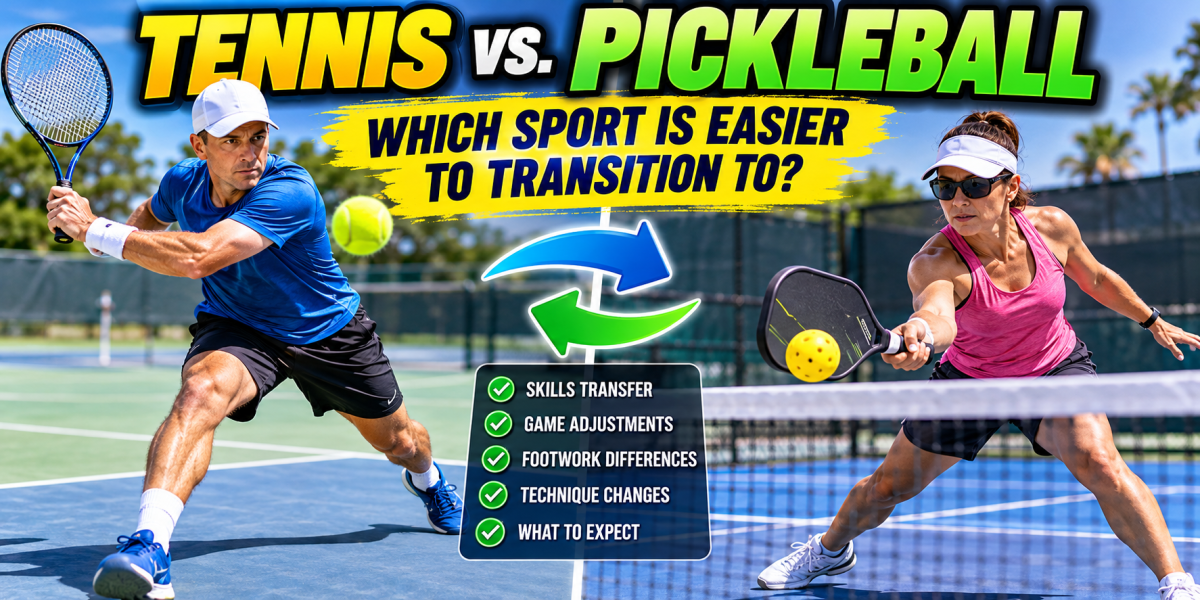
Why can tennis players often adapt quickly to pickleball, while pickleball players may need more time to adjust to tennis?
The answer involves more than racket skills. It includes anticipation, coordination, footwork, timing, spatial awareness, and the ability to make dynamic adjustments during a rally.
However, the transition works in both directions. Pickleball players also possess valuable skills that can help them become better tennis players.
1. Why Tennis Players Can Adapt Quickly to Pickleball
A. Reading the ball and anticipating the opponent
Experienced tennis players spend years learning to recognize ball direction, spin, pace, contact points, and opponent positioning.
These skills can transfer to pickleball.
When the opponent prepares to hit, a tennis player may already be anticipating whether the ball will travel crosscourt, down the line, or toward the body.
Pickleball requires its own learning process, especially for dinks, kitchen-line exchanges, and softer shots. Nevertheless, an experienced tennis player already has a foundation for reading rallies.
B. Dynamic footwork and court positioning
Tennis players regularly adjust their feet before, during, and after a shot.
They learn to recover toward a useful position, maintain balance, and prepare for the next ball rather than simply admiring their previous shot.
In pickleball, the court is smaller, so the adjustments can happen in a more compact space. The player may need to make short lateral movements, small recovery steps, and quick changes in direction.
The tennis player's existing movement experience can make these adjustments feel natural.
C. Changing tactics during the rally
Good tennis players do not rely on one shot for every situation.
They may hit aggressively when a ball sits short, use height and spin when under pressure, or play a safer shot when out of position.
Pickleball also rewards tactical adjustments, but the choices are different. A powerful shot is not always the best option near the kitchen line, where control, patience, and placement often matter more than pace.
The transferable skill is not simply hitting hard. It is recognizing what the situation requires and choosing the right response.
D. Hand-eye coordination and racket control
Years of tennis practice develop coordination between visual information, body movement, and racket contact.
This foundation can help a tennis player control the pickleball paddle and make adjustments to the ball's speed and direction.
However, tennis and pickleball paddles have different characteristics. Tennis players must learn to control their natural tendency to use a full swing when a short, compact movement is more effective.
2. Why Pickleball Can Feel Easy for an Experienced Tennis Player
Pickleball is played on a smaller court than tennis, and the ball and paddle produce a different playing experience.
For a tennis player, this can reduce some of the initial challenges associated with court coverage and long-distance movement.
But the smaller court does not mean that pickleball is automatically easy.
Pickleball introduces several skills that tennis players must learn:
-
The non-volley zone, or kitchen: Players cannot volley while standing in the kitchen or touching its line.
-
The two-bounce rule: After the serve, the receiving team must let the ball bounce, and the serving team must also let the return bounce before volleying becomes legal.
-
The soft game: Dinks and controlled shots are often used to create openings rather than immediately finish the point.
-
Compact paddle technique: Short, controlled movements are essential during fast exchanges at the net.
-
Patience and shot selection: Attacking the wrong ball can give the opponent an easy opportunity to counterattack.
My second experience felt easier because I already had a foundation in racket sports. However, adapting to the sport is different from mastering its specialist techniques.
3. Why Pickleball Players May Struggle When Transitioning to Tennis
A pickleball player who wants to play tennis must learn to manage a different set of physical and technical demands.
A. The tennis court requires greater movement coverage
A standard tennis court is considerably larger than a pickleball court.
Tennis players must cover more ground, recover after wide shots, and maintain positioning while preparing for the next stroke.
A pickleball player who is comfortable with short movements near the kitchen line may initially struggle with the distance and recovery demands of tennis.
The solution is to develop split-step timing, lateral movement, efficient running mechanics, and recovery footwork.
B. Tennis groundstrokes require different swing mechanics
The tennis racket is longer, and the ball generally requires a different combination of swing path, racket-head speed, spin, and contact-point control.
Pickleball players may initially use compact paddle movements that are suitable for the smaller game but insufficient for consistent tennis groundstrokes.
They need to learn how to prepare earlier, rotate their body, space themselves from the ball, and complete an appropriate follow-through.
C. Serving is a major technical adjustment
The tennis serve is an overhead stroke that requires coordinated leg drive, trunk rotation, shoulder movement, racket acceleration, and accurate timing.
Pickleball's underhand serve or other permitted serving techniques do not develop the same complete serving pattern.
A pickleball player moving into tennis should dedicate separate practice time to the toss, service stance, racket preparation, contact point, and controlled serving progression.
D. Tennis demands more sustained movement
Longer rallies and greater court coverage can increase the physical demands of tennis.
Players need sufficient aerobic endurance, repeated acceleration, leg strength, balance, and the ability to recover between points.
A pickleball player can build these qualities progressively rather than trying to cover the entire tennis court at full speed immediately.
4. Which Sport Has the Best Game Transition?
The answer depends on which sport you already play and what you want to learn.
| Skill | Tennis player moving to pickleball | Pickleball player moving to tennis |
|---|---|---|
| Ball tracking | Often a strong starting advantage | Useful foundation |
| Racket or paddle coordination | Requires paddle-specific adaptation | Requires racket-specific adaptation |
| Court coverage | Adjusts to a smaller playing area | Must learn to cover a larger court |
| Power and swing mechanics | Must control full swings | Must develop fuller tennis strokes |
| Net play | Must learn kitchen positioning and dinking | Must learn tennis volley technique and positioning |
| Serve | Must learn pickleball serving rules | Must learn the overhead tennis serve |
| Tactical awareness | Transfers, but tactics change | Transfers, but tactics change |
| Physical conditioning | Must adapt to pickleball's movement patterns | Must build tennis-specific movement and endurance |
My assessment: For an experienced tennis player, the initial transition to recreational pickleball may often feel easier because many racket-sport skills transfer and the court is smaller.
For a pickleball player moving to tennis, the transition can take longer because tennis requires additional technical development in groundstrokes, serving, spin production, and court coverage.
This is a general tendency, not a universal rule. A highly skilled pickleball player may adapt faster than a beginner tennis player, and individual athletic ability, coaching, and practice habits matter considerably.
5. The Secret Is Dynamic Adjustment, Not Just Technique
What separates an adaptable racket-sport player from someone who struggles is the ability to change a movement or decision as the situation changes.
Consider these examples:
Situation 1: The opponent hits the ball wide.
A good player moves efficiently toward the ball, adjusts their balance, chooses a suitable shot, and prepares for recovery.
Situation 2: The opponent approaches the net.
The player recognizes that a powerful groundstroke may not be the best response. Depending on the ball and position, a controlled passing shot, lob, or angled placement may be more effective.
Situation 3: The rally becomes faster.
Instead of using a large swing on every shot, the player shortens the preparation, stays balanced, and prioritizes clean contact.
Situation 4: The ball arrives shorter than expected.
The player adjusts their footwork and contact point rather than reaching awkwardly or hitting from a poor position.
These examples apply to both sports, although the exact movements and shot choices differ.
The most important principle is simple: A good player does not repeat the same movement blindly. A good player reads the situation, adjusts, and prepares for what happens next.
6. Training Drills to Improve Transition Between Tennis and Pickleball
Drill 1: Split-step and directional response
Have a coach or partner feed balls randomly to the left, right, and center.
The player performs a split-step, reacts to the direction, moves into position, and returns to a balanced recovery position.
Start slowly, then gradually increase the speed and unpredictability of the feeds.
Goal: Improve anticipation, reaction, and efficient movement.
Drill 2: Short-ball adjustment
Feed balls at different depths.
The player must recognize whether the ball is short, deep, or wide and adjust their movement and swing accordingly.
For tennis, focus on preparation and spacing. For pickleball, focus on compact strokes and controlling the ball's trajectory.
Goal: Develop better decision-making and contact-point control.
Drill 3: Soft hands and controlled contact
Practice short, controlled exchanges at the net.
Tennis players moving to pickleball should practice dinks and blocks rather than trying to hit every ball aggressively.
Pickleball players moving to tennis should practice controlled volleys with proper racket preparation and stable positioning.
Goal: Improve touch and reduce unnecessary swing movements.
Drill 4: Recover after every shot
Hit a ball, recover to an appropriate position, and prepare for the next feed.
Do not remain still after contact.
The coach should vary the direction and depth to prevent the player from memorizing a fixed movement pattern.
Goal: Make recovery an automatic part of every stroke.
Drill 5: Play points with changing conditions
Begin a rally with a cooperative feed, then allow the point to develop freely.
The player should identify when to attack, defend, change direction, slow the pace, or move forward.
After each point, ask: Was the decision appropriate for the ball and the player's position?
Goal: Connect technical skills with real-game decisions.
7. A Simple Four-Week Transition Plan
Week 1: Learn the differences
Understand the rules, equipment, court dimensions, and basic strokes of the new sport.
Week 2: Build movement and contact control
Practice footwork, split steps, spacing, recovery, and consistent contact at a comfortable pace.
Week 3: Introduce tactical situations
Work on net positioning, shot selection, changing direction, and recognizing opportunities to attack.
Week 4: Apply the skills in match play
Play points, identify recurring mistakes, and focus on one or two improvements at a time.
This plan is a starting framework rather than a guarantee of mastery. Progress will depend on the player's existing experience, fitness, coaching, and practice frequency.
Conclusion: The Best Player Is the One Who Can Adjust
My second pickleball experience reminded me that learning a new racket sport does not always mean starting from zero.
Years of tennis can provide a foundation in coordination, anticipation, movement, and tactical awareness. Those skills can make the early stages of pickleball feel more familiar.
At the same time, pickleball players bring valuable abilities into tennis, including touch, compact reactions, and quick decision-making at the net.
Neither sport automatically makes someone the better athlete. Each sport rewards a different combination of technique, movement, strategy, and discipline.
The best transition happens when players respect the differences instead of assuming that one sport is simply an easier version of the other.
Final lesson: Your previous experience gives you an advantage, but your willingness to adapt determines how far you can go.
Whether you play tennis, pickleball, or both, keep learning to read the ball, adjust your feet, control your racket, and make better decisions under pressure.