
Most players hit balls before they prepare their body. That is exactly why injuries show up and progress stalls. The best players in the world do not skip this step. They build mobility, activate the right muscles, and prime their nervous system before every session. This article explains why preparation is essential, why so many players ignore it, and how ten targeted stretches will protect your body and elevate your game.
Why Preparation Is the Most Overlooked Part of Tennis
Tennis is a sport of explosive starts, sudden stops, rotational torque, and repetitive impact. The body is asked to sprint, lunge, twist, reach, and recover within seconds. Without proper preparation, muscles are cold, joints are stiff, and the nervous system is not ready to coordinate high‑speed movements. The result is not just poor performance but a direct path to injury.
Preparation is not about hitting a few extra balls. It is about:
-
Raising core body temperature
-
Increasing blood flow to muscles
-
Activating stabilizers around the shoulder, hip, and knee
-
Improving range of motion for lunges and serves
-
Priming the brain to react faster
Players who prepare correctly move faster, stay explosive, protect their shoulders and hips, and generate more power, especially on their serve.
Why Most Players Skip Preparation
Despite the clear benefits, the majority of recreational and even competitive players skip a structured warm‑up. The reasons are predictable but dangerous.
1. Lack of Time
Players arrive late to the court or try to maximize hitting time. They believe that hitting balls is the warm‑up. It is not. Hitting cold only increases injury risk.
2. Poor Body Anatomy Education
Most players do not understand how muscles, tendons, and joints work together. They do not know that tight hip flexors lead to lower back pain, or that stiff shoulders reduce serve speed and cause rotator cuff injuries. Without basic anatomy knowledge, they cannot connect preparation to performance.
3. False Confidence from Youth
Younger players often feel invincible. Their bodies recover quickly, so they skip stretches and warm‑ups without immediate consequences. However, micro‑damage accumulates. By their mid‑twenties, chronic issues appear.
4. Imitating Pros Incorrectly
Beginners see professionals walk onto court and hit immediately during practice. They do not see the 30‑45 minutes of off‑court mobility work done before stepping onto the court.
The Consequences: Play and Practice Then Have Injury
When players skip preparation, muscles are dislocated more easily. This does not mean joint dislocation in the medical sense, but rather muscle fibers being pulled out of their ideal alignment. Tight muscles tear. Cold tendons inflame. The most common tennis injuries directly result from poor preparation:
-
Rotator cuff tendinitis from serving with stiff shoulders
-
Tennis elbow from cold forearm muscles and poor technique
-
Lower back strain from tight hamstrings and hip flexors
-
Patellar tendinitis from explosive lunges with cold quads
-
Calf and Achilles tears from sudden sprints without activation
Once injured, progress stalls. Time off the court leads to lost fitness, lost feel, and frustration. Many players never return to their previous level.
The 10 Essential Tennis Stretches
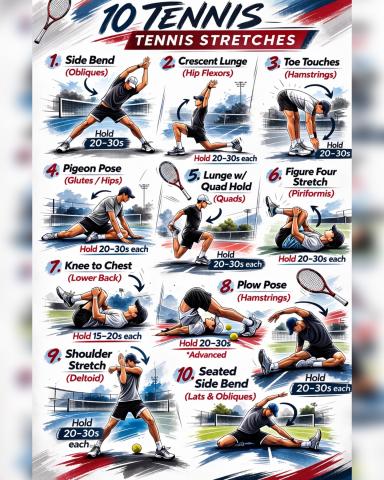
The following ten stretches target the specific muscle groups tennis uses most: obliques, hip flexors, hamstrings, glutes, quads, piriformis, lower back, deltoids, and lats. Hold each stretch as indicated. Perform them after light cardio (five minutes of jogging or jumping jacks) to warm the body first.
Stretch 1: Side Bend (Obliques)
-
How: Stand with feet shoulder‑width apart. Raise one arm overhead and lean to the opposite side. Keep hips stable.
-
Hold: 20‑30 seconds each side.
-
Why: Prepares rotational core muscles for twisting serves and groundstrokes.
Stretch 2: Crescent Lunge (Hip Flexors)
-
How: Step one foot forward into a deep lunge. Keep back leg straight. Drop hips forward.
-
Hold: 20‑30 seconds each side.
-
Why: Opens tight hip flexors that limit split‑step and lateral movement.
Stretch 3: Toe Touches (Hamstrings)
-
How: Stand with feet together. Hinge at hips and reach toward toes. Keep knees slightly soft.
-
Hold: 20‑30 seconds.
-
Why: Loosens hamstrings to reduce lower back strain and improve forward bending for low volleys.
Stretch 4: Pigeon Pose (Glutes / Hips)
-
How: From all fours, bring one knee forward toward same wrist. Extend other leg straight back. Sink hips.
-
Hold: 20‑30 seconds each side.
-
Why: Releases deep gluteal tension that affects hip rotation and serve motion.
Stretch 5: Lunge with Quad Hold (Quads)
-
How: From a standing lunge, reach back with same‑side hand and hold the back foot. Pull heel toward glutes.
-
Hold: 15‑20 seconds each side.
-
Why: Stretches quadriceps to prevent patellar tendinitis and improve knee stability.
Stretch 6: Figure Four Stretch (Piriformis)
-
How: Lie on back. Cross one ankle over opposite knee. Pull the uncrossed leg toward chest.
-
Hold: 20‑30 seconds each side.
-
Why: Relieves sciatic tension and improves hip external rotation for open‑stance shots.
Stretch 7: Knee to Chest (Lower Back)
-
How: Lie on back. Pull one knee toward chest while keeping other leg straight or bent.
-
Hold: 20‑30 seconds each side.
-
Why: Decompresses lumbar spine after repetitive rotational loading.
Stretch 8: Plow Pose (Hamstrings)
-
How: Lie on back. Lift legs overhead toward floor behind head. Support lower back with hands.
-
Hold: 15‑20 seconds.
-
Why: Deep hamstring stretch that also lengthens the spine. Advanced; modify by keeping legs straight up if needed.
Stretch 9: Shoulder Stretch (Deltoid)
-
How: Bring one arm across chest. Use opposite hand to pull gently near the elbow.
-
Hold: 20‑30 seconds each side.
-
Why: Prepares rotator cuff and deltoids for overhead serving motion.
Stretch 10: Seated Side Bend (Lats & Obliques)
-
How: Sit cross‑legged. Reach one arm overhead and lean to the opposite side. Feel stretch from hip to armpit.
-
Hold: 20‑30 seconds each side.
-
Why: Opens latissimus dorsi, which connects shoulder to lower back and is critical for serve power.
The Preparation Process: How to Use These Stretches
Do not stretch cold muscles. Follow this simple process before every practice and match.
Phase 1: Light Cardio (5 minutes)
Jog, jump rope, or cycle lightly. Raise body temperature until you begin to sweat.
Phase 2: Dynamic Activation (5 minutes)
Perform leg swings, arm circles, walking lunges, and torso twists. Do not hold static stretches yet.
Phase 3: Static Stretches (10 minutes)
Perform the ten stretches above in order. Hold each for the recommended time. Breathe deeply. Do not bounce.
Phase 4: Sport‑Specific Warm‑Up (5 minutes)
Hit mini‑tennis, shadow swing, practice serves at 50 percent speed. Gradually increase intensity.
Phase 5: After Match or Practice (Cool Down)
Repeat stretches 1, 4, 6, 7, and 9. Hold each for 30 seconds. This reduces next‑day soreness and improves recovery.
What Happens When You Prepare Correctly
Players who commit to this preparation routine report:
-
Faster first steps to wide balls
-
Less stiffness the morning after matches
-
Fewer muscle pulls and joint pains
-
Higher serve speeds due to full shoulder range
-
Longer playing careers without chronic injuries
The best players in the world do not skip this step. They build mobility, activate the right muscles, and prime their nervous system before every session. If you are serious about improving and performing at a higher level, this is your foundation.
Final Word
Tennis is a game of skill, but skill cannot express itself through a tight, injured body. Most players hit balls before they prepare their body. That is exactly why injuries show up and progress stalls. The ten stretches described here are not optional extras. They are as essential as your racket.
Save this guide. Stay consistent. Perform these stretches before practice to get match‑ready, and after matches to recover smarter. Watch your tennis evolve. Your body will thank you for years to come.
Use them to move faster, stay explosive, protect your shoulders and hips, and generate more power, especially on your serve. If you are serious about improving and performing at a higher level, this is your foundation.