
Kamil Majchrzak Stuns Alejandro Tabilo at Wimbledon 2026: The Alpha Mindset, Tactical Adjustments, and ATP-Level Lessons Behind a Straight-Sets Victory
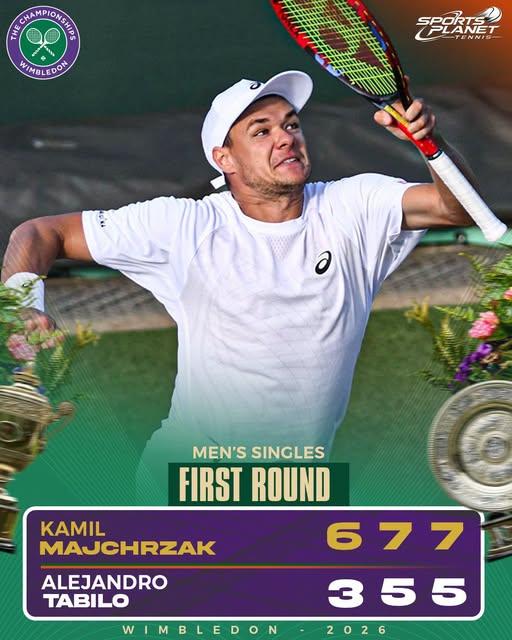
The opening round of Wimbledon 2026 produced several impressive performances, but one of the most tactically disciplined victories belonged to Kamil Majchrzak, who defeated Alejandro Tabilo in straight sets 6-3, 7-5, 7-5. While the scoreline suggests a comfortable win, the match itself was a fascinating battle of adjustments, mental resilience, court positioning, and tactical execution.
Grass courts reward players who make fast decisions, attack intelligently, and maintain emotional control. Majchrzak demonstrated all three. Instead of trying to overpower Tabilo, he systematically dismantled the Chilean's rhythm through intelligent shot selection, disciplined movement, and an unwavering Alpha mindset.
From the perspective of an American ATP coach, this match serves as a textbook example that modern tennis is no longer won by simply hitting harder. It is won by making smarter decisions under pressure.
Final Score
Kamil Majchrzak def. Alejandro Tabilo
6-3, 7-5, 7-5
Straight sets.
Yet every set required different tactical solutions.
That is what separated the winner.
Wimbledon Grass Rewards Precision
Grass is unique.
Players have less time to react.
The ball stays low.
The bounce is unpredictable.
Points become shorter.
Players must transition from defense into offense almost instantly.
Majchrzak embraced these conditions.
Tabilo never fully adapted.
The Alpha Game Begins Before the First Ball
Alpha tennis isn't arrogance.
It is calm confidence.
It means entering every point believing:
"I dictate the rally."
Majchrzzak's body language communicated exactly that.
He walked confidently.
He recovered quickly.
He accepted mistakes.
He never looked rushed.
Meanwhile, Tabilo occasionally allowed frustration to show after missed opportunities.
Elite opponents recognize emotional vulnerability.
Majchrzak sensed it.
He increased pressure immediately afterward.
First Set Analysis (6-3)
The opening set established the tone.
Majchrzak attacked first.
Instead of engaging in long baseline exchanges, he looked to shorten rallies whenever possible.
His priorities included:
- Strong first serves
- Early forehand aggression
- Taking returns early
- Moving forward
- Keeping points under control
Tabilo attempted to establish baseline rhythm.
Unfortunately, grass rarely rewards passive rhythm.
Every slightly shorter ball became an invitation for Majchrzak.
Service Efficiency
Majchrzak served intelligently.
Rather than chasing maximum power, he focused on:
- Placement
- Variety
- Body serves
- Wide serves
- Surprise serves down the T
These combinations prevented Tabilo from reading patterns.
Every service game became mentally exhausting for the returner.
Return Position
One overlooked strength was Majchrzak's return positioning.
He constantly adjusted.
Sometimes standing deep.
Sometimes stepping inside.
Sometimes attacking second serves.
This uncertainty created pressure before Tabilo even struck the serve.
Elite returning is often psychological.
Court Positioning
Majchrzak consistently occupied the center of the court.
That sounds simple.
It is incredibly difficult.
After every shot he recovered efficiently.
His recovery steps were explosive but economical.
No wasted movement.
No panic running.
Every recovery prepared him for the next attack.
Tabilo's First Adjustment
Midway through the first set Tabilo attempted to increase topspin.
Normally this is effective.
On grass, however, excessive topspin often sits up enough for aggressive opponents.
Majchrzak stepped inside the baseline.
He redirected pace.
Instead of defending, he attacked the rising ball.
This neutralized Tabilo's adjustment.
Second Set Analysis (7-5)
The second set became much tighter.
Tabilo improved his first-serve percentage.
His forehand became more aggressive.
His confidence increased.
For several games he controlled rallies.
This was the critical phase.
Champions remain composed when momentum shifts.
Majchrzak never panicked.
Alpha Tennis Means Solving Problems
Many players become emotional when losing momentum.
Alpha competitors become analytical.
Majchrzak appeared to ask himself:
"What adjustment wins the next game?"
Instead of forcing winners, he:
- Added margin
- Chose higher-percentage targets
- Extended rallies selectively
- Waited for shorter balls
This patience shifted pressure back onto Tabilo.
Net Play
Grass rewards players who finish points.
Majchrzak chose excellent moments to approach.
His approaches followed:
Deep forehand.
Strong backhand.
Low slice.
Wide serve.
Only then did he move forward.
Too many club players rush the net without creating an advantage first.
Majchrzak earned every approach.
Passing Shot Defense
When forced to defend against passing shots, Majchrzak displayed excellent volley fundamentals.
His volleys stayed:
Low.
Compact.
Simple.
Controlled.
No unnecessary swing.
Exactly how ATP professionals are taught.
Emotional Stability
One noticeable difference:
Majchrzak's emotional level remained almost unchanged.
Whether winning or losing points:
Same expression.
Same energy.
Same routine.
Grass rewards emotional consistency.
Third Set Analysis (7-5)
The third set often separates mentally strong players from physically talented ones.
Tabilo refused to surrender.
He continued fighting.
Many players relax after winning the first two sets.
Majchrzak did not.
His intensity remained identical.
That is Alpha discipline.
Pressure Tennis
Late in sets, players stop playing freely.
They begin protecting games.
Majchrzak avoided this trap.
He continued attacking opportunities.
He trusted his patterns.
That trust made the difference.
The Serve Plus One Pattern
Modern ATP tennis revolves around the first two shots.
Serve.
First groundstroke.
Majchrzak executed this beautifully.
Examples:
Wide serve.
Open court.
Forehand winner.
Body serve.
Weak return.
Backhand into open space.
Serve down the T.
Attack immediately.
These combinations prevented neutral rallies.
Footwork Excellence
Footwork often decides Wimbledon matches.
Majchrzak's movement featured:
Small adjustment steps.
Excellent balance.
Low center of gravity.
Quick recovery.
Strong split-step timing.
These fundamentals allowed clean ball striking under pressure.
Shot Selection
One of the smartest aspects of his performance was knowing when NOT to attack.
He avoided low-percentage winners.
Instead he:
Moved opponents.
Created angles.
Forced defensive replies.
Finished only when the opportunity appeared.
This is mature ATP tennis.
Tabilo's Missed Opportunities
Alejandro Tabilo possesses tremendous talent.
His left-handed patterns can trouble anyone.
However, several areas limited his effectiveness.
1. Too Predictable Crosscourt
Majchrzak anticipated many crosscourt exchanges.
Occasionally changing direction earlier could have created uncertainty.
2. Limited Net Pressure
Grass rewards aggressive transitions.
Tabilo stayed behind the baseline too frequently.
More forward movement may have shortened points.
3. Second Serve Vulnerability
Majchrzak consistently attacked second serves.
A higher kick or more variation could have reduced return pressure.
4. Emotional Momentum
After losing critical games, Tabilo appeared slightly frustrated.
Against elite professionals, emotional recovery must occur within seconds.
Tactical Adjustments Tabilo Could Have Made
If coaching from the ATP bench, several changes would have been suggested.
More Slice Backhands
Grass keeps slices low.
Majchrzak would have been forced upward repeatedly.
Increase Serve Variety
Mix:
Body.
Wide.
Flat.
Kick.
Constant variation creates hesitation.
Attack the Forehand Earlier
Instead of allowing Majchrzak to dictate with his forehand, earlier aggression could have shifted initiative.
Shorter Points
Long rallies favored Majchrzak's discipline.
More serve-and-volley combinations may have changed rhythm.
Why Majchrzak Won
The victory resulted from several interconnected strengths.
- Better tactical discipline
- More consistent serving
- Superior court positioning
- Excellent footwork
- Calm decision-making
- Effective return strategy
- Strong net execution
- Outstanding emotional control
None alone explains the win.
Together they formed championship-level tennis.
The Alpha Mindset Every Player Can Learn
Alpha tennis is not about intimidation.
It is about personal discipline.
Players can develop it by practicing:
Stay Present
Forget previous points.
Play only the next ball.
Trust Training
Pressure reveals preparation.
Do not invent new shots under stress.
Trust practiced patterns.
Control Body Language
Opponents constantly observe.
Walk confidently.
Recover quickly.
Project calm.
Attack Opportunities
Aggression should be intelligent.
Not reckless.
Choose the correct ball.
Commit fully.
Solve Problems
When losing momentum, ask:
"What adjustment gives me a better percentage?"
Instead of:
"Why am I playing badly?"
This simple shift changes performance.
Lessons for Club Players
Every recreational player can borrow concepts from this match:
- Recover to the center after every shot.
- Prioritize first-serve placement over raw power.
- Attack short balls decisively.
- Keep volleys compact and controlled.
- Vary your return position to create uncertainty.
- Use slices to keep the ball low on faster courts.
- Stay emotionally neutral after errors.
- Focus on one point at a time instead of the scoreboard.
These habits improve consistency at every level of the game.
Conclusion
Kamil Majchrzak's 6-3, 7-5, 7-5 victory over Alejandro Tabilo at Wimbledon 2026 was not simply a showcase of clean ball striking—it was a masterclass in strategic discipline. His success came from making high-percentage decisions, adapting as the match evolved, and maintaining composure during the most important moments. Rather than chasing spectacular winners, he trusted proven patterns, served with purpose, and consistently took away Tabilo's preferred rhythms.
For players, coaches, and tennis enthusiasts, this match reinforces one of the most important truths in modern tennis: the strongest competitor is not always the hardest hitter, but the one who thinks clearly under pressure. The Alpha mindset is built on preparation, resilience, and intelligent adjustments. Majchrzak demonstrated all three, turning a challenging first-round contest into a convincing straight-sets victory and providing an excellent blueprint for anyone seeking to elevate their own game.