Tennis Elbow in Beginner Tennis Players: A USA Tennis Coach and Sports Medicine Guide to Preventing Lateral Epicondylitis Through Better Technique, Proper Racquet Setup, and Smarter Recovery
Tennis is one of America's fastest-growing recreational sports. Thousands of beginners join local clubs, community parks, school programs, and organizations like United States Tennis Association every year. While the game offers tremendous cardiovascular, mental, and social benefits, one injury consistently sidelines new players more than almost any other—tennis elbow.
Known medically as Lateral Epicondylitis, tennis elbow is an overuse injury affecting the tendons that attach to the outside of the elbow. Despite its name, this painful condition doesn't affect only tennis players. However, beginners are particularly vulnerable because they are still developing efficient stroke mechanics, selecting equipment, and conditioning their muscles for repetitive impact.
One of the biggest misconceptions among new players is believing the elbow itself is the problem. In reality, the elbow is usually the victim of poor mechanics happening elsewhere in the body.
Sports medicine specialists across the United States consistently observe that tennis elbow develops from a combination of equipment choices, improper swing mechanics, excessive gripping pressure, and sudden increases in playing volume. Fortunately, almost every contributing factor can be corrected before permanent tendon damage develops.
Understanding Tennis Elbow
Tennis elbow occurs when the wrist extensor tendons become overloaded.
These tendons originate from the lateral epicondyle—the bony prominence on the outside of the elbow—and help stabilize the wrist during every tennis stroke.
Instead of healing normally after repeated microscopic stress, the tendon gradually degenerates.
Modern research shows tennis elbow is less of an inflammatory condition and more of a tendon degeneration disorder caused by repetitive overload.
This explains why anti-inflammatory medications alone rarely solve the underlying problem.
Why Beginners Develop Tennis Elbow More Frequently
Experienced players generate power differently than beginners.
Elite players use:
- Legs
- Hips
- Core muscles
- Shoulder rotation
- Smooth kinetic chain
Beginners often generate power using only:
- Wrist
- Forearm
- Elbow
This overloads the forearm muscles with every swing.
After hundreds of balls, the tendons begin developing microscopic tears.
Weeks later, pain appears.
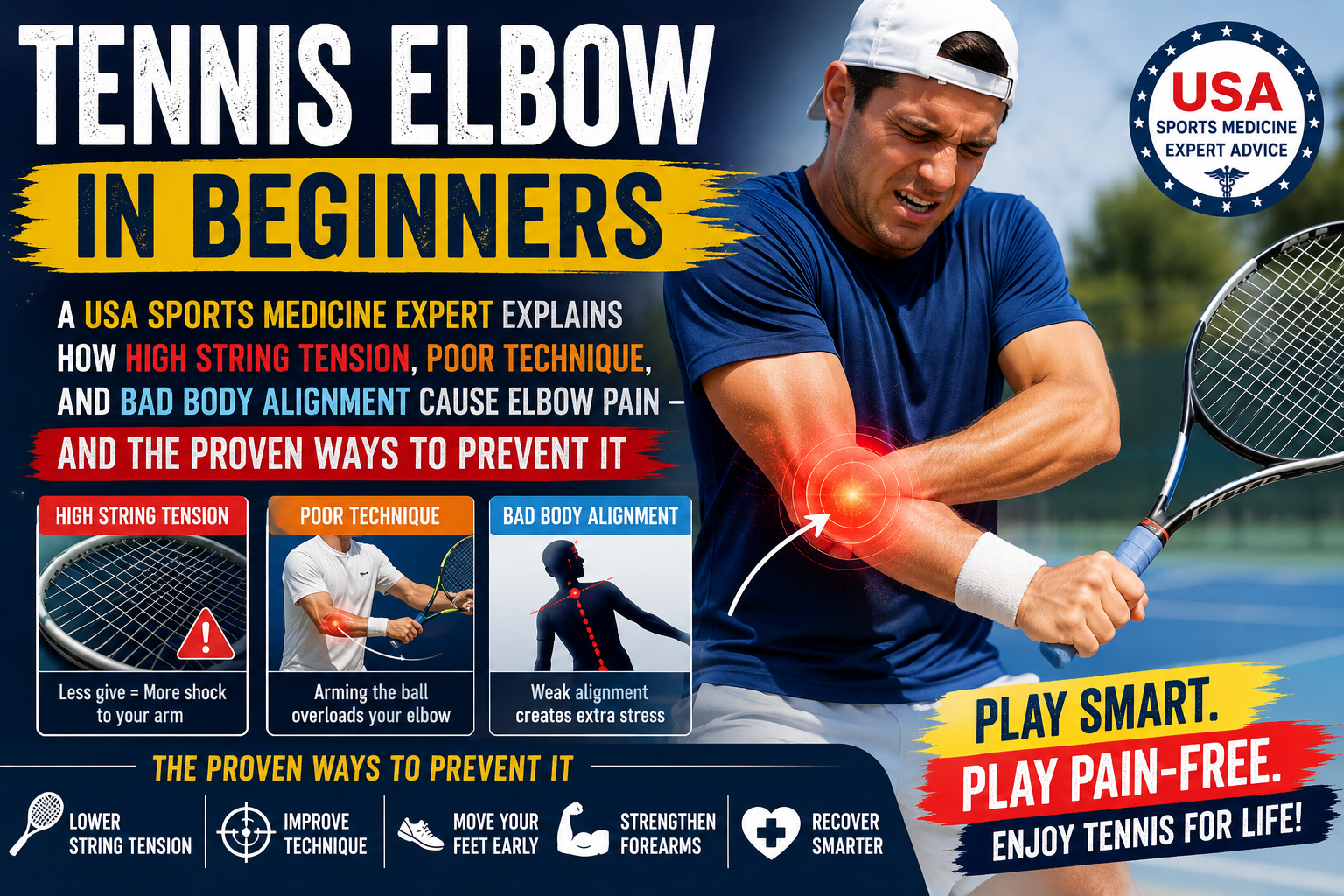
The Biggest Cause: High String Tension
Many beginners believe tighter strings equal better control.
While tighter strings can provide more precision for advanced competitors, they dramatically increase impact shock.
Imagine dropping a ball onto:
- A concrete floor
- A trampoline
The concrete returns nearly all impact.
The trampoline absorbs most of it.
A tightly strung racquet behaves much closer to concrete.
Instead of allowing the strings to stretch and absorb energy, the impact travels directly into:
- Racquet frame
- Handle
- Hand
- Wrist
- Forearm
- Elbow
Every shot sends another vibration into the tendon.
Eventually the tendon begins breaking down.
Polyester Strings Can Make Things Worse
Many recreational players copy professional equipment without understanding why professionals use it.
Professional players often swing over 80 mph with tremendous topspin.
They benefit from polyester strings because:
- Better control
- More spin
- Greater durability
However, polyester strings are significantly stiffer than softer alternatives.
For beginners, stiff polyester combined with high tension creates the perfect recipe for tennis elbow.
Better Beginner String Choices
Sports medicine experts often recommend:
Multifilament
Advantages:
- Softer feel
- Excellent comfort
- Shock absorption
- Easier power
Examples include premium multifilament strings popular among recreational players.
Natural Gut
Still considered the gold standard for comfort.
Advantages include:
- Maximum elasticity
- Outstanding vibration reduction
- Exceptional arm friendliness
Although expensive, it remains one of the safest options for players recovering from elbow injuries.
Lower String Tension
A simple adjustment can dramatically reduce stress.
Example:
Instead of:
55 pounds
Try:
49–51 pounds
A reduction of only four to six pounds often produces a noticeable decrease in arm discomfort while maintaining excellent playability.
Why Poor Technique Creates Tennis Elbow
The arm should never be the engine.
Instead, the body should function as one connected system.
This is known as the kinetic chain.
Proper sequence:
Legs
↓
Hips
↓
Core
↓
Shoulders
↓
Arm
↓
Racquet
If one link fails, the elbow compensates.
Eventually it becomes overloaded.
The Dangerous Habit of "Arming the Ball"
Many beginners swing using only:
- Forearm
- Wrist
- Elbow
Instead of rotating their body.
This causes:
- Late acceleration
- Excessive wrist extension
- Forearm overuse
- Elbow overload
The player feels they are "muscling" every shot.
That effort comes directly from the injured tendons.
The Late Contact Point
Another extremely common beginner mistake involves hitting the ball too late.
Instead of making contact in front of the body, players wait until the ball passes them.
This forces the wrist to compensate.
The elbow suddenly absorbs tremendous force.
Over hundreds of repetitions, the tendon develops microscopic injury.
The Golden Rule
Contact the ball slightly in front of the lead hip.
This allows:
- Stable wrist position
- Better balance
- More efficient energy transfer
- Reduced elbow stress
One-Handed Backhand Challenges
The one-handed backhand is beautiful but demanding.
Without proper preparation, beginners often:
- Bend the elbow excessively
- Pull upward
- Flick the wrist
- Swing only with the arm
This creates enormous stress directly over the lateral epicondyle.
Players learning a one-handed backhand should prioritize:
- Shoulder turn
- Early preparation
- Forward weight transfer
- Full extension through contact
Grip Size Matters More Than People Think
Grip size affects muscle tension.
Too small:
Players squeeze excessively.
Constant squeezing activates the forearm muscles throughout the match.
Those muscles attach directly to the injured tendon.
Too large:
Players struggle changing grips.
Both situations increase unnecessary strain.
A properly fitted grip allows approximately one finger width between the fingertips and palm when holding the racquet comfortably.
Gripping Too Tightly
Another common beginner mistake:
Holding the racquet as tightly as possible.
This creates continuous forearm contraction.
Professional players typically grip the racquet surprisingly lightly during preparation and increase pressure only briefly at impact.
Learning relaxed grip pressure significantly reduces tendon fatigue.
Racquet Selection
Not all racquets are equally arm friendly.
Beginners recovering from elbow pain should generally consider:
- Moderate weight
- Flexible frame
- Larger sweet spot
- Head size around 100 square inches
These characteristics reduce shock while increasing forgiveness on off-center hits.
Off-Center Contact
The sweet spot exists for a reason.
Balls struck near the frame twist the racquet violently.
That twisting force travels directly into the forearm.
Improving footwork to consistently hit the sweet spot dramatically reduces cumulative elbow stress.
Footwork Is Elbow Protection
Many people think tennis elbow starts in the arm.
It often starts in the feet.
Poor movement causes:
- Late positioning
- Reaching
- Off-balance swings
- Emergency wrist adjustments
Better footwork allows cleaner mechanics with much less arm effort.
Playing Too Much Too Soon
New players often become enthusiastic.
They may suddenly play:
- Two hours daily
- Weekend tournaments
- Ball machine sessions
- Lessons
The tendons cannot adapt that quickly.
Increase playing volume gradually.
A good rule is increasing total weekly hitting time by no more than about 10 percent.
Warm-Up Matters
Cold tendons are less resilient.
A proper warm-up should include:
- Light jogging
- Dynamic arm circles
- Shoulder mobility
- Wrist mobility
- Mini tennis
- Progressive rallying
Avoid serving at maximum speed immediately after arriving at the court.
Strength Training for Prevention
Strong forearm muscles absorb more force.
Effective exercises include:
- Wrist extensions
- Reverse wrist curls
- Pronation
- Supination
- Grip endurance
- Shoulder stability
- Rotator cuff strengthening
These exercises help distribute loads more effectively throughout the upper limb.
The Tyler Twist Exercise
Among rehabilitation exercises, one stands out.
The Tyler Twist performed with a flexible resistance bar has strong clinical support.
It emphasizes eccentric strengthening.
Research demonstrates eccentric loading encourages tendon remodeling.
Consistency matters more than intensity.
Perform exercises exactly as instructed by a qualified healthcare professional or physical therapist.
Counterforce Braces
A counterforce elbow strap sits just below the elbow.
Instead of allowing the injured tendon to absorb all force, the brace redistributes tension across the forearm muscles.
Many players experience immediate symptom relief while continuing rehabilitation.
However, braces should supplement—not replace—correct technique and strengthening.
Ice or Heat?
Immediately after playing:
Ice may reduce pain.
Before activity:
Gentle heat may improve tissue flexibility.
Always avoid placing ice directly against the skin.
Recovery Nutrition
Healthy tendons require adequate nutrition.
Athletes should prioritize:
- Lean protein
- Vitamin C-rich fruits
- Hydration
- Omega-3 fats
- Whole grains
- Colorful vegetables
Proper nutrition supports tissue repair after repetitive training.
Sleep Is Part of Recovery
Growth hormone production increases during deep sleep.
Poor sleep slows tendon healing.
Aim for consistent, restorative sleep each night, especially during periods of heavy practice.
Warning Signs You Should Never Ignore
Stop playing and seek medical evaluation if you experience:
- Persistent elbow pain lasting more than one to two weeks
- Pain that interferes with daily activities
- Weak grip strength
- Difficulty lifting light objects
- Numbness or tingling
- Severe swelling
- Sudden loss of motion
Early intervention often prevents chronic tendon degeneration.
Returning to Tennis Safely
Do not return simply because pain decreases.
Instead, ensure:
✓ Full range of motion
✓ Normal grip strength
✓ Pain-free practice swings
✓ Pain-free strengthening exercises
✓ Gradual hitting progression
Many sports medicine professionals recommend beginning with short rally sessions before returning to competitive match play.
Long-Term Prevention Checklist
Before every match:
✓ Warm up properly
✓ Use appropriate string tension
✓ Choose arm-friendly strings
✓ Check grip size
✓ Relax grip pressure
✓ Move your feet early
✓ Rotate hips and shoulders
✓ Contact the ball in front
✓ Stretch after playing
✓ Strengthen forearms weekly
✓ Rest when pain develops
Final Thoughts
Tennis elbow is one of the most preventable injuries in recreational tennis. For beginners across the United States, the condition usually develops not from a single bad swing, but from thousands of small mechanical errors combined with equipment that transmits excessive shock to the arm.
Lowering string tension by four to six pounds, switching from stiff polyester to softer multifilament or natural gut strings, selecting the correct grip size, and learning to generate power through the entire kinetic chain can dramatically reduce stress on the elbow. Equally important are gradual training progression, proper warm-ups, strength training, and allowing adequate recovery between sessions.
Remember that the elbow is rarely the true source of the problem—it is often the final link in a chain that begins with the feet, hips, core, and shoulders. By building efficient technique from the start and listening to early warning signs rather than playing through pain, beginners can enjoy years of tennis while greatly reducing their risk of developing chronic lateral epicondylitis. Prevention is always easier, faster, and less frustrating than rehabilitation, making smart equipment choices and sound fundamentals the best investment any new player can make.