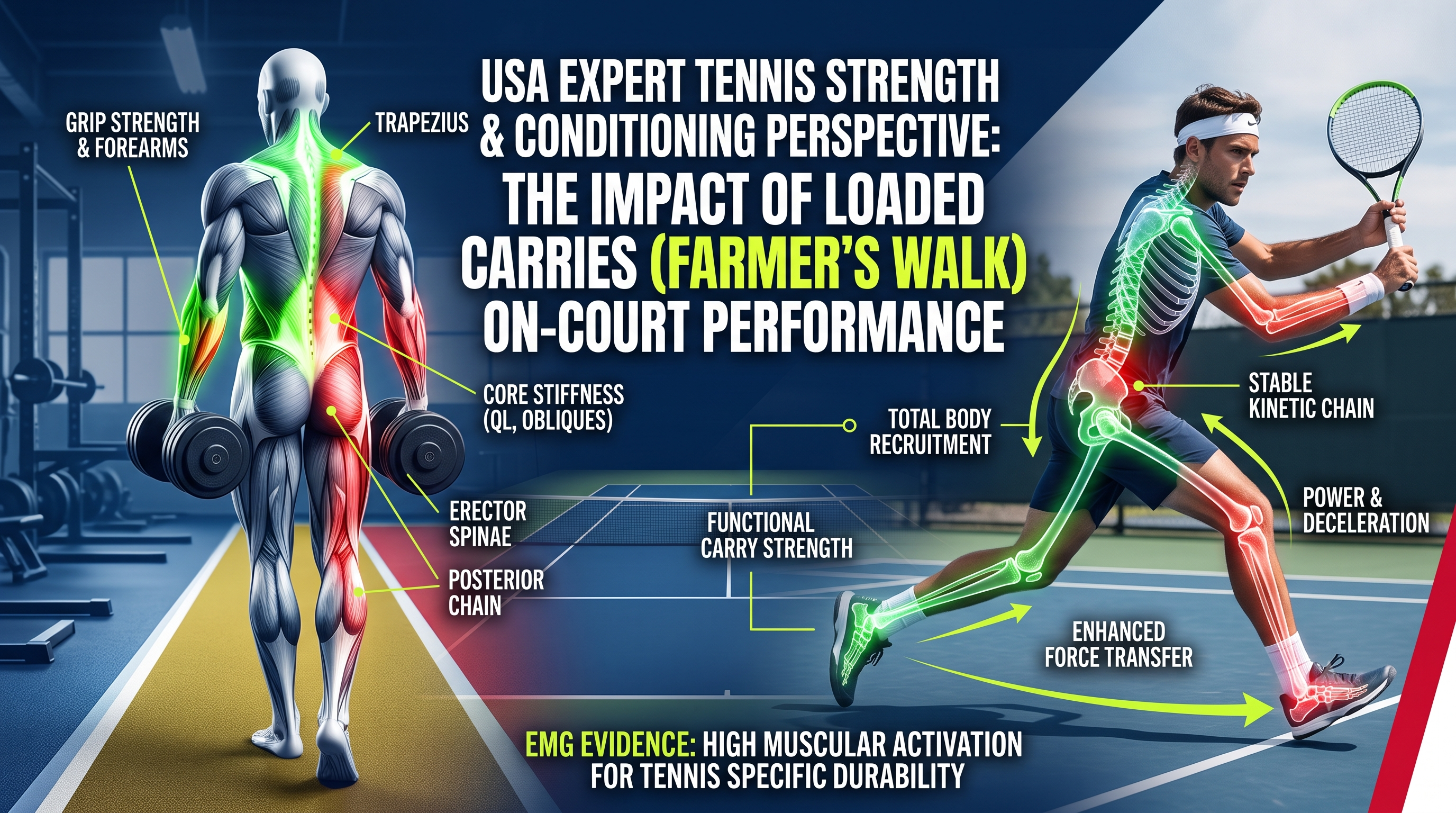
From a U.S. Strength and Conditioning (CSCS) and High-Performance Tennis Coaching standpoint, integrating loaded carries—specifically the Farmer's Walk— into a player's training protocol is one of the most effective, high-yield add-on routines available.
As highlighted by Dr. Stuart McGill’s electromyography (EMG) and biomechanical research, loaded carries create simultaneous high-level activation across the entire kinetic chain while requiring the body to continuously stabilize itself under dynamic movement.
In tennis, where every shot relies on generating ground-force energy and transferring it up through the core to the upper extremity, the Farmer’s Walk translates directly to performance enhancements and injury resilience.
1. Kinetic Chain & On-Court Performance Translation
A. Grip Strength & Forearm Resilience (Racquet Stability & Injury Prevention)
-
The Tennis Mechanism: Off-center ball impacts and high-tension strings generate massive shockwaves that travel up the handle to the forearm muscles. Weak grip and forearm fatigue lead to racquet face twist at contact, reduced shot control, and micro-trauma at the epicondyles.
- Farmer's Walk Solution: Static, heavy isometric loading of the forearm flexors and flexor/extensor groups strengthens the grip without repetitive joint strain. This protects the elbow against lateral epicondylitis (tennis elbow) and medial epicondylitis by fortifying the tendons that absorb ball impact shock.
B. Core Stiffness & Rotational Energy Transfer
-
The Tennis Mechanism: Power on groundstrokes and serves does not originate in the arms; it is generated from the legs and transferred through the core via the kinetic chain. A weak or "leaky" midsection dissipates kinetic energy, forcing the upper body to overcompensate ("arming" the ball).
- Farmer's Walk Solution: By heavily recruiting the quadratus lumborum, obliques, rectus abdominis, and erector spinae, farmer's carries train anti-lateral flexion and rotational core stiffness. A rigid core pillar allows a player to uncoil explosively on forehands and backhands without losing structural integrity or strain on the lower back.
C. Shoulder & Scapular Stability (Serves & Overhead Protection)
-
The Tennis Mechanism: Repetitive high-velocity serves subject the shoulder to intense forces during the late cocking and follow-through phases. Subacromial space narrowing and scapular dyskinesis can lead to shoulder impingement, rotator cuff tendinitis, and SLAP (labral) tears.
- Farmer's Walk Solution: Carrying heavy loads forces the trapezius, rhomboids, serratus anterior, and rotator cuff to contract continuously. This packs the scapula down and back (scapular depression and retraction) and centers the humeral head inside the socket, preventing subacromial impingement and stabilizing the shoulder during aggressive serve motions.
D. Lower-Body Deceleration & Multi-Directional Footwork
- The Tennis Mechanism: Modern tennis demands aggressive deceleration, quick split-stepping, and fast directional changes.
- Farmer's Walk Solution: Loaded walking engages the glutes, quadriceps, hamstrings, and calves under dynamic weight-bearing conditions. This strengthens the lower-body stabilizers needed to brake hard, maintain a low center of gravity, and recover back to the center of the court efficiently.
2. Expert Recommended Add-On Conditioning Protocols
To integrate loaded carries into a tennis player’s weekly routine without causing neural fatigue that interferes with court time, use the following structured progressions:
Routine 1: Bilateral Heavy Farmer's Carry (Post-Practice / Gym Days)
- Goal: Full-body kinetic chain strength, grip endurance, and core stiffness.
- Equipment: Dumbbells, Trap Bar, or Kettlebells (approx. 50–70% of total body weight combined).
-
Execution: 1. Stand tall with chest open, shoulders drawn down and back (retracted and depressed).
2. Take short, quick, controlled heel-to-toe steps. Maintain a neutral spine; avoid letting the weights swing or lean forward.
- Volume: 4 sets $\times$ 30–40 meters. Rest 90 seconds between sets.
Routine 2: Unilateral (Single-Arm) Suitcase Carry (Tennis-Specific Rotational Stability)
- Goal: High oblique and quadratus lumborum activation to resist lateral tipping (mimicking single-leg loading on groundstrokes).
- Equipment: 1 Single Heavy Kettlebell or Dumbbell in one hand.
-
Execution: 1. Walk holding the weight on one side only.
2. Maintain a completely straight, vertical posture—do not tilt toward or away from the weighted side.
- Volume: 3 sets $\times$ 25 meters per side.
Routine 3: Asymmetrical / Mixed Overhead & Low Carry (Serve Shoulder Protocol)
- Goal: Scapular overhead stability combined with core anti-extension.
- Equipment: 1 Light Kettlebell pressed straight overhead (waiter walk) + 1 Heavy Kettlebell held at the side.
- Execution: Walk while keeping the top arm fully extended with active shoulder packing, and the bottom arm steady.
- Volume: 3 sets $\times$ 20 meters per side.
3. Summary Matrix: How Loaded Carries Fix Common Tennis Weaknesses
Tennis Specific Need
Muscle Groups Activated
Performance / Injury Outcome
Grip & Racquet Control
Forearm flexors/extensors, hand intrinsic muscles
Eliminates racquet twisting on heavy balls; mitigates Tennis Elbow.
Serve Power & Protection
Rotator cuff, latissimus dorsi, trapezius, rhomboids
Centers humeral head, prevents shoulder impingement & SLAP tears.
Rotational Shot Force
Obliques, rectus abdominis, quadratus lumborum
Eliminates kinetic chain energy leaks for cleaner power transfer.
Deceleration & Recovery
Glutes, quadriceps, hamstrings, calves
Improves stopping power and dynamic multi-directional footwork agility.
By making loaded carries a staple 15-minute finish to strength and conditioning sessions 2–3 times per week, tennis players build the structural durability, core rigidity, and grip strength required to sustain high-level performance and prevent overuse injuries.