
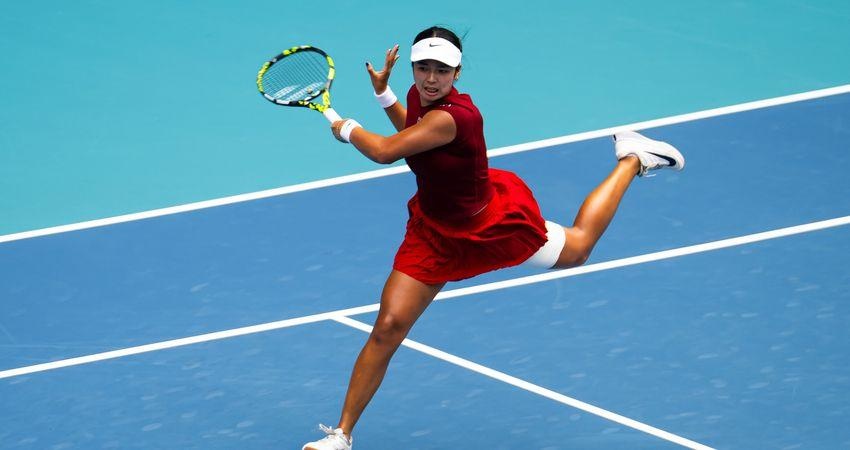
Alex Eala continues to rewrite Philippine tennis history.
In one of the biggest victories of her young career, Alex Eala defeated four-time Grand Slam champion Naomi Osaka 6–4, 6–2 in just 1 hour and 16 minutes to reach her first WTA 500 final at the 2026 Mubadala DC Open in Washington, D.C.
While the scoreline appears comfortable, the match revealed something even more significant: Eala's game has reached another level. Rather than simply waiting for Osaka to make mistakes, Eala dictated the match tactically, mentally, and strategically from the baseline.
Match Overview
Tournament: Mubadala DC Open (WTA 500)
Round: Semifinal
Surface: Hard Court
Date: August 1, 2026
Result:
Alex Eala def. Naomi Osaka (3)
6–4, 6–2
The victory sends Eala into:
- Her first WTA 500 final
- Her first hard-court final on the WTA Tour
- Another career-defining win over a multiple Grand Slam champion
Match Statistics
Category
Alex Eala
Naomi Osaka
First Serve %
59.6%
54.2%
First Serve Points Won
71.4%
59.4%
Second Serve Points Won
78.9%
48.1%
Aces
0
5
Double Faults
1
5
Break Points Converted
4/12
1/4
Total Points Won
62
44
One statistic stands above all others:
Eala won nearly 79% of her second-serve points.
Against one of the best returners and servers in women's tennis, that is an exceptional performance.
Eala Has Expanded Her Winning Territory
Every breakthrough player eventually reaches a point where victories are no longer viewed as surprises.
Alex Eala appears to have reached that stage.
Earlier in the tournament she defeated strong opponents including Elina Svitolina and Leylah Fernandez. Against Osaka, she demonstrated that her success is built on repeatable patterns rather than isolated upsets.
Her confidence has expanded beyond clay courts and lower-tier events.
She is now winning consistently against elite players on hard courts—the surface where many of the world's best thrive.
Her Game Has Reached Another Level
The biggest difference was not power.
It was maturity.
Throughout the match Eala showed:
- Better shot selection
- Excellent anticipation
- Improved point construction
- Calm emotional control
- Smart use of court geometry
Rather than rushing winners, she patiently built rallies until Osaka was forced into uncomfortable positions.
That is the hallmark of an experienced competitor.
Left-Handed Tennis Created Constant Problems
One of Eala's greatest advantages is something statistics cannot fully measure:
She is left-handed.
Left-handed players naturally create different ball trajectories, wider angles, and unusual spins that many right-handed players see far less often.
Against Osaka, those patterns repeatedly disrupted timing.
Wide Forehand Angles
Eala's forehand curved away from Osaka, forcing her outside the doubles alley before opening the opposite side of the court.
Crosscourt Exchanges
Instead of exchanging predictable forehands, Osaka constantly had to adjust to topspin moving in unfamiliar directions.
Early Contact
Eala took many balls on the rise, reducing Osaka's reaction time and preventing her from establishing rhythm.
The result was a match where Osaka often looked uncomfortable trying to judge ball trajectories and adjust her positioning.
Osaka Could Not Find Effective Answers
It would be inaccurate to describe Osaka as simply "choking." She did make several uncharacteristic errors—including five double faults—but much of that pressure was created by Eala's consistent tactical play.
Throughout the match Osaka searched for adjustments:
- hitting bigger serves,
- flattening groundstrokes,
- increasing pace,
yet none consistently disrupted Eala's rhythm.
Instead, Eala absorbed the pace, redirected it with angles, and repeatedly forced Osaka to defend.
When a player is continually made uncomfortable by an opponent's tactics, errors often increase. That appeared to be a significant factor in this semifinal.
The Second Serve Told the Story
Many matches are decided by first serves.
This one was decided by second serves.
Eala:
- Won 78.9% of second-serve points.
- Lost only four second-serve points all match.
Osaka:
- Won just 48.1% of hers.
- Added five double faults.
That difference completely shifted momentum.
Every time Osaka missed a first serve, Eala immediately attacked.
Returning With Purpose
Eala did not simply return the ball safely.
She returned with intent.
She consistently:
- stepped inside the baseline,
- attacked Osaka's second serve,
- forced immediate pressure,
- created twelve break-point opportunities.
Converting four breaks against one of the tour's strongest servers reflects both tactical execution and mental composure.
Emotional Control Was the Hidden Weapon
The opening set included one dangerous moment.
Eala faced three break points early.
She saved them all.
After surviving that game, her confidence visibly grew.
Meanwhile Osaka increasingly appeared to press for bigger shots, and the pressure mounted as Eala continued to hold serve comfortably.
Championship-level tennis is often decided by how players respond to pressure rather than how they perform when ahead.
Eala passed that test impressively.
What This Victory Means
This victory carries significance beyond reaching a final.
It suggests that Eala is developing into a player capable of competing consistently with the WTA's elite.
Her improvements are visible in several areas:
- More efficient serving
- Better movement
- Smarter point construction
- Stronger defensive skills
- Greater tactical flexibility
- Increased confidence under pressure
Perhaps most importantly, she is no longer relying solely on speed or athleticism. She is winning through intelligent decision-making and disciplined execution.
Final Thoughts
Alex Eala's victory over Naomi Osaka was not just another upset.
It showcased a player whose game continues to evolve, combining left-handed variety, tactical intelligence, and mental composure to challenge some of the sport's biggest names.
Reaching a first WTA 500 final is a milestone, but the manner of the victory may be even more encouraging. If Eala continues to build on these strengths, she has the potential to become a regular contender at the highest levels of women's tennis.
For Philippine tennis, this semifinal may be remembered not simply as a historic win, but as another sign that Alex Eala's rise is being built on a foundation capable of sustaining success against the world's best.